
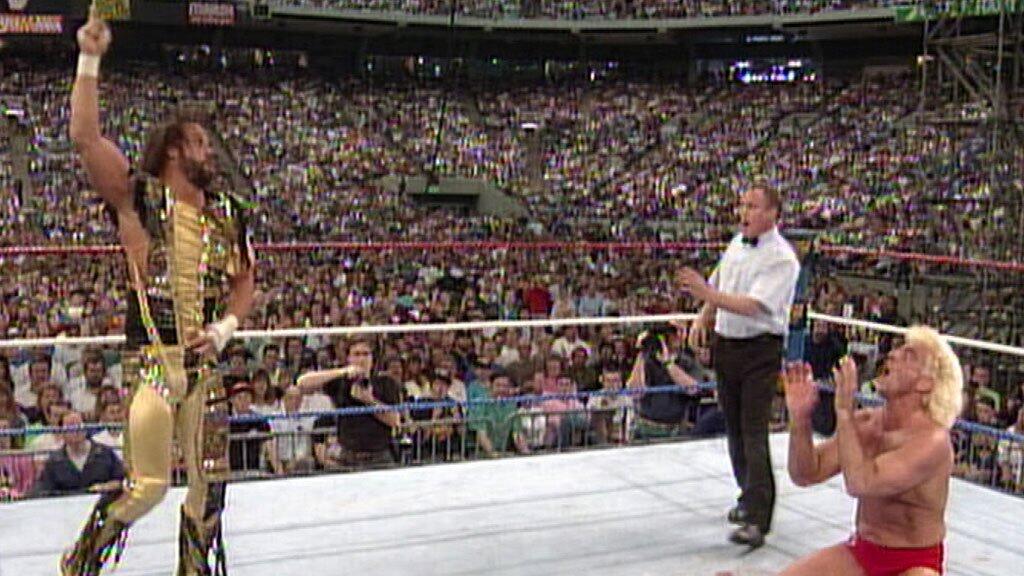
On April 5, 1992, the WWF arrived in Indianapolis for WrestleMania VIII carrying all the pressure that comes with its biggest annual show, and more baggage than usual. The company was fighting through ugly headlines away from the ring, the long-teased Hulk Hogan vs. Ric Flair singles match had been abandoned, and there were real questions about whether the event would feel like a true blockbuster by the time the bell rang.
The Observer coverage from the weeks around the show captured that uncertainty clearly. In the final build, there was concern about the event's momentum and about how heavily the Hoosier Dome would need to be papered to create the kind of visual scale WrestleMania demanded. Yet when the night was over, the lasting image was not about soft buzz or reshuffled plans. It was Randy Savage standing tall again as WWF Champion after beating Ric Flair in the match that voters to the Observer overwhelmingly chose as the best bout on the show.
That is why April 5, 1992 still matters. WrestleMania VIII did not become iconic because everything around it was clean or perfectly organized. It became memorable because, in the middle of the chaos, Savage and Flair gave the show the personal, emotional center it needed.
The match that gave WrestleMania VIII its backbone
Savage vs. Flair was built around one of the most heated personal stories WWF had run to that point. Flair had arrived in the company with the world title, the confidence of an outsider star, and a storyline claim that he had once been involved with Miss Elizabeth before her relationship with Savage. That was lurid television even by early 1990s standards, but it gave the title match a level of emotional bite that went beyond rankings and contendership.
By the time WrestleMania VIII reached April 5, the company had effectively split the event into two headline attractions. Hogan had his advertised farewell-style showdown with Sid Justice, but the title match had the richer wrestling story. Savage was chasing the championship and his own pride at the same time. Flair was trying to prove that the biggest stage in WWF now belonged to him.
The result mattered because the title did not feel like a prop in this feud. Savage winning meant the audience got a payoff that was both athletic and personal. It restored one of the promotion's most established stars to the top spot, but it also gave the show an emotional release that the Hogan-Sid main event, with all of its disqualification chaos and post-match confusion, could not match.
What the Observer saw in real time
The Observer's April 13, 1992 newsletter framed WrestleMania VIII as a mixed show overall, but there was little ambiguity about which match resonated most. In the immediate post-show poll, Flair vs. Savage ran away with best match honors, while Piper vs. Bret Hart finished a distant second. The same issue also described the event as a major live gate, even with heavy papering, and noted the show's importance as one of the biggest North American wrestling events of its era.
That split is part of what makes the night so interesting in hindsight. WrestleMania VIII was not remembered as an all-time great top-to-bottom card. It was remembered as a huge show that contained two performances people could not stop talking about: Savage vs. Flair for the WWF Championship, and Piper vs. Bret Hart for the Intercontinental title.
The Observer's pre-show coverage also helps explain why Savage vs. Flair landed so hard. In the final days before the event, the magazine noted that Flair's interviews had been vintage Flair, and that the company was using every tool it had to sharpen the emotional stakes around the show. That mattered, because this was not just a title defense on paper. Flair felt dangerous, manipulative and smug, and Savage entered with the kind of righteous fury that always made him one of the industry's most compelling babyfaces.
Why Savage's win still stands out
Savage had already been a world champion, of course, and by 1992 he was already secure as a central figure in WWF history. But this title win still feels different from his earlier coronation at WrestleMania IV.
The 1988 tournament win made Savage a made man. The April 5, 1992 victory reminded people how effective he could be when a match had a truly personal hook. He was not climbing the mountain for the first time anymore. He was fighting to reclaim his standing, his championship, and his dignity from a champion whose entire act was built on humiliation.
That gave the match a sharper edge than a standard WrestleMania title contest. Savage's comeback did not play as nostalgia. It played as vindication.
It also mattered that Flair was the man on the other side. His jump from WCW had been one of the most important talent moves of the era. If WWF wanted to present him as a real game-changing acquisition, it needed a feud worthy of the name. Putting him against Savage on WrestleMania, then having them deliver the best-received match on the card, gave the company exactly that.
The rest of the card, and the shadow it cast
One reason April 5, 1992 remains such a rich date in WWF history is that the whole event felt like a crossroads. Bret Hart's Intercontinental title match with Roddy Piper pointed toward the next generation. Hogan's match with Sid was sold with the gravity of an ending, even though the famous non-finish and the Ultimate Warrior's return sent the show into a very different kind of spectacle. Business-wise, WrestleMania was still big enough to post a major gate and look enormous on camera, but the Observer made it clear that the promotion had not hit the dream numbers it had hoped to reach.
That left Savage vs. Flair carrying a lot of the event's historical weight. It is the match that best represents the show at its strongest: major stars, personal stakes, a title that meant something, and a payoff fans accepted.
Why April 5, 1992 changed the feel of the WWF title picture
Savage leaving Indianapolis as champion gave the WWF title scene a different emotional center overnight. Flair's reign had brought swagger, controversy and outsider energy. Savage winning shifted the belt back to a beloved company pillar at a moment when WWF needed stability on screen.
It also helped define WrestleMania VIII in a cleaner way than the Hogan-Sid aftermath ever could. When wrestling fans look back at this event, they usually start with Savage vs. Flair and Piper vs. Bret, not the planned farewell for Hogan. That says everything. On the night itself, the official headline attraction may have been split in two. In memory, the title match won.
That is the real legacy of April 5, 1992. WrestleMania VIII was supposed to be a giant spectacle, and it was, but the part people still talk about most is the old-fashioned heart of pro wrestling: one great villain, one great hero, a championship on the line, and a crowd ready to believe the hero had earned it.