
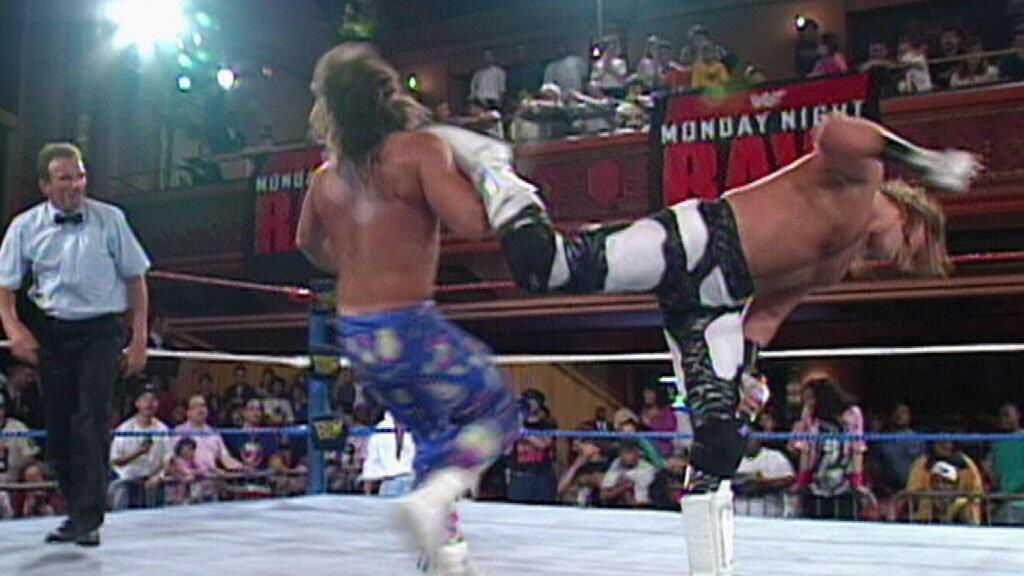
On May 17, 1993, Monday Night Raw still felt new enough that it could surprise people in a way wrestling television rarely does now.
That night at the Manhattan Center, the surprise came walking out of the crowd.
Marty Jannetty had been gone for months. Shawn Michaels had already moved on as the singles star from the Rockers split, carrying the Intercontinental Championship like it belonged on him. Then, in the middle of a Michaels interview, Jannetty suddenly reappeared, accepted an open challenge and by the end of the night had pinned his former partner to win the title.
For Jannetty, it was a comeback that felt overdue. For Michaels, it was one more step in the long story that turned him from tag team breakout to top level heel. For Raw, it was the kind of live-feeling jolt that helped define the show in its earliest years.
The return nobody was expecting
The emotional power of the moment came from everything that had happened before the bell ever rang. When Michaels superkicked Jannetty and sent him through the Barber Shop window in early 1992, WWF had found one of its most enduring betrayal angles. Michaels took the turn and ran with it. Jannetty, meanwhile, never got the clean follow-up push people expected.
Part of that was story. A bigger part was real life.
By the spring of 1993, Jannetty's WWF run had already been full of interruptions, missed chances and firings. The May 17 return landed because it felt like the company was reopening a door that had been slammed shut more than once. He was not presented as a polished conquering hero. He was presented as a ghost from Michaels' past, the one man who could puncture all the swagger for one night.
That framing mattered. Michaels had spent months acting like he had outgrown the old team and outgrown Jannetty with it. So when Jannetty stepped back into the picture without warning, the match instantly had more heat than a standard title defense ever could.
Why the upset worked so well
The week's Wrestling Observer Newsletter described the match as a near 11-minute bout filled with close calls, with Michaels at the height of his powers and Jannetty showing only a little ring rust. That is the key to why the title change still holds up.
This was not a fluke win built around smoke and mirrors from the opening bell. The match gave fans time to believe Jannetty belonged there.
Michaels wrestled it with the confidence of a champion who thought he had the whole situation under control, which made the finish hit harder. Mr. Perfect, stationed at ringside because of his own issues with Michaels, finally tipped the balance by throwing his towel at the champion. Jannetty capitalized with a small package and suddenly the whole room had been turned upside down.
That kind of finish can go wrong when it feels too cute. Here, it worked because it fit every piece of the story. Michaels had made enemies by being arrogant. Perfect had reason to get involved. Jannetty was opportunistic, but he still had to survive a real match first. The result protected Michaels without stealing the catharsis from Jannetty.
And for fans who had waited more than a year to see some payoff from the Rockers breakup, catharsis was the whole point.
The night Raw felt dangerous
It is easy to forget how important unpredictability was to early Raw. Modern wrestling fans are used to swerves, surprise returns and title changes built for social media reaction. In 1993, a live Monday night WWF show still carried a little more uncertainty because the format itself was finding its identity.
May 17 was a great example of that. Jannetty's title win was not the only upset on the card. Sean Waltman, still just "The Kid" at that point, pinned Razor Ramon in one of the earliest true underdog shocks of the Raw era. Put those moments together and the show had an energy that felt less manufactured and more volatile.
That mattered to the larger business. Raw needed reasons for viewers to feel like anything could happen in the Manhattan Center, even if the promotion's bigger money still lived on pay-per-view and house shows. A surprise title switch between former partners, built on an old grudge that fans already understood, was exactly the sort of television hook that made the show feel worth watching live.
Jannetty's championship run was never going to redefine the company. Michaels was clearly the bigger long-term play, and everyone involved understood that. But that does not make the moment smaller. In some ways it makes it more interesting.
For one night, WWF chose emotion over long-range hierarchy. It chose payoff over certainty. It chose to reward fans for remembering the betrayal, the absence and the unfinished business. Wrestling needs nights like that.
What the title win said about Michaels and Jannetty
Jannetty's victory remains compelling because it sits at the intersection of two very different careers.
For Michaels, the loss was not a derailment. If anything, it strengthened the picture of him as a star because the feud suddenly had stakes beyond insults and old footage. A champion who never gets touched is less interesting than a champion whose ego finally gets cracked.
For Jannetty, this was the last real glimpse of the singles run many fans thought he could have. He had the timing, the athleticism and the sympathy of the crowd. On this night, all of it clicked. Even if the bigger arc of his career never fully stabilized, May 17, 1993 stands as proof that the connection was real and that the audience was ready to go with him.
That is why the title change still feels important. It was not just a surprise. It was a reminder of the alternate version of early 1990s WWF that briefly flickered into view, one where Jannetty managed to turn a chaotic career into a sustained run at the top of the card.
Also on this date
May 17 produced other notable moments in the 1992-2020 archive window, including Bret Hart beating The Miz for the United States title in Toronto in 2010 and Shad Gaspard's heroic final act in 2020, when he told rescuers to save his son first.
But for pure early Raw electricity, it is hard to top the night Marty Jannetty came back from nowhere, caught Shawn Michaels looking past him, and walked out of the Manhattan Center with the Intercontinental title.