
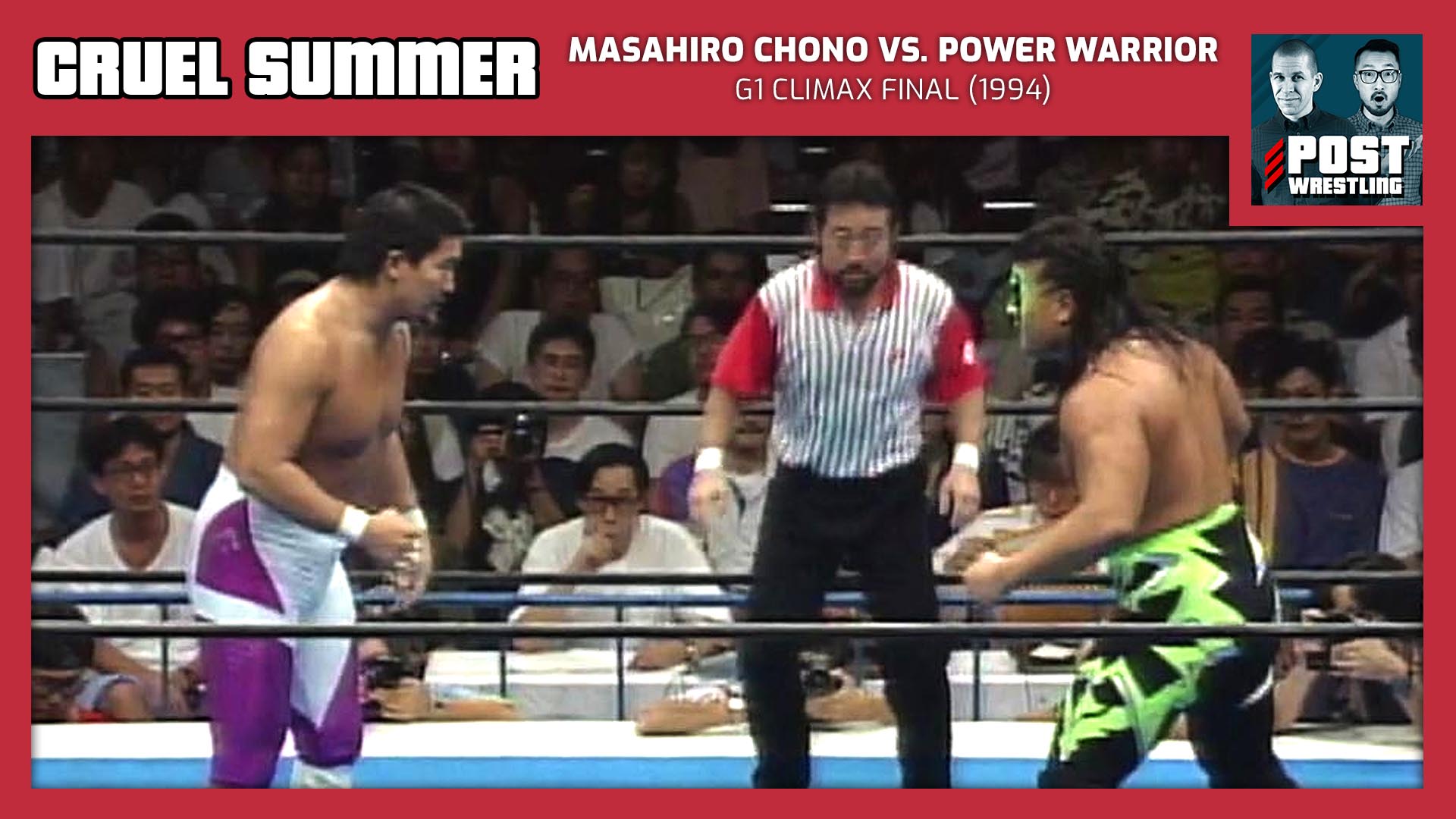
On August 7, 1994, Masahiro Chono beat Power Warrior in the G1 Climax final at Tokyo's Sumo Hall and gave New Japan one of those victories that matters more for what it confirmed than for any single move inside the match. Chono had already won the tournament in 1991 and 1992. By winning it again in 1994, this time with an STF submission over the man beneath the Power Warrior paint, Kensuke Sasaki, he stopped being merely one of the promotion's top stars in August and started to feel like the wrestler who owned the month.
That is the real weight of the date. Plenty of tournament wins look important in the box score and less important in memory. Chono's third G1 triumph in four years did the opposite. It pushed his summer reputation from strong to unmistakable, helped define the early identity of the G1 as a stage where New Japan's biggest names actually had to survive each other, and arrived at a moment when the company was learning how to build around several top stars at once instead of one untouchable ace.
The week New Japan made August its own
The 1994 G1 was not just another tournament dropped onto the calendar. New Japan ran five straight nights at Sumo Hall from August 3 through August 7, and contemporary coverage framed that run as a modern benchmark, 11,500 fans a night, five nights in a row, for a building that size. That kind of stretch tells you something important about where the company stood in the mid 90s. This was a promotion confident enough in its depth to ask fans to keep showing up every night, and fans did.
The tournament structure mattered too. New Japan had returned to a two-block format, with Chono emerging from the A block and Power Warrior taking the B block. Power Warrior was not yet the decorated heavyweight champion Kensuke Sasaki would become later in the decade, but he was already a serious figure, a bruising young star carrying the Road Warriors-inspired look that had helped make the Hell Raisers such a force in New Japan's tag scene. He reached the final by surviving a block that included Shinya Hashimoto, Tatsumi Fujinami and Hiroshi Hase. Chono's road was hardly easier. That is part of why this final mattered before the bell even rang.
What New Japan was selling in that period was parity at the top. Chono, Keiji Muto and Hashimoto, the famous Three Musketeers generation, were not being protected like cartoon superheroes who never had to bend. They were being presented as elite wrestlers who could beat anyone and lose to anyone under the right circumstances. That is a harder thing to sustain in wrestling than it sounds. Promotions often say everyone is dangerous, then book one person as obviously above the rest. New Japan in the G1 years worked harder than most to make the tournament itself feel like the truth serum.
Why Chono's third G1 win mattered so much
The final with Power Warrior is not remembered as the greatest G1 match. Even people who love the era tend to place the symbolism above the bell-to-bell classic level. In wrestling, that symbolism is often how careers harden into legacy.
Chono's August reputation had started with that first G1 in 1991, when New Japan used the tournament to elevate a new generation. His 1992 repeat, which also carried the revived NWA world title stakes, proved the first win was no fluke. The 1993 tournament broke the streak when Tatsumi Fujinami won. That mattered because it kept the event from turning into one man's private property too quickly.
The 1994 victory put the idea back in Chono's hands, and this time with more permanence. Three wins in four years is no accident. It is a pattern. It tells the audience that when New Japan reaches its hardest, hottest stretch of the summer, this wrestler has a different gear for it.
There was also upset value in the result. Chono was not the assumed favorite. Contemporary reporting noted that many of the gambling-minded expectations around the tournament had leaned toward bigger established names such as Riki Choshu or Fujinami. Instead, New Japan doubled back to Chono. That choice says a lot about how the office saw him. He was not simply a talented member of the top mix. He was the man they trusted to give the whole event its recurring shape.
And that shape still echoes through the G1 now. Later tournament legends like Hiroshi Tanahashi, Kazuchika Okada and Tetsuya Naito all benefited from a version of the G1 that had already been taught to feel prestigious, grueling and identity-making. Chono was one of the people who taught the audience to see it that way. His early wins gave the tournament lineage while it was still young enough to need it.
The August 7 win that closed one chapter
The date also matters because of where Chono's career went next. A short time after this win, he reinvented himself. The cleaner-cut Chono of the early 90s gave way to the colder, harder personality that would define much of the rest of his career, from Team Wolf into nWo Japan and beyond. In that sense, August 7, 1994 feels like the last great marker for one version of Chono and the launch point for another.
That makes the result richer in hindsight. When people call him Mr. August, they are not only talking about the trophy count. They are talking about the way he fit New Japan's changing identity. He could be a tournament ace without being a white-meat superhero. He could be technically sharp, mean when he needed to be, and calm enough to make a long match feel like a test instead of a sprint. Even when the 1994 final itself is discussed as something short of a masterpiece, the finish still lands historically because the tournament had become part of Chono's silhouette.
Power Warrior's role in all of this should not get lost either. Sasaki losing here did not diminish him. It underlined how deep New Japan's heavyweight pool was becoming. He would later drop the Power Warrior persona and rise as a major singles star, but on this night he was the dangerous final obstacle in front of Chono's claim on August.
That is why August 7, 1994 still stands up as more than a tournament statistic. It was the night Chono's relationship with the G1 stopped feeling temporary. New Japan had built a summer proving ground, filled Sumo Hall five nights running, and asked which star best embodied that pressure. The answer, once again, was Masahiro Chono.
Also on this date
August 7 has another early G1 landmark attached to it. One year earlier, Tatsumi Fujinami beat Hiroshi Hase to win the 1993 tournament final, a result that briefly interrupted Chono's grip on New Japan's signature month. That mattered, but the broader historical picture still bends back toward 1994, because Chono's third crown is the one that made his August legend feel fixed in place.