
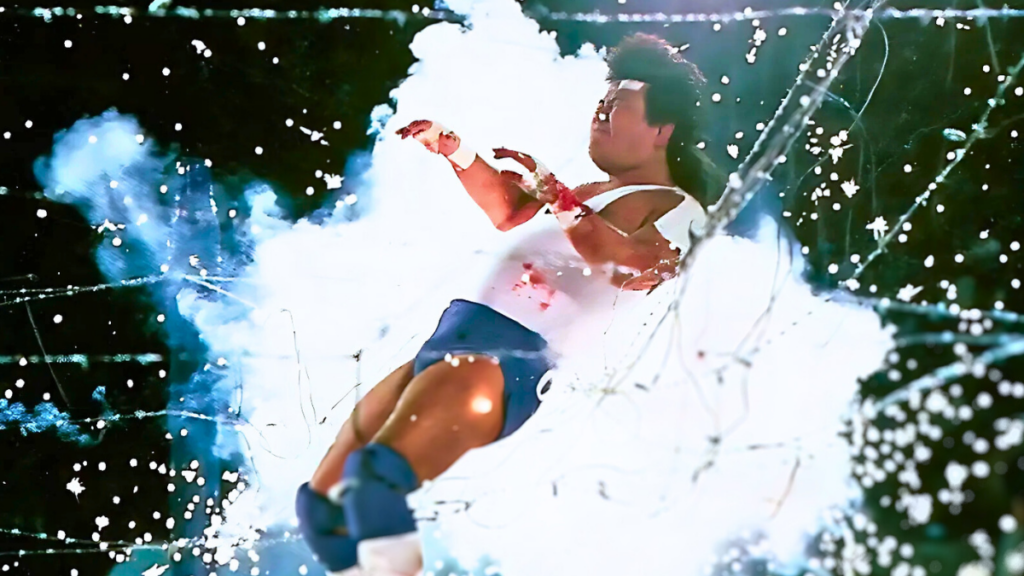
On July 31, 1994, Frontier Martial-Arts Wrestling brought one of its signature summer cards to Yokohama Bunka Gym and packed the building with 5,625 fans. The main event was exactly the kind of spectacle that made FMW feel less like a normal promotion and more like a controlled detonation. In a no rope barbed wire barricade street fight double hell death match, Atsushi Onita and Mitsuhiro Matsunaga defeated Mr. Pogo and Hisakatsu Oya to win the World Brass Knuckles Tag Team Championship.
That sentence alone tells you a lot about what FMW had become by the middle of 1994. The company was violent, theatrical, faction-driven and completely committed to turning chaos into box office. Onita had built the promotion around danger and emotion, but the real trick was that the violence almost never stood alone. The blood and the fire mattered because the grudges did.
By the time FMW reached Yokohama that summer, Onita was already deep into one of the most important stretches of his career. He was the promotion's founder, its biggest star and the figure everything revolved around, but he was no longer carrying the story by himself. Mr. Pogo had become one of the essential villains of the era, a brutal force who fit FMW's appetite for destruction perfectly. Oya, with a rougher, more grounded style, gave Pogo's side a different kind of credibility. Matsunaga, meanwhile, was one of the most fascinating figures in the company: reckless, fearless and increasingly impossible to ignore.
That mattered because Matsunaga was not just another partner for Onita. He represented the next wave of FMW's identity. He had already made his name as someone willing to embrace the ugliest and most punishing corners of deathmatch wrestling, and there was real value in pairing him with the founder at a moment when the company was trying to prove its future could be as compelling as its past. When Onita stood next to Matsunaga in a match like this, it felt like FMW showing its audience that the madness would not end with one generation.
The Observer's report from that week captured the essentials: a sellout crowd, a loaded card and a main event built around the special stipulation language that had become part of FMW's vocabulary. To outsiders, those match names could sound like excess for the sake of excess. To FMW fans, they were a promise. A no rope barbed wire barricade match meant there would be no safe edges. A double hell stipulation meant the match was supposed to feel like a descent, not simply a contest.
What made July 31 stand out was that the title change gave the violence a clear narrative payoff. This was not random mayhem. Onita and Matsunaga beat Pogo and Oya and took something from them. In FMW, championships did not always function the way they did in more conventional promotions. Sometimes the real prize was momentum, revenge or the right to stand at the center of the company's next explosion. But on this night the belts mattered because they showed a power shift in the middle of one of FMW's hottest rivalries.
The wider card made that even clearer. The Gladiator beat Big Titan, continuing another feud FMW had been building through the summer. Masashi Aoyagi was also active in the orbit of the promotion at the time, and his presence mattered because he represented one more old rivalry being pulled back into the fire around Onita. FMW in 1994 was not content with one issue at a time. It stacked grudge on top of grudge until every major show felt unstable.
That was Onita's genius as a promoter and performer. He understood that hardcore wrestling was most effective when it felt personal, and he understood that personal did not always mean subtle. FMW's best cards were emotional in capital letters. Heroes bled. Villains cheated. Partners looked temporary even when they won. The atmosphere was never calm for long. July 31 in Yokohama fit that formula perfectly because the win by Onita and Matsunaga felt less like an ending than a fresh turn of the screw.
In hindsight, that is why the date holds up so well. This was not the single biggest match in FMW history, and it was not the most famous stipulation Onita ever worked. But it was a sharp snapshot of the promotion at full volume. You had Onita at the center, Pogo opposing him, Matsunaga rising, a sellout crowd in a meaningful venue and a championship change delivered through the kind of match only FMW could present with complete conviction.
It also says something important about the company's place in wrestling history. FMW did not become influential just because it was extreme. Plenty of wrestling has been violent. FMW mattered because it married that violence to character, escalation and event-building in a way that forced people to pay attention. It helped create the template that later deathmatch promotions, indie hardcore scenes and even mainstream wrestling borrow from when they want a feud to feel dangerous rather than merely angry.
So when we look back at July 31, 1994, the image is bigger than the title belts themselves. It is Onita and Matsunaga surviving the wreckage, Pogo and Oya being pushed back for one night and FMW reminding its audience that summer in that promotion was never supposed to feel safe. It was supposed to feel like the ring might barely contain what was coming next.