
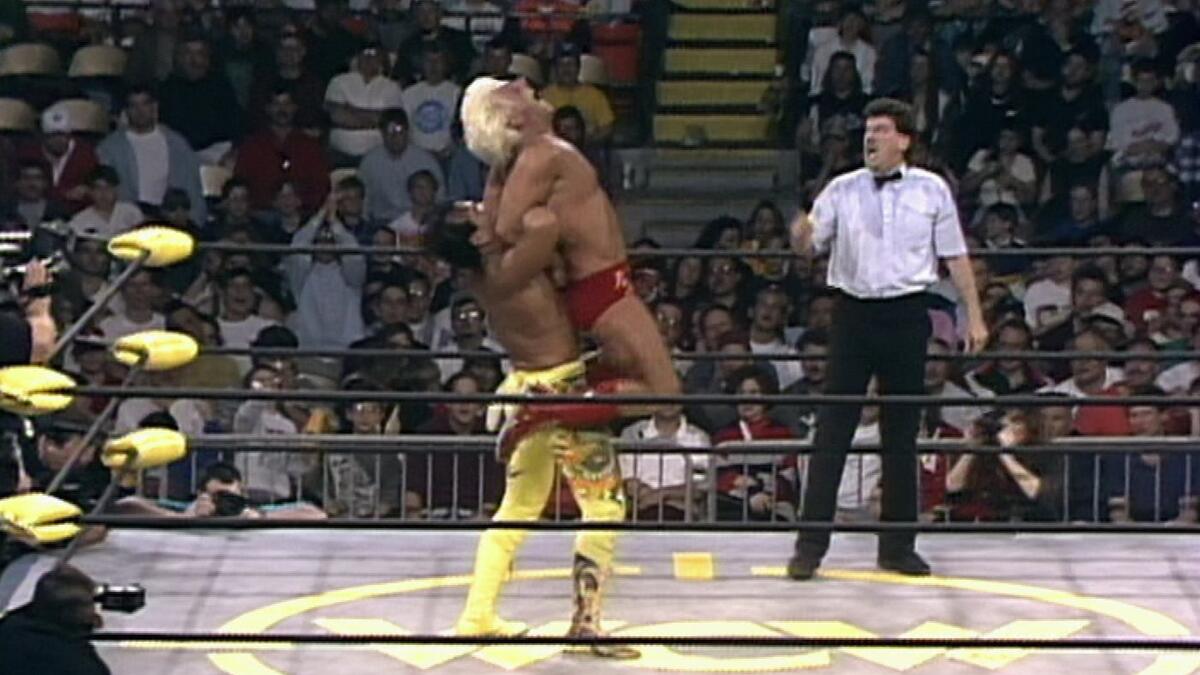
On April 17, 1994, WCW put on the kind of pay-per-view that still makes historians stop and ask what the company might have looked like if it had stayed on this path a little longer.
Spring Stampede 1994 was not the biggest event in company history, and it did not have the cultural weight that later came with Hulk Hogan's arrival or the Nitro boom. What it did have was something that can be just as revealing in hindsight, a loaded card, a hot building, strong wrestling up and down the show and the feeling of a promotion suddenly clicking into place.
That night at the Rosemont Horizon in suburban Chicago, WCW looked deep, confident and unusually complete.
That is why the date still matters.
By the spring of 1994, WCW was still trying to define itself against the World Wrestling Federation while also sorting through its own internal contradictions. It had elite in-ring talent, but not always the focus to present that talent in a way that felt coherent from top to bottom. It had established names, rising names and a fanbase that would respond when given a reason. What it lacked was consistency.
Spring Stampede gave the company one of its clearest answers.
The main event brought Ric Flair and Ricky Steamboat back to center stage in another chapter of one of wrestling's greatest rivalries, this time for the WCW world heavyweight title. Their match ended in a double pin, a messy finish on paper, but the bout itself still carried the old Flair-Steamboat magic. It felt serious. It felt athletic. It felt like a championship fight between two men whose history already meant something before the bell rang.
That alone would have made the show memorable. But the card around it gave the event its real identity.
Sting beat Rick Rude to win the WCW International World Heavyweight Championship in a match built around star power, tension and Harley Race's interference backfiring at the worst possible moment. Vader flattened The Boss in another violent showcase of just how terrifying he still looked in that era. Steve Austin, still years away from becoming the industry's defining star, defended the United States title against The Great Muta. Brian Pillman and Lord Steven Regal went to a time-limit draw for the television title. The Nasty Boys, Cactus Jack and Maxx Payne turned a non-title street fight into the kind of wild brawl that gave the show a harder edge.
It was a card with range, but not in a scattered way. Everything felt like it belonged on the same night.
That was a big part of what made Spring Stampede stand out in real time. Observer coverage after the event praised the overall workrate and match quality while noting that even the flaws, especially the clumsy explanation of the double-pin finish and the misleading hype around a Hogan appearance that never happened, did not overwhelm what people had just watched. The sense coming out of the show was that WCW had delivered one of its best pay-per-views in years.
The crowd told the same story.
WCW drew 12,200 fans to the Rosemont Horizon, with roughly 9,000 paid according to coverage at the time, a strong North American gate for the company and its biggest paid crowd in the region since the Flair-Sting title switch at the 1990 Great American Bash. That mattered. WCW had often been able to produce good wrestling, but good wrestling and major-event momentum were not always happening at the same time. In Chicago, they were.
You can feel the importance of that when looking back now. Spring Stampede was not just a good show. It was proof that WCW could fill a major building and satisfy an audience with a card built primarily around wrestling quality, established feuds and a roster that had depth beyond the very top names.
That is also what gives the show its bittersweet place in history.
Within months, WCW would become a different company. Hogan's signing changed the scale of its ambition and eventually helped reshape the entire business. That broader story matters more in the long run, of course. But Spring Stampede remains valuable because it preserved a snapshot of the version of WCW that existed just before that transformation, a promotion driven less by celebrity shock and more by the idea that a stacked wrestling card could still be the whole selling point.
And it was some card.
Flair and Steamboat represented the classic world title tradition. Sting and Rude felt like major stars operating just beneath or alongside that level. Vader was still the monster around whom any promotion could build danger. Austin, Pillman and Regal hinted at just how much talent WCW had in reserve, even if the company would not fully capitalize on all of it. Cactus Jack was bringing a kind of chaos that made the promotion feel less polished and more alive.
That mix is why the show ages so well. It catches several generations of wrestling thought colliding in one place. There is old NWA-style title-match gravity. There is early 1990s WCW athleticism. There is emerging brawling violence. There are future industry-shaping names scattered up and down the lineup. It feels like a crossroads card, and those are often the ones that become more interesting with time.
The finish of Flair vs. Steamboat is still debated because it was more awkward than elegant, and that criticism is fair. A great show did not end with a perfect exclamation point. But sometimes history remembers the larger feeling more than the cleanest final chapter. Spring Stampede 1994 is remembered less for technical booking neatness than for the sense that WCW, for one night, looked like a promotion firing on every level that actually mattered to fans in the building.
That matters because 1994 was a transitional year. WCW was not yet the juggernaut it would become during the Monday Night War, but it was no longer just a company coasting on inherited identity either. On its best nights, it could feel hungry, modern and full of possibilities. Spring Stampede was one of those nights.
On this day, WCW did more than put on an excellent pay-per-view. It showed the version of itself that many longtime fans still wonder about, the one that might have thrived simply by leaning harder into the depth already on the roster.
Before the big reinvention arrived, WCW had already found one night that proved it could be great.