
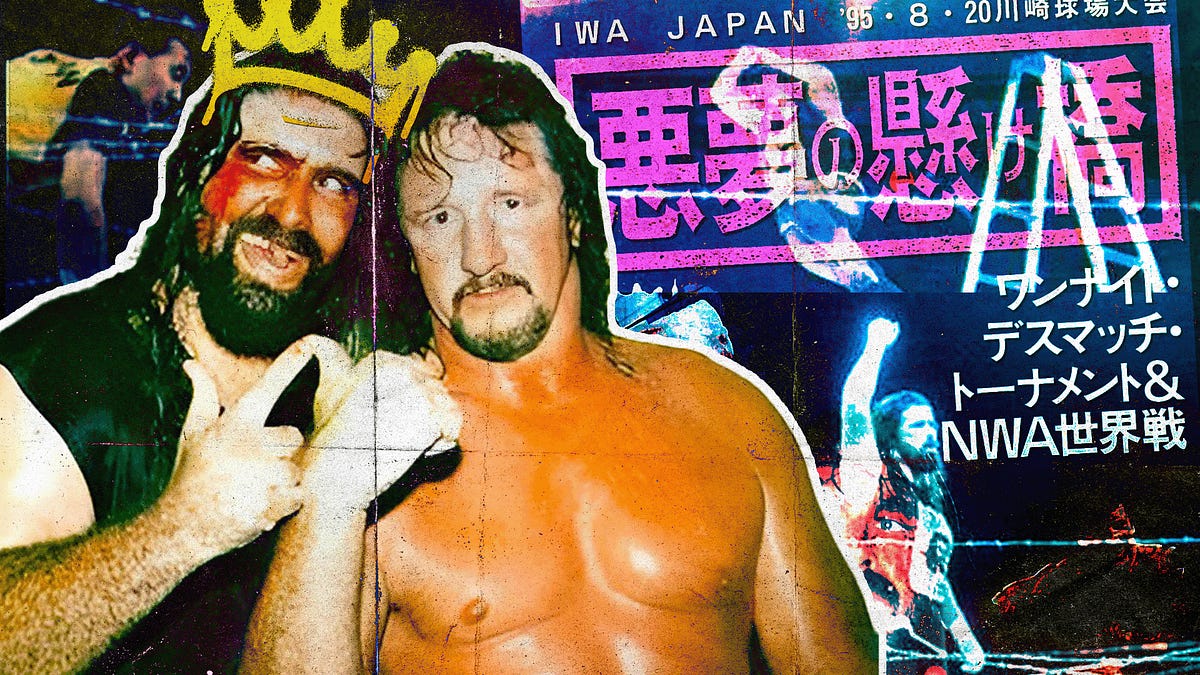
On August 20, 1995, Mick Foley did the kind of thing that only made sense in the wrestling world of that era. Working as Cactus Jack, he went into Kawasaki Stadium in Japan, survived a one-night deathmatch tournament, and then beat Terry Funk in a final that looked less like a wrestling match than a dare that kept getting worse.
The result mattered far beyond one blood-soaked night. Cactus Jack had already built a reputation as a fearless brawler, but Kawasaki Dream gave that reputation a different kind of permanence. He was no longer just a gifted lunatic who could thrive in violent matches. After this show, he felt like the central figure in deathmatch wrestling's most unhinged mythology.
The following week's Observer coverage captured the scale of it. IWA Japan drew 28,757 fans to Kawasaki Stadium, the biggest gate the promotion had ever seen, and built the whole spectacle around an eight-man King of the Deathmatch tournament. By the end of the night, Cactus Jack had gone through Terry Gordy and Shoji Nakamaki before meeting Funk in a barbed wire rope, exploding board, exploding ring time bomb final that lasted 13:21.
IWA Japan bet everything on one outlaw spectacle
That show was about more than violence for the sake of violence. IWA Japan was not one of the era's giant national powers, so it needed an event big enough to cut through on ambition alone. Kawasaki Dream did that by treating deathmatch wrestling as a stadium attraction.
The card was loaded with chaos. Dan Severn defended the NWA World Heavyweight Championship against Tarzan Goto. The Headhunters won the IWA world tag titles. The deathmatch tournament itself had Terry Funk, Tiger Jeet Singh, Terry Gordy, Leatherface and other names who all felt dangerous in different ways. Nothing about the presentation was small-time. The whole event was built to feel excessive, reckless and impossible to ignore.
That mattered because deathmatch wrestling was still fighting for its place in the broader hierarchy of the business. It was popular, but it was also treated by a lot of people as a sideshow, something too wild to be taken seriously as a headline style. Kawasaki Dream argued the opposite. It put this form of wrestling in a stadium, gave it scale, and trusted that fans would follow if the personalities were vivid enough.
Few personalities were more vivid than Funk and Foley. Funk was the aging madman whose willingness to suffer had made him a legend in every corner of wrestling. Foley, under the Cactus Jack name, had the same appetite for punishment but carried it with a younger man's desperation. Put them in the same tournament, in the same building where Funk had already created famous carnage with Atsushi Onita two years earlier, and the story almost wrote itself.
Cactus Jack and Terry Funk turned a disaster into a legend
The final is remembered because it was brutal, but also because it was messy in a way that revealed exactly why fans stayed invested in both men.
By the time they reached the last match, both had already survived one round after another of barbed wire and gimmick chaos. The final was designed to top all of it. The ropes were barbed wire. The boards exploded. A bigger ring explosion was supposed to deliver the grand climax. On paper, it sounded like the purest version of 1990s deathmatch escalation.
In practice, it nearly fell apart.
Foley took a ladder bump into barbed wire that reportedly came close to tearing his other ear apart. Funk suffered burns when one of the explosions caught his arm. The giant ring blast that was supposed to be the unforgettable exclamation point did not land the way it was intended, and the crowd turned on it immediately. In a lesser match, that would have been fatal. The whole illusion would have died right there.
Instead, Funk and Foley did what the best wrestlers always do when the plan fails. They kept going until emotion replaced the malfunction. They threw themselves into even nastier bumps, found the crowd again and dragged the match back to life. The finish came with Cactus Jack crawling over to pin Funk after both men had crashed into the barbed wire. It was not elegant. It was not clean. It was better than either of those things. It felt like survival.
That is a huge part of why the match still lives on. Plenty of deathmatches offered violence. This one offered violence, scale, disaster and recovery all in the same performance. Fans were not just watching two men endure punishment. They were watching two masters rescue the very idea of the match in real time.
Why Kawasaki changed Mick Foley's place in wrestling history
Foley's career did not begin that night, and it certainly did not end there. He would go on to bigger mainstream fame in the United States, especially once the Mankind character took him to the top of WWF. But Kawasaki gave him something different from a title belt or a television push. It gave him legend status.
There is a reason so much of Foley's long-term aura comes back to moments like this. He was never the sleek superhero champion of a corporate wrestling poster. He became important because fans believed he would go places other wrestlers would not go, and then somehow bring meaning back from the edge with him. August 20, 1995 may be the purest version of that belief.
It mattered for Funk as well. By 1995, Funk was already one of wrestling's most respected wild men, but this match reinforced his value to an entire new generation of hardcore fans. He was not there as a nostalgia act. He was still the standard against which this kind of madness was judged, and losing to Cactus Jack did not diminish him. If anything, it helped pass the torch without making the torch feel lighter.
The larger consequence is easy to see in hindsight. Deathmatch wrestling kept evolving, but so much of its modern identity still traces back to nights like Kawasaki Dream, where violence alone was not enough. The violence had to be attached to personalities who made people care. Funk and Foley did that better than almost anyone.
Also on this date, Shinsuke Nakamura beat Samoa Joe for the NXT Championship at TakeOver: Brooklyn II in 2016, and WWE's announcement that NXT would move live to USA Network in 2019 helped kick off the Wednesday Night War. Those were major August 20 moments. But for raw myth, few wrestling nights can touch the one where Cactus Jack and Terry Funk turned Kawasaki Stadium into deathmatch folklore.