
On May 14, 1995, the World Wrestling Federation tried something that looked modest on paper and ended up mattering for years.
The company brought its first In Your House pay-per-view to Syracuse, New York, pricing it at $14.95 instead of the usual premium rate and positioning it as a smaller, more frequent show between the established tentpoles. WrestleMania, SummerSlam, Survivor Series, Royal Rumble and King of the Ring were still the major landmarks, but this was the night WWF began filling the gaps.
That might sound normal now, in an era when wrestling calendars are packed and monthly specials feel routine. In 1995, it was a meaningful shift in strategy. WWF was looking for a way to create more revenue, cut back on house show dependence and give fans a lower-cost reason to stay engaged between its biggest events. The first In Your House was the start of that experiment.
It was not a perfect show. In some ways, that is part of why it still stands out. The card was uneven, the main event underdelivered, and the crowd did not leave with a universally beloved classic. But the show's historical weight never depended on being an all-time great pay-per-view. It mattered because it marked the beginning of a new WWF business model.
A new kind of WWF pay-per-view
The week's Wrestling Observer Newsletter framed the event as the start of a new era in American wrestling. That was not hyperbole. By the spring of 1995, both WWF and WCW were moving toward a more crowded pay-per-view marketplace, and WWF's answer was to create a cheaper series that could sit between the larger events on the calendar.
The first show took place at the Onondaga County War Memorial in Syracuse before a reported crowd of 7,000. The concept even came wrapped in a very 1995 promotional hook: the company gave away a house in Orlando during the broadcast. It was a gimmick, yes, but it also told you exactly how WWF wanted this series to feel. In Your House was supposed to be more casual, more accessible and more saleable to the fan who might think twice before buying every big show at full price.
That pricing strategy was the real story. WWF was betting that a less expensive pay-per-view could attract lapsed buyers and maybe even create a habit. Instead of asking fans to save their money only for the largest events, the company wanted them to view wrestling pay-per-view as a more regular purchase.
That change helped set the direction for the rest of the decade. In Your House would go on to become more than a budget concept. It turned into the branding shell for some of the most important WWF shows of the late 1990s, from Badd Blood to Canadian Stampede to D-Generation X. But on May 14, 1995, it was still just a new idea trying to prove it could work.
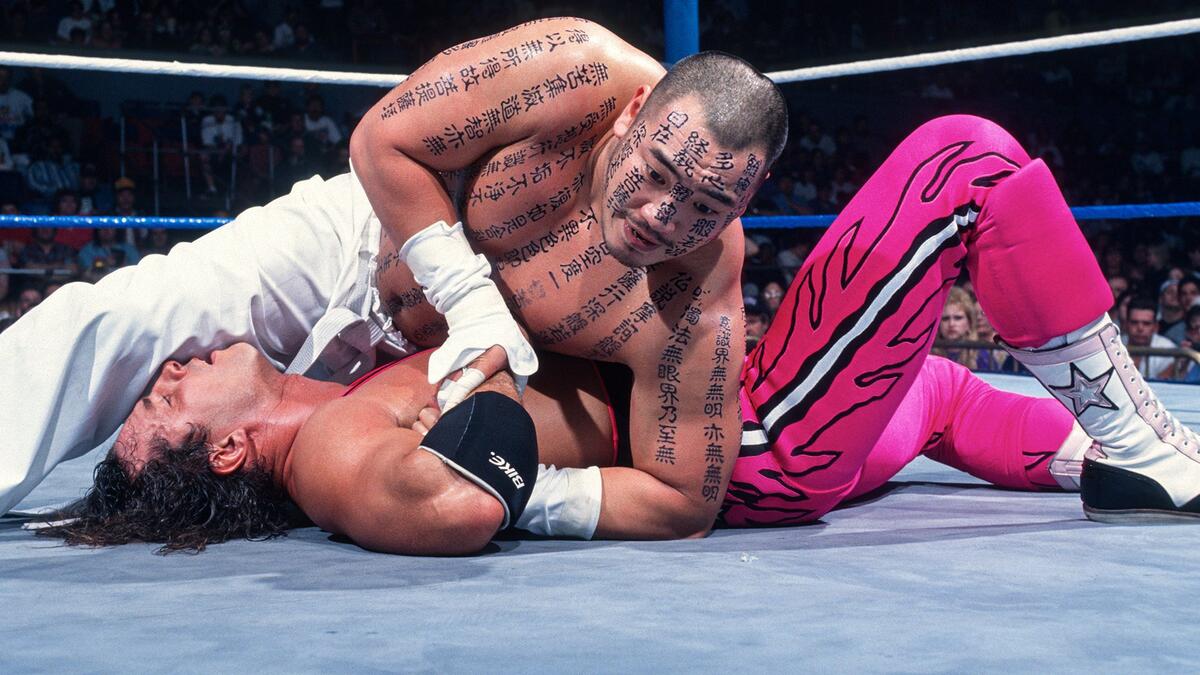
Bret Hart and Hakushi gave the night its best wrestling
If the business concept was the headline, Bret Hart and Hakushi supplied the artistic proof that the first In Your House was not just a branding exercise.
Their opener was the match people remembered. The Observer's post-show poll had it as the runaway best match of the night, and that tracks with the reputation it still carries. Hart's timing, balance and control made him the ideal opponent for Hakushi's flashier offense, and Hakushi brought a different rhythm than most WWF audiences were used to seeing on that stage in 1995.
The match mixed Hart's clean structure with Hakushi's speed, aerial attacks and sudden bursts of risk. Hart eventually won with a cradle after surviving outside interference from Shinja, but the finish was not the point. What mattered was that the match felt alive in a way much of mid-1995 WWF often did not.
It also gave the first In Your House an identity beyond the pricing gimmick. If fans were going to be asked to buy a secondary pay-per-view line on a regular basis, WWF still needed to give them wrestling worth talking about. Hart and Hakushi did that immediately.
There was a knock-on effect elsewhere on the card, too. A cracked cervical vertebra suffered by 1-2-3 Kid before the event forced a change, turning what had been planned as a tag match into Razor Ramon against Jeff Jarrett and The Roadie in a handicap bout. Ramon won, and the match held up well enough, but it was another reminder that this first In Your House was a live test case more than a polished finished product.
The show itself was mixed, but the idea survived
The rest of the event reflected the contradictions of WWF in 1995.
Diesel retained the WWF Championship against Sid by disqualification in the main event, a finish that protected the feud without giving the audience much payoff. The match had the strongest television build on the card, but it was also widely seen as the low point of the show. Bret Hart later returned to face Jerry Lawler, and even that angle-heavy follow-up felt more like connective tissue than a destination.
In other words, the first In Your House was not historically important because it was an overwhelming creative success. It was important because WWF learned it could build a new lane for its content even while the on-screen product was uneven.
That distinction matters. Wrestling history is full of great matches and hot angles that burned bright and disappeared. In Your House stuck because it answered a business question. Could WWF persuade fans to buy more often if the price was lower and the events were framed as something between a supercard and a routine stop on the schedule?
The answer was yes, or at least yes enough to keep going. The line continued, the brand deepened, and over time the name stopped meaning bargain experiment and started meaning an entire era of WWF pay-per-view.
Why May 14, 1995 still matters
What happened in Syracuse did not instantly transform the company. The New Generation problems did not vanish overnight, and one mixed pay-per-view was never going to solve them. But this show did open the door to a faster, denser WWF calendar, and that became one of the central rhythms of the promotion before the Attitude Era took hold.
That is the real reason the first In Your House matters. It was not just another 1995 pay-per-view. It was the moment WWF started redefining how often it could ask fans to buy in.
By the end of the decade, that idea would feel completely normal. In May 1995, it was still a gamble.
And like a lot of important wrestling gambles, its first night was messy, fascinating and more influential than it looked in the moment.
Also on this date
May 14 in the 1992-2020 archive window also includes other notable moments, including Super Delfin winning the vacant UWF Super Welterweight title in Michinoku Pro in 1995 and Miyu Iwatani beating Kairi Hojo for the Wonder of Stardom title in 2017.
Both mattered in their own corners of wrestling history. But for broad industry impact, the launch of In Your House is the May 14 story that cast the longest shadow.