
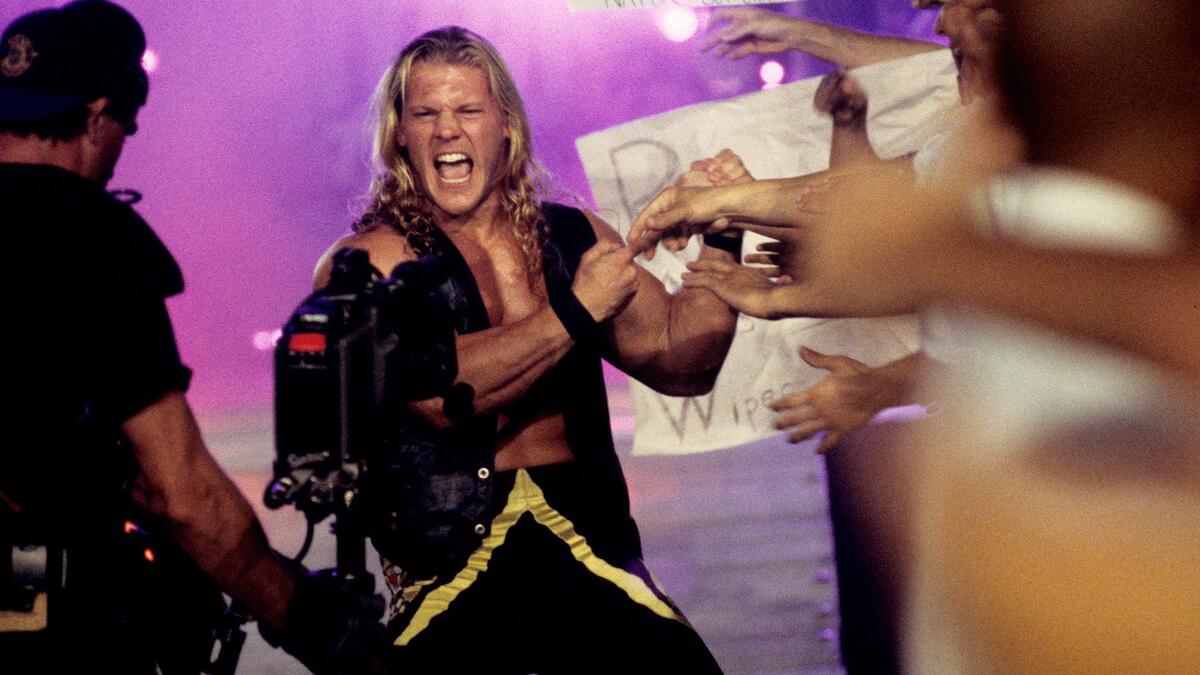
On August 26, 1996, Chris Jericho walked onto WCW Monday Nitro for the first time and did not get the kind of debut that usually ends up in highlight packages.
He did not win. He did not cut a defining promo. He did not arrive with fireworks or some giant angle built around him. He wrestled Alex Wright in Palmetto, Florida, the match ended without a winner after Wright crashed to the floor, and Jericho refused to take a cheap victory by countout.
In the moment, it felt modest. In hindsight, it looks like the first national television glimpse of a wrestler who would spend the next three decades proving he could survive almost any system, any style and any reinvention.
The debut that nearly did not happen
Part of what makes the date interesting is how close Jericho came to starting even more awkwardly.
The Wrestling Observer Newsletter noted the following week that WCW had originally scheduled him to debut at Hog Wild against Hugh Morrus, only for the match to be dropped without anyone ever properly informing him. His plane ticket never came, the match disappeared, and the company simply moved on. That was Jericho's first taste of the strange mix of opportunity and dysfunction that defined a lot of mid-1990s WCW.
So when he finally appeared on Nitro on August 26, it was less a grand unveiling than a quiet correction. WCW knew he could wrestle. It knew he had built a reputation in Mexico, Japan and ECW. It also knew the cruiserweight division was becoming one of the few places on American television where fans could reliably see something faster, sharper and less formulaic than the heavyweight main events.
Jericho fit that space immediately. Even in a debut that did not have much dramatic weight behind it, he looked like he belonged.
A clean-cut debut in a dirty era
The match with Wright was good enough to show Jericho's timing, speed and poise, but the more revealing detail was the finish.
Wright was injured on the floor, Jericho refused to accept a hollow win, and the bout ended in a no contest. On paper, that was meant to introduce Jericho as an honorable babyface. In practice, it showed the limits of how WCW initially saw him. This was the middle of the nWo summer, when Nitro was increasingly built around swagger, chaos and stars who felt dangerous. A noble sportsman finish belonged to another generation.
That did not mean Jericho failed. If anything, it underlined how much of his eventual stardom would come from discovering the exact opposite instinct. He would become great not by being a pure-hearted hero, but by learning how to weaponize wit, vanity, pettiness and timing. The future "Lionheart" and later the master manipulator behind so many memorable character turns was still there, just not yet presented in the form most people would come to know.
There is something almost charming about that mismatch now. WCW introduced one of wrestling's best talkers and sharpest character minds as a respectful young athlete who did not want to win the wrong way. It was not wrong, exactly. Jericho was a serious wrestler, and that technical credibility mattered. But it was only a fraction of the act that would eventually make him indispensable.
Why August 26 mattered anyway
Jericho's Nitro debut matters because it marked the moment he stopped being a promising international talent and started becoming a nationally visible one.
That shift is easy to underrate because the match itself was so small. But television exposure changes the scale of a career. On the independents and in international promotions, Jericho had already shown that he could adapt. On Nitro, he entered the weekly bloodstream of the biggest wrestling war in North America. From there, everything sped up.
Within a year he was WCW cruiserweight champion. Soon after, he was turning undercard television time into must-watch material through sheer personality, whether that meant mocking opponents, leaning into self-importance or finding comedy in his own arrogance. Even fans who were frustrated by WCW's ceiling for smaller stars could see that Jericho was learning how to command attention beyond the bell.
That evolution matters because it explains why his later success never felt accidental. The version of Jericho who electrified WWE in 1999, who became the first Undisputed WWF Champion in 2001, and who kept finding fresh forms years after most wrestlers settle into one fixed identity, did not appear out of nowhere. He was built piece by piece. August 26, 1996 was one of the earliest pieces most American fans ever saw.
The larger WCW lesson in Jericho's first night
Jericho's debut also says something important about WCW itself.
The company was brilliant at spotting certain kinds of talent in that period. It loaded the cruiserweight division with wrestlers who could make the product feel modern and international. At the same time, it often struggled to imagine how far some of those wrestlers could really go. Jericho arrived with all the tools of a future headliner, but on debut he was still framed as a useful addition to the roster rather than a potential centerpiece.
That was a recurring WCW blind spot. The company loved stars, but it often defined star power too narrowly. Jericho eventually forced people to see more in him because he was too inventive, too adaptable and too charismatic to stay in one box forever. Still, his first Nitro match is a reminder that even obvious talent does not always get obvious treatment at the start.
Maybe that is part of why the date holds up so well. It captures Jericho before the slogans, before the countdown clock, before the long list of reinventions. He was just a very good young wrestler getting a chance on the biggest stage he had seen in America, trying to make an impression in a company that had not fully figured out what it had.
By the end of the night, WCW had not turned him into a star. But it had opened the door. For Chris Jericho, that turned out to be enough.