
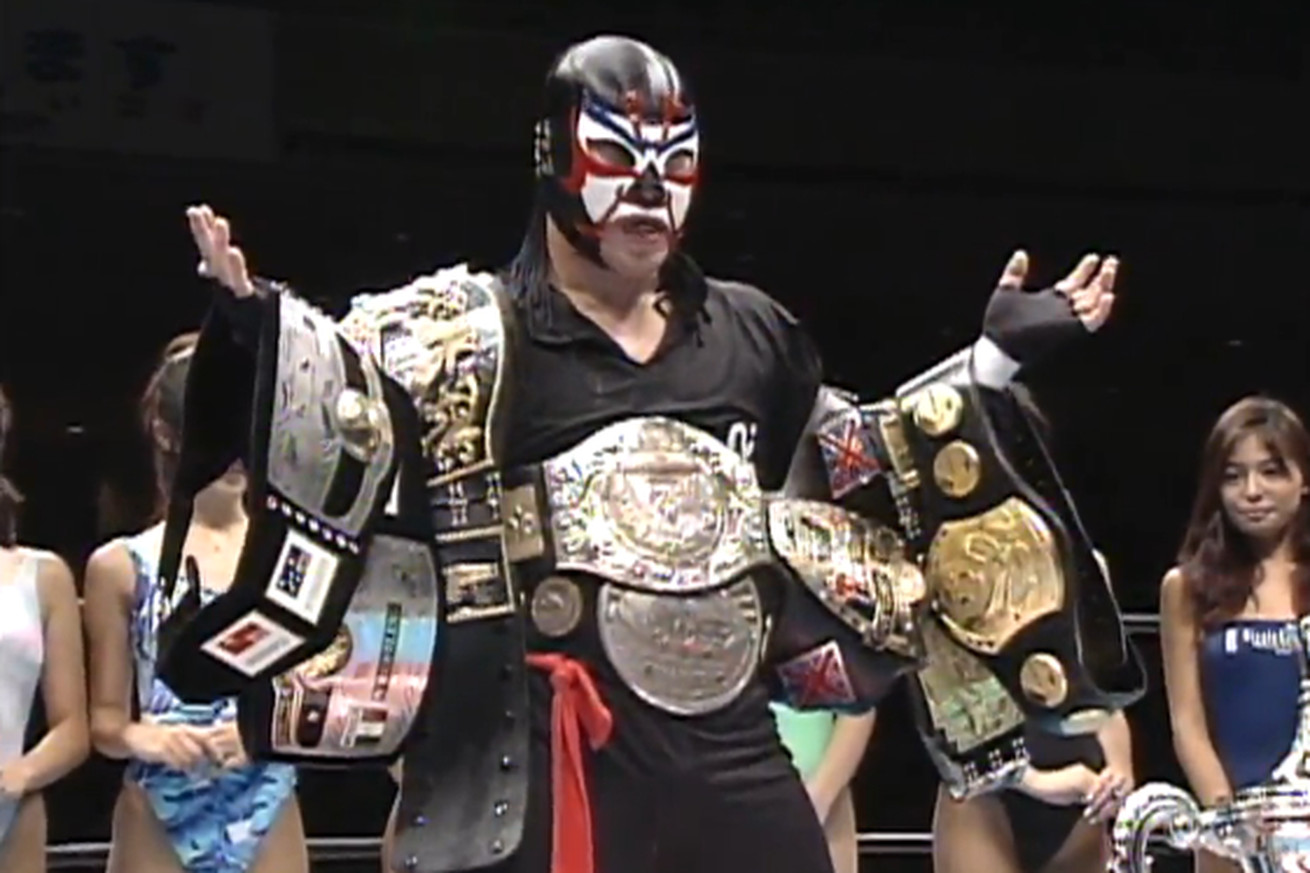
On August 5, 1996, The Great Sasuke beat Ultimo Dragon in Tokyo to become the first J-Crown champion, and in the process gave junior heavyweight wrestling one of its great visual statements. Eight title belts were at stake. Two masked innovators walked in with entire careers' worth of mileage already on their bodies. When it was over, Sasuke stood as the man who had unified a globe-spanning collection of championships and, for one night, looked like the most decorated wrestler alive.
What made the date matter was not only that Sasuke won a tournament final. It was the scale of the idea behind it. New Japan's J-Crown brought together belts from Japan, Mexico, Britain and the WWF orbit and treated the junior heavyweight division as something worthy of major-league ceremony. That may sound normal now, after decades of cruiserweight spotlights and international tournaments, but in 1996 it still felt radical to present smaller wrestlers with this much grandeur. The belts themselves gave the match an almost absurd spectacle. The ambition behind it is what made it historic.
A contemporary Observer account framed the final as the biggest junior heavyweight match ever assembled on paper, and it is easy to see why. Sasuke and Dragon were not simply excellent wrestlers having another acclaimed match. They represented two different but deeply connected strands of 1990s innovation. Dragon was the polished international star, a New Japan dojo product who rebuilt himself in Mexico and came back as one of the defining junior heavyweights of his generation. Sasuke was the daredevil visionary who helped turn Michinoku Pro into a cult phenomenon by showing Japanese crowds movement, risk and creativity that still looked futuristic.
There was also a teacher-and-student thread running through the match that gave it extra emotional weight. Before Sasuke became the masked icon who seemed willing to launch himself at any angle the human body would allow, he had learned from the same world Dragon helped popularize. By the summer of 1996, the student had become a peer and arguably the bolder symbol of where junior heavyweight wrestling was heading next.
The tournament itself had already been strong before the final bell rang on August 5. Sasuke had advanced through Masayoshi Motegi and El Samurai. Dragon had come through Jushin Thunder Liger and Shinjiro Otani. Those names matter. This was not a novelty bracket built around belts alone. It was a concentrated snapshot of how much depth junior heavyweight wrestling had in Japan at the time, with New Japan using the J-Crown alongside G-1 week to tell fans that the lighter weights deserved the same seriousness as any heavyweight main event.
Then came the final, and it sounded as wild as the concept deserved. Dragon attacked with the speed and technique that made him special, folding in the dragon screw, the Asai moonsault and the kind of sudden near falls that could flip a building's mood in an instant. Sasuke answered with his own breathtaking offense, including a matching moonsault and the reckless fearlessness that made him feel unlike anyone else in the world. The match was not a neat, clean laboratory classic. It was dramatic, chaotic and a little dangerous, which in some ways suits the story better. Both men were banged up by the end. Sasuke famously took a frightening landing on a flip to the floor, cracked his skull and still finished the match.
That ugliness is part of the memory now. So is the imperfect finish. Dragon's knee was giving him trouble, Sasuke was hurt badly, and the last sequence had to be hurried home. In a strange way, that makes the match even more emblematic of 1990s junior heavyweight wrestling rather than less. It was daring to the point of self-destruction, brilliant enough to make the risk feel worth it in the moment, and ambitious enough to leave a permanent mark even without an immaculate closing stretch.
Sasuke's win also mattered because of who he was representing. He was not just another New Japan star being elevated by the machine. He was the founder and face of Michinoku Pro, a smaller promotion built on invention, regional identity and stubborn belief in a style that bigger companies had once treated as niche. Seeing Sasuke walk out with all eight belts was a victory for that whole ecosystem. It said that the most influential ideas in wrestling did not always come from the largest office or the safest template.
The reign itself was brief. Sasuke lost the unified crown back to Dragon on October 11, and the J-Crown as a concept lasted only a little more than a year. That short lifespan is one reason the image still hits so hard. The title was never around long enough to become ordinary. It exists in memory as a snapshot of a moment when junior heavyweight wrestling felt limitless, when promotions from different worlds could be folded into one ambitious prize, and when the wrestlers carrying those expectations were good enough to make the whole thing feel real.
That is why August 5, 1996 still stands out. The J-Crown final did not launch the junior heavyweight style from scratch, and it did not settle every debate about who the best was. What it did do was put the division on a pedestal and present it with the pomp usually reserved for bigger men and older traditions. For one night, Great Sasuke and Ultimo Dragon made junior heavyweight wrestling look not like an alternative to the main event, but like the main event's future. Sasuke leaving with eight championships was the image that proved it.