
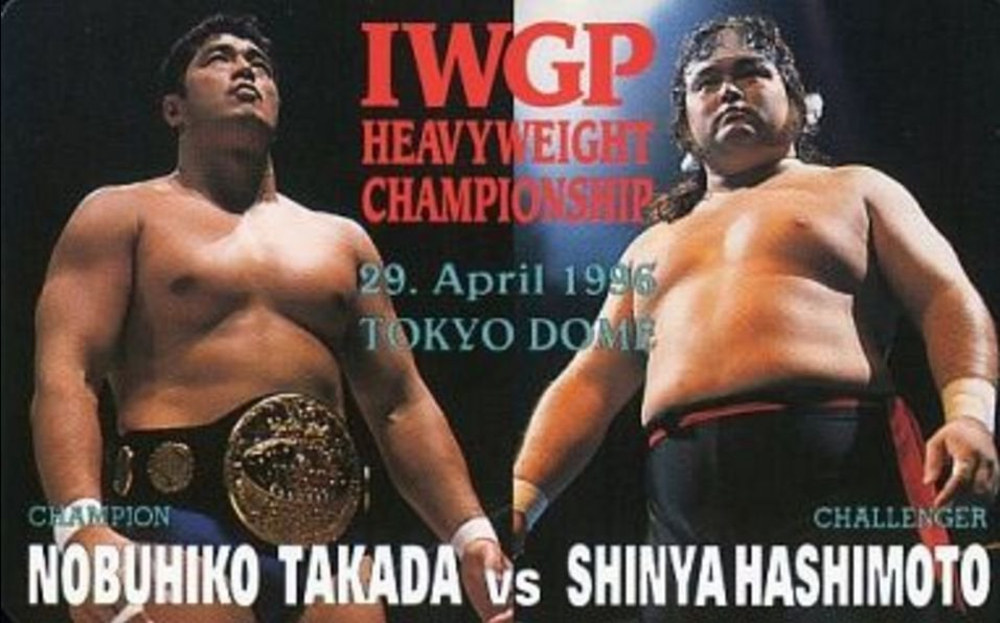
On April 29, 1996, Shinya Hashimoto defeated Nobuhiko Takada in the main event of Battle Formation at the Tokyo Dome and reclaimed the IWGP Heavyweight Championship for New Japan Pro-Wrestling. On paper, that sounds like a straightforward title change. In practice, it felt much bigger than that.
This was New Japan fighting for its identity in front of a massive Tokyo Dome crowd.
By the spring of 1996, Takada was not just another challenger from outside the company. He was the face of UWFi, the shoot-style rival that had become one of the most compelling forces in Japanese wrestling. He had already beaten Keiji Muto for the IWGP title on January 4 and turned that belt into the center of an interpromotional war. New Japan still had its stars, its prestige and its scale, but the image that mattered most was uncomfortable for the home side. Its top championship belonged to an outsider.
That is what gave Hashimoto's challenge its weight. He was not stepping into the Dome as a novelty opponent or a one-night savior. He was one of the pillars of 1990s New Japan, a wrestler whose presence always felt solid, grounded and dangerous. When fans looked at Hashimoto, they saw somebody who represented the company the way Takada represented the rebellion against it.
The larger feud had already proven it could draw on a historic level. The New Japan versus UWFi program had become one of the hottest business runs the industry had seen, blurring the line between promotion warfare, style warfare and national-level spectacle. The May 6, 1996 Wrestling Observer Newsletter reported that Battle Formation drew a sellout announced at 65,000 fans and what was believed at the time to be the second largest live gate in pro wrestling history. That kind of number tells you this was not simply a major match. It was a statement event.
The card around it looked like a super show built to underline that point. The Great Sasuke beat Jushin Liger for the IWGP Junior Heavyweight Championship, and the event pulled in talent from multiple promotions. Even so, everything revolved around the same central question. Could New Japan put its own flag back on top of its own mountain?
Hashimoto answered it the hard way.
The match with Takada was not built around flashy excess. It was built around tension, status and the feeling that every exchange carried more meaning than usual. Takada brought the aura that had made him such a draw in the first place, the sense that he belonged to a harsher and more legitimate version of combat. Hashimoto met that aura head on and refused to be swallowed by it. Instead of chasing Takada's mystique, he stood as a blunt reminder that New Japan's own main event style could still feel every bit as forceful when the stakes were real enough.
When Hashimoto finally won by submission with a cross armbreaker, the finish landed as both a title change and a release valve. New Japan had its belt back. More importantly, it had one of its own deliver the answer in the middle of the ring. For a promotion that had spent months selling the danger and credibility of the invading side, that mattered.
What makes the date so memorable is the balance it captured. Takada was still incredibly valuable. In fact, part of the drama here comes from the fact that he had been such a remarkable business driver. The feud worked because the invading ace felt special enough to threaten the home company's hierarchy for real. If he had not felt that dangerous, Hashimoto's win would not have meant nearly as much.
But wrestling history is full of moments when a promotion discovers that making money and protecting its symbolic center are not always the same thing. Takada helped create the boom. Hashimoto provided the restoration. Battle Formation worked because it offered both halves of that story in the same arc.
It also says a lot about Hashimoto himself. He sometimes gets discussed behind other giants when fans talk about the defining Japanese stars of the 1990s, but nights like this are the reason his legacy stays secure. He was believable without needing embellishment. He felt like the sort of wrestler a company could trust with its reputation when the moment called for something sturdier than charisma alone. At the Tokyo Dome that night, sturdiness was exactly what New Japan needed.
There is also something fitting about the fact that this happened in the Dome, the building most closely tied to New Japan's biggest ambitions. Battle Formation was not just a successful show. It was a reminder that the company could still turn a major ideological fight into a huge live event without losing sight of who was supposed to stand tallest when the lights went down.
That does not mean the broader story of 1990s Japanese wrestling suddenly became simple after April 29. The era was too chaotic, too inventive and too competitive for that. Promotions kept borrowing from one another, raiding one another and trying to outdo one another. But Hashimoto beating Takada remains one of the clearest snapshots of how high the stakes could feel when that competition reached the top of the card.
A lot of title wins matter because of the belt. This one mattered because of what the belt had come to represent.
On that night, the IWGP Heavyweight Championship was not just New Japan's top prize. It was the proof of who had won the argument.
Hashimoto brought it home.