
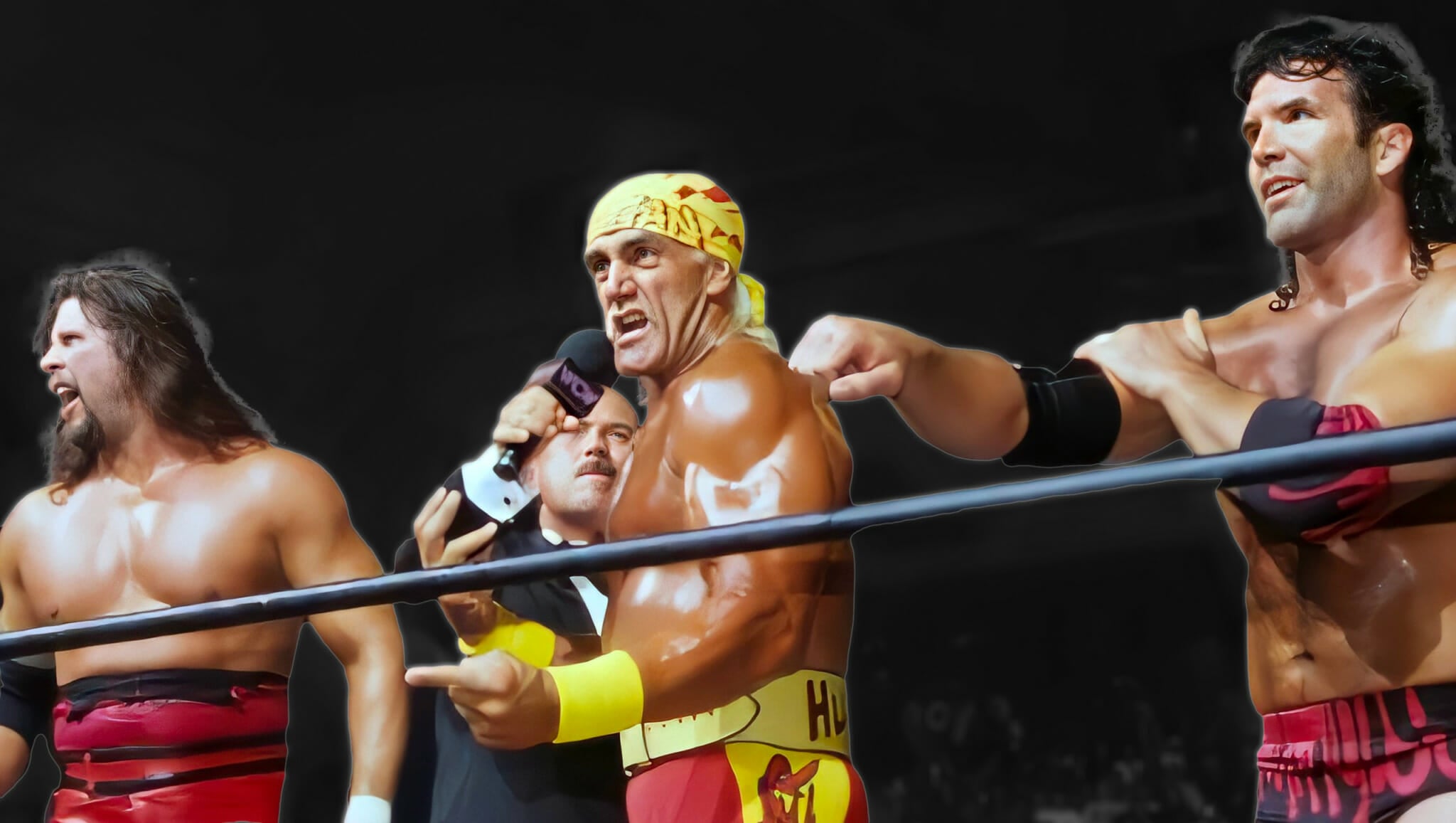
On July 7, 1996, World Championship Wrestling pulled off one of the few true gasps in wrestling history. Fans bought Bash at the Beach expecting to finally learn who would stand beside Scott Hall and Kevin Nash in their war against WCW. What they got was Hulk Hogan dropping the leg on Randy Savage, turning heel after more than a decade as the biggest all-American hero in the business, and helping launch the New World Order.
It is hard to overstate how unnatural that felt in the moment. Hogan was not just a top babyface. He was the babyface of an entire generation, the human logo for Hulkamania, Saturday morning morality plays, and the bright red-and-yellow version of wrestling that had dominated the 1980s. Even after he jumped to WCW in 1994, the assumption was that Hogan would always be Hogan. On this night, that idea died in front of a live pay-per-view audience, and wrestling changed with it.
The moment the room turned
Hall and Nash had spent weeks making WCW feel unstable. They arrived like invaders, spoke in a deliberately blurry way about where they came from, and forced the company to build everything around the question of the mystery third man. That tension carried the whole pay-per-view.
The main event began with Savage, Sting, and Lex Luger representing WCW. Luger was attacked early and removed, leaving the match to become a two-on-two fight while the crowd waited for the promised reveal. Hogan then walked out to what was still a babyface reaction. For a few seconds, the building got exactly what it thought it wanted, the old hero arriving to save the day.
Then came the leg drop on Savage.
Not one, but multiple drops, followed by the pin as Hall counted along. The visual was instantly bigger than the match itself. Fans threw garbage into the ring. Gene Okerlund looked disgusted. Tony Schiavone closed the show by telling Hogan to go to hell. In a business built on betrayal, this one landed because almost nobody believed WCW would actually do it.
Hogan's post-match promo mattered just as much as the turn. He did not hedge. He did not tease doubt. He leaned into contempt, mocking the fans and making it clear that he, Hall, and Nash were starting a new power structure. That was the real birth of the nWo, not just a faction name, but a whole new emotional language for mainstream American wrestling.
Why Hogan had to become the villain
The turn worked because it arrived at exactly the right moment.
By the summer of 1996, Hogan's act in WCW was cooling. He was still famous, still a draw, and still presented as a giant star, but the audience was changing faster than his character was. The cartoon certainty that had made him unbeatable in the 1980s no longer felt fresh in the middle of the Monday Night War. Hall and Nash, by contrast, brought a smug, looser, more dangerous energy. They felt modern in a way Hogan suddenly did not.
Turning Hogan solved several problems at once. It gave Hall and Nash the biggest possible ally. It gave Hogan a role that fit the audience's mood. Most importantly, it gave WCW a central story that felt hotter than simply running its established names through another round of matches.
That is the real genius of July 7. WCW did not just shock people. It repositioned its most famous star inside a story that finally felt bigger than one match or one pay-per-view. Hogan was no longer there to carry the company in the old way. He was there to poison it from the inside.
The nWo made wrestling feel less safe
A lot of angles are remembered because they were executed well. This one is remembered because it changed the air around the business.
The Outsiders storyline had already been playing with uncertainty, especially in an era when fans still did not have instant access to every contract detail and backstage update. Once Hogan joined them, WCW had a faction that felt less like a normal heel stable and more like a hostile takeover. Black-and-white shirts replaced the bright colors. Cool heels became the center of the act. The promotion's main stories now revolved around infiltration, divided loyalties, and the idea that the company itself might not be able to control what was happening on its own television.
That tone shift mattered. The nWo turned weekly wrestling into something fans followed not just for finishes, but for escalation. Who was joining next? Who could be trusted? Was WCW fighting back hard enough? Those questions drove conversation in a way the business had not seen for years.
It also helped push WCW into the strongest stretch of its modern life. The company suddenly had a visual identity, a cultural hook, and a feud structure that could stretch across every level of the card. Plenty of later nWo expansions became bloated, but on the night it began, the idea felt sharp, rebellious, and genuinely huge.
Why July 7 still echoes
Hogan's heel turn remains one of the industry's most important acts of reinvention because it proved no image was too fixed to break. The ultimate hero became the ultimate traitor, and instead of shrinking, he got bigger again.
That turn also helped define the version of wrestling the late 1990s would run on. Anti-heroes became cooler. Moral lines got blurrier. Merchandise, catchphrases, and faction identity became even more central to how fans picked sides. The Monday Night War did not start on July 7, 1996, but it undeniably changed shape that night.
That is why the image still holds up: Hogan in black, Hall and Nash beside him, trash raining into the ring, and fans trying to process something they never thought they would see. Wrestling has produced louder pops and maybe even stranger swerves, but very few moments have so cleanly split the business into a before and an after.
Also on this date, other archive hits included Chris Jericho's July 7, 1995 match with Ultimo Dragon in Tokyo, a bout later described as pivotal in raising Jericho's profile, AJ Styles beating Kevin Owens for the United States title at Madison Square Garden on July 7, 2017, and the July 7, 2018 death of mini wrestling standout Piratita Morgan.
On this day in 1996, though, one story towered over the rest. Hulk Hogan stopped being the man who told kids to say their prayers and eat their vitamins. He became the face of wrestling's coolest invasion, and the business spent years chasing the feeling that created.