
On June 10, 1996, WCW's invasion angle stopped feeling like a weird one-man stunt and started feeling like a hostile takeover. Scott Hall had already walked into Nitro and made viewers wonder what exactly they were watching. When Kevin Nash stepped in beside him one week later, the whole thing suddenly had weight, menace and direction.
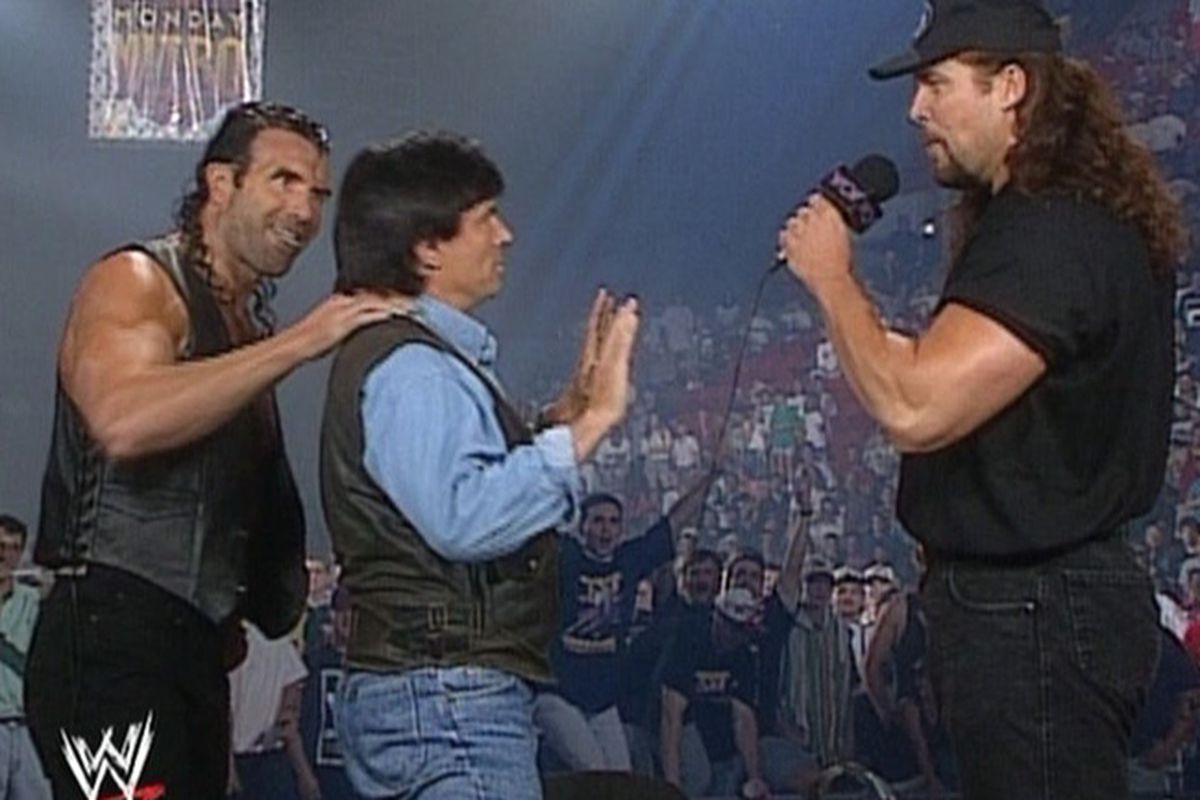
That moment came at the end of Nitro in Wheeling, West Virginia. Eric Bischoff was in the ring with Hall, trying to confront him directly after days of disruption and unanswered threats. Hall had promised a big surprise. Bischoff tried to call the bluff. Then Nash appeared behind him, looming over the segment like the answer to a problem WCW had not been prepared to solve.
Nash looked familiar on purpose. He carried himself like Diesel, the giant star fans had just seen on the other side of the Monday night divide, but he was now standing on a WCW show acting as if he and Hall were not simply new signings. They presented themselves as invaders, men arriving from somewhere else to embarrass the company on its own television. That was the genius of it. Wrestling had done outsider angles before, but this one played directly into what fans already knew about the business in 1996. Hall and Nash were not anonymous heels pretending to be dangerous. They were recognizable stars crossing a line the audience understood.
That gave the segment a realism that felt fresh for major American wrestling TV. The point was not subtle. Hall and Nash talked down to WCW, mocked its stars and treated the promotion as a soft target. They did not behave like men asking for a match. They behaved like men forcing a crisis. A lot of wrestling angles in that period still announced themselves too clearly as wrestling angles. This one invited viewers to sit with the uncertainty for a minute and ask whether the company was losing control of its own show.
The contemporary Wrestling Observer Newsletter coverage made clear that the rest of the episode was not especially memorable, but the closing angle was the part that mattered. That tracks with how the moment has lasted in memory. Fans do not go back to June 10, 1996 because it was one of the deepest Nitros ever. They go back because it was the night the story found its second lead, and once Nash was standing there with Hall, the promotion had something bigger than a simple surprise debut.
Hall brought swagger and unpredictability. Nash brought scale. He looked like the kind of guy who could back up every threat Hall had made. More importantly, the pairing gave WCW a visual that was impossible to ignore. Hall alone felt like a provocation. Hall and Nash together felt like a movement. Before long they would be known as the Outsiders, but even before the name settled in, the chemistry was obvious. Hall did the talking, Nash supplied the cold confidence, and suddenly WCW had two stars who could hijack the mood of an entire program just by showing up near the announce desk.
The timing could not have been better for WCW. Nitro was still a relatively young national institution, live and energetic but not yet the unstoppable weekly habit it would become. The company had major names, but it also had a tendency to drift between exciting ideas and a lot of clutter. Hall and Nash gave the show a clean spine. You could tune in for the matches, but you now had to tune in to see what the invaders would do next. That difference matters. Wrestling booms are often built less on one perfect match than on the feeling that missing a week means missing the conversation.
June 10 was also the night the road to Bash at the Beach became clear. Hall and Nash were not there to win random matches on television. They were there to push WCW into a larger showdown, one that eventually drew Sting, Lex Luger and Randy Savage into the line of fire before Hulk Hogan's shocking turn completed the picture less than a month later. Hogan joining them on July 7 is the famous image, and rightly so. But Hogan's turn only landed with that force because the invasion already felt serious by the time he chose a side. Nash's arrival is the moment the angle stopped being a clever disruption and became a real power play.
There is another reason the segment mattered so much. It captured a shift in how wrestling television could talk to its audience. The best parts of the Monday Night War worked because they trusted fans to bring outside knowledge into the room. Viewers knew Hall and Nash had been major WWF stars. They knew contracts existed, that promotions competed, that talent jumped from place to place and that locker-room politics were part of the appeal. WCW did not need to explain every piece of that on air. It only needed to wink at the truth and let the audience fill in the rest. That was a more modern kind of storytelling, one built on implication, attitude and the thrill of seeing the curtain pulled back just enough.
Nash's debut also helped define his own career in a way that is easy to overlook because of how enormous the nWo story became later. Diesel had been a top champion, but this version of Nash was looser, cooler and more naturally suited to the role. He was no longer being asked to carry himself like a traditional corporate headliner. He could lean into sarcasm, menace and that effortless sense that the rules did not apply to him. In that sense, June 10 was not just a key WCW moment. It was one of the most important reinventions of a major American wrestling star in the 1990s.
If Hall's first invasion promo lit the fuse, Nash's arrival told everyone the explosion was really coming. The segment gave WCW the confidence to keep escalating, gave Nitro an angle that felt larger than the usual TV cycle and helped create the atmosphere that made 1996 feel different from what had come before. Wrestling history is full of debuts that looked important in the moment and faded later. This one did the opposite. It looked disruptive that night, and with every year that followed it became clearer just how much had changed.
On this day in 1996, Kevin Nash did more than walk onto Nitro. He gave Scott Hall a partner, gave WCW's invasion story its full shape, and helped turn one of wrestling's hottest summers into the beginning of a real industry power shift.