
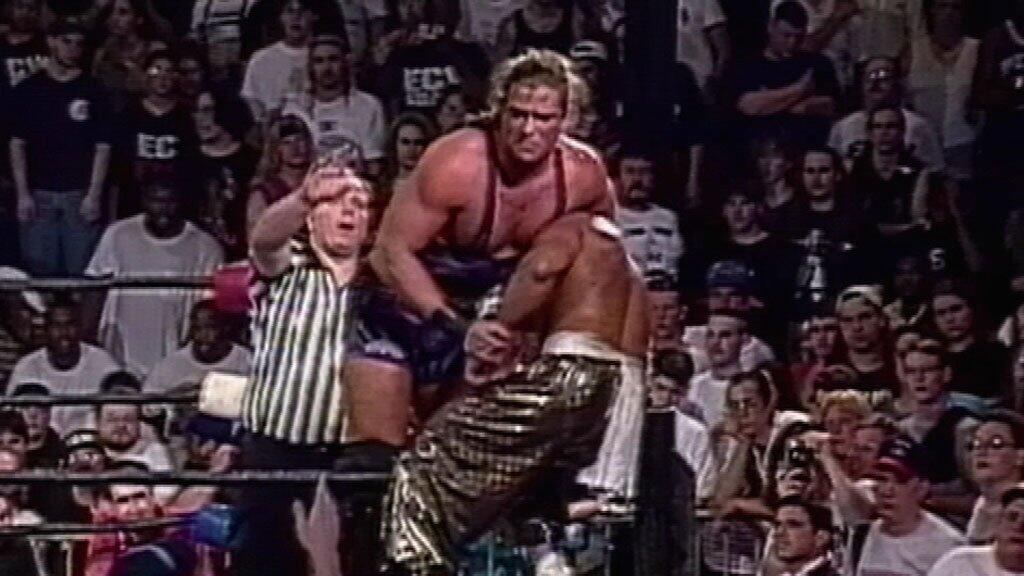
On June 22, 1996, ECW staged the kind of night that only ECW could have staged.
Hardcore Heaven 1996 was loud, messy, overheated, half out of control and impossible to forget. The show ran long. The production kept failing. The ring itself started betraying the people working in it. And somehow, by the time the night was over, all of that chaos had made the event feel even more like a perfect snapshot of what ECW meant in the mid-1990s.
At the center of it was Sabu vs. Rob Van Dam, a match that felt like a collision between two different ideas of rebellion.
Sabu was already one of ECW's defining symbols by then, the scarred-up daredevil who made every match look like it might leave permanent damage behind. Van Dam was newer to the promotion, but he already carried a different kind of electricity. He was smoother, flashier, more openly cocky, and just athletic enough to make fans wonder if he was seeing pro wrestling a few seconds ahead of everyone else. Their first two matches earlier that year had already established the chemistry. By the time the rubber match was set for Hardcore Heaven, the bout had real heat behind it.
That mattered because the rest of the show had plenty going on. Tommy Dreamer and Brian Lee were still in the middle of one of ECW's ugliest feuds. Taz was being positioned as a killer and put opposite Paul Varelans in a heavily hyped fight that blurred the line between wrestling stunt and real contest. Chris Jericho was climbing fast and had a shot at the ECW World Television Championship. Raven was still the promotion's bleak, manipulative center of gravity. On paper, Hardcore Heaven looked loaded.
In practice, it became a survival test.
Contemporary Observer coverage described the event as one of ECW's best shows, but also one of its most chaotic. Fans packed the ECW Arena in what was reported as the company's biggest crowd to that point, more than 1,500 people crammed into the building for a show that stretched to roughly five hours. Technical problems kept piling up. The sound system went out. Angles had to be stalled and improvised. The crowd was left waiting deep into the night for the main event, and when Sabu and Van Dam finally got to the ring at around 12:30 a.m., the top rope broke only a couple of minutes into the match.
Most promotions would have seen that as the end of the main event.
ECW treated it as another obstacle to fight through.
What makes June 22 stand out is not just that Sabu and Van Dam kept going. It is that the match still felt important after the wheels started coming off. They wrestled through the broken rope and the late hour with the same reckless commitment that had made the rivalry work in the first place. Sabu won with the Arabian facebuster, and both men were taken out on stretchers at the finish. Even by ECW standards, it looked like a match that had demanded everything from both of them. Reports at the time indicated Sabu may have re-injured his hand in the process.
That finish says a lot about what ECW understood better than most promotions of the era. Fans were not coming to Philadelphia for clean polish. They were coming for intensity, danger and the feeling that the show might spin off the rails at any second. Hardcore Heaven gave them all of that, but the key difference was that the chaos did not swallow the wrestling. Sabu and Van Dam made sure of that.
The match also mattered because it captured a shift that was happening inside ECW's identity. Sabu represented the promotion's original violent poetry, all motion and risk and scar tissue. Van Dam represented where the style could go next. He was still reckless, but in a different register. His offense had more glide to it, more snap, more of the hybrid athleticism that would later become a much bigger part of mainstream American wrestling. Put those two together in front of an ECW crowd, and the result felt like a bridge between generations of innovation.
The rest of the card helped make the night feel even bigger. Jericho beat Pitbull #2 to win the ECW World Television Championship, the first championship of his career in the United States. Dreamer took one of the year's nastiest bumps when Brian Lee chokeslammed him off a balcony through tables. Raven retained the ECW title in an unannounced defense against Terry Gordy. Even the notorious delays became part of the show's mythology, with the promotion throwing whatever it could at the crowd just to keep the building from boiling over before the main event.
That is why Hardcore Heaven 1996 still holds a special place in ECW history. It was not the promotion at its cleanest. It was the promotion at its most revealing.
You could see the ambition in the packed house, in the loaded card, and in the faith that fans would stay with the company through a marathon night because they believed they were seeing something that did not exist anywhere else. You could also see the danger in the way everything felt one small mistake away from collapse. ECW was always walking that line. On June 22, it walked it in public for five straight hours.
Sabu and Van Dam ended up giving the night its lasting image because they turned breakdown into texture. The broken rope did not become an excuse. The lateness did not kill the crowd. The match still landed like a main event because both men wrestled as if the disorder around them was just part of the atmosphere they were supposed to conquer.
Looking back now, Hardcore Heaven 1996 feels like a concentrated dose of what made ECW influential. The promotion was not important just because it was bloody or because it swore more than everybody else. It mattered because it trained fans to treat urgency as part of the art form. Imperfection was not automatically failure. Sometimes it was proof that what you were watching had real edge to it.
On this day, Sabu and Rob Van Dam gave ECW one of its purest nights. Not the prettiest version of the company, and not the most stable, but maybe the most honest. Everything was breaking, and the main event still worked. In ECW, that counted as a kind of triumph.