
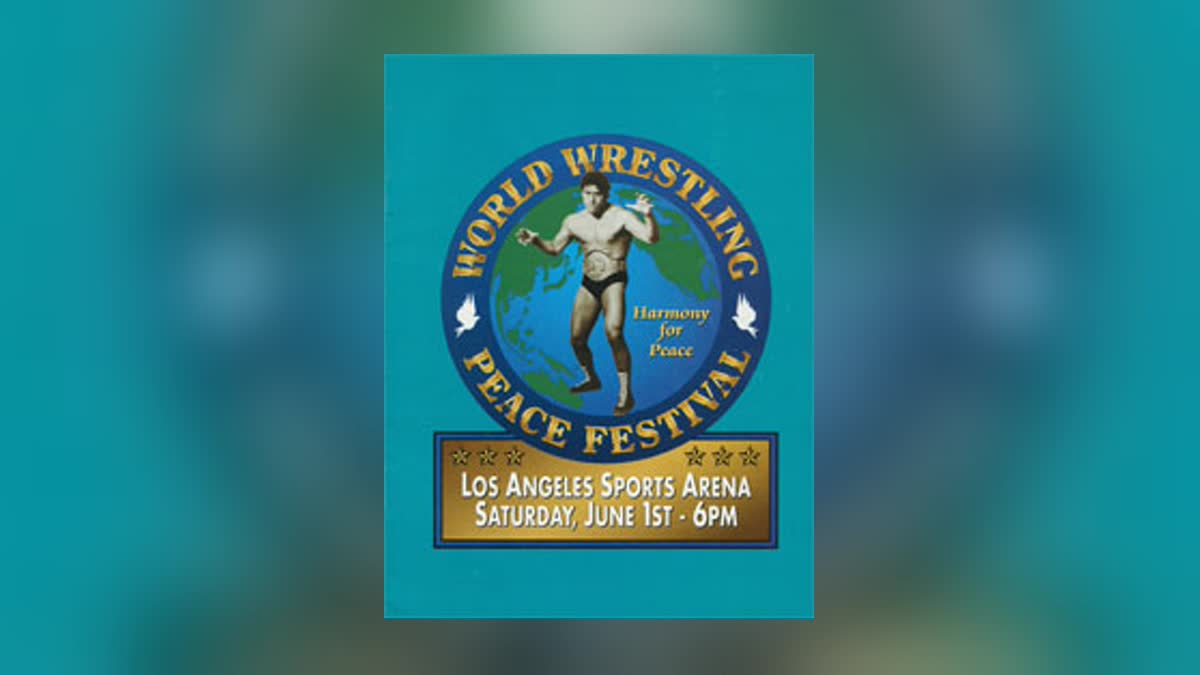
On June 1, 1996, Antonio Inoki tried to stage a wrestling version of world diplomacy in Los Angeles.
That sentence sounds grand, maybe even a little ridiculous, and that is exactly why the World Wrestling Peace Festival still stands out. Inoki's idea was not to run just another big card. He wanted a symbolic summit, one night where wrestlers from Japan, Mexico and the United States could share a ring under a banner of peace, prestige and international cooperation. It was idealistic, self-mythologising and deeply Inoki all at once.
It was also a financial mess.
The show drew only 2,513 paid fans at the Los Angeles Sports Arena after the original dream of running the far larger Coliseum had already been abandoned. Even with thousands of freebies distributed, the building was nowhere near full. On paper, that should have made the event a historical curiosity and nothing more.
Instead, it became something better than that. The World Wrestling Peace Festival was a commercial failure, but it was also a vivid snapshot of what wrestling looked like when the barriers between styles and promotions briefly came down.
Inoki tried to turn a supercard into a statement
Inoki had spent years presenting himself as more than a wrestler or promoter. By 1996 he was a political figure, a national icon in Japan and a man who rarely thought in small terms. After the massive 1995 North Korea shows, he tried a very different kind of international statement in Southern California.
The premise was pure Inoki. Bring together talent associated with New Japan, WCW, AAA, EMLL, Michinoku Pro and other corners of the wrestling world. Mix lucha libre, heavyweight U.S. television stars, junior heavyweight brilliance and shoot-style credibility. Wrap it all in language about peace and racial harmony. Then put Inoki himself in the main event at 53 years old, because of course he was not going to watch this from the sidelines.
That ambition gave the show its hook. This was not built around a single blood feud or one hot title match. It was built around the novelty of the card itself. Fans could see Sting and The Giant on the same event as Jushin Liger, Great Sasuke, Rey Misterio Jr., Psicosis, Konnan, Chris Jericho, Perro Aguayo and Tatsumi Fujinami. Even in an era when cross-promotional relationships were more common than they are now, that lineup still looked unusual.
The card felt like someone had dumped three wrestling magazines onto a table and decided every promotion should send a representative.
The best parts of the show were exactly what you would hope
What makes the festival worth remembering is that the in-ring product justified the curiosity.
The card was uneven, and the crowd itself was split into different pockets with different tastes, but several matches delivered the kind of international showcase Inoki had envisioned. Rey Misterio Jr. and Ultimo Dragon against Psicosis and Heavy Metal was widely seen as the best match on the show, the sort of fast, inventive lucha showcase that could stop even a distracted crowd and force it to pay attention. Jushin Liger against Great Sasuke gave the event a genuine junior heavyweight dream match, and Liger won with the Liger Bomb after a match that felt big enough to match the names involved.
There were other odd touches that made the night memorable in a very 1996 way. The ring broke during one of the six-man matches, and workers had to keep going while the problem was managed on the fly. The Giant, already WCW world champion, pinned Sting clean in a non-title match that probably made more sense as a piece of star power than as actual booking logic. Konnan, Jericho and Bam Bam Bigelow worked a triangle match that turned into one of the pleasant surprises of the night.
That variety was the event's real strength. It did not feel polished in the neat, modern sense. It felt chaotic, multinational and occasionally patched together with tape. For a show sold on the idea of wrestling's many worlds colliding, that was part of the charm.
The main event said everything about Inoki
If the undercard showed the range of the festival, the main event explained its soul.
Inoki teamed with Dan Severn against Yoshiaki Fujiwara and Oleg Taktarov, a match designed to blend pro wrestling theatre with real combat legitimacy. Severn was the reigning NWA world heavyweight champion and had just fought Ken Shamrock in one of the most discussed UFC matches of the era. Taktarov was a major name from the same scene. Fujiwara brought his own submission-wrestling credibility and long history with Inoki. The whole thing was constructed to make Inoki look like the elder statesman who could still stand shoulder to shoulder with dangerous men.
And, in its own way, it worked.
Severn made Fujiwara submit to an armbar in 9:15, but the lasting image was not really about the finish. It was about Inoki placing himself at the center of this impossible card and making the entire night orbit around his reputation. That had always been one of his great gifts. He could make even his grandest self-created myths feel substantial for a while, because he believed in them so completely.
The World Wrestling Peace Festival was full of contradictions. It was meant to project global importance, yet it struggled badly at the box office. It was promoted as a gesture toward unity, yet much of its appeal came from the sheer weirdness of seeing so many disconnected wrestling worlds forced together for one night. It was not the biggest show in America, or the best, or the most influential in any obvious direct way.
But it captured something valuable.
Why the Peace Festival still matters
A lot of wrestling history is built around winners, title changes and angles that launched the next boom period. This show matters for a different reason. It showed how broad wrestling's universe already was in 1996, even before the internet flattened everything into one constant conversation.
One Los Angeles card gave fans a taste of lucha libre, junior heavyweight fireworks, heavyweight spectacle, shoot-style credibility and Inoki pageantry in the same evening. In that sense, it was ahead of its time. Modern fans are used to seeing wrestling through a global lens. In 1996, that still felt novel in the United States, especially on one card.
The festival also holds up as a reminder that not every important wrestling event is a clean success story. Some shows matter because they make money. Some matter because they change business forever. And some matter because they reveal what the people behind them believed wrestling could be.
On this night, Inoki believed wrestling could be a cultural summit, a political statement and a spectacular mess all at once.
He was not entirely wrong.