
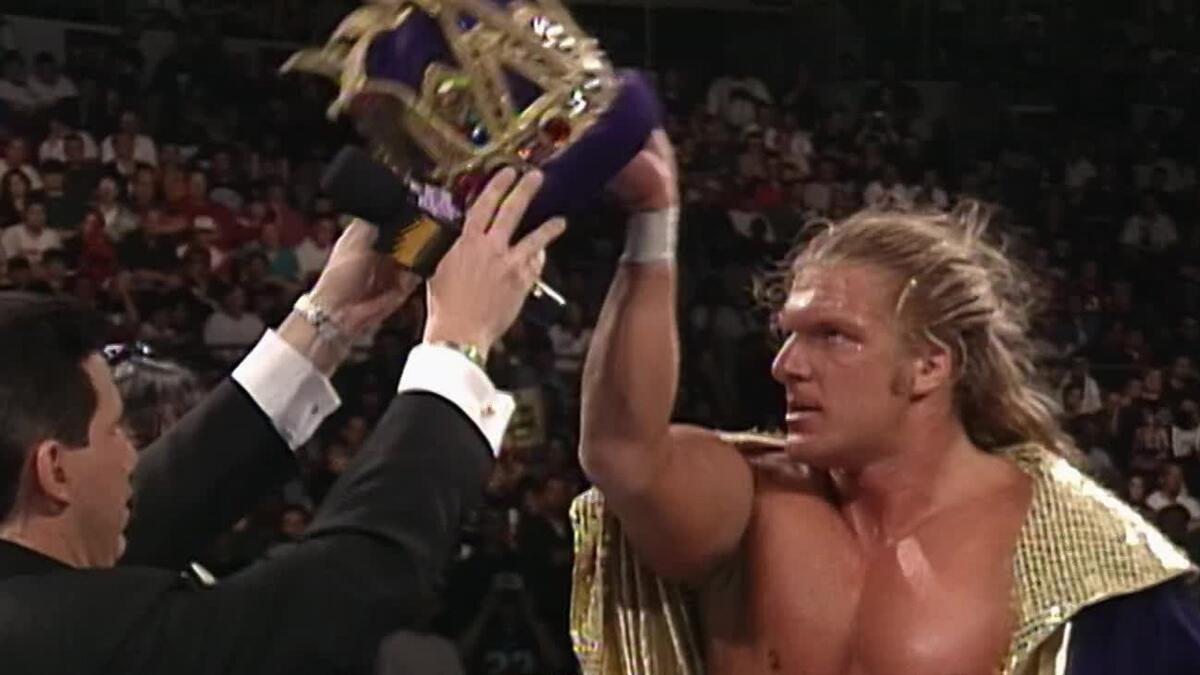
On June 8, 1997, Hunter Hearst Helmsley won the King of the Ring tournament in Providence, Rhode Island, and with it claimed the moment that finally pushed his WWF career back onto stable ground.
That does not mean the crown instantly made him the top star in the company. It did not. Steve Austin was already surging, Bret Hart was still one of the central figures of the promotion, Shawn Michaels remained a main event force, and The Undertaker sat at the top as WWF champion. But Helmsley's tournament win mattered because it came at the exact point where his career could have gone in a very different direction.
A year earlier, he had been the man originally lined up for this same prize. Then came the Madison Square Garden curtain call, the notorious post-match sendoff involving Helmsley, Michaels, Kevin Nash and Scott Hall. Nash and Hall were leaving for WCW. Michaels was too protected to take the full hit. Helmsley was the one who paid for it. His planned 1996 King of the Ring breakthrough disappeared, and for months he looked less like a future pillar and more like a wrestler the company had quietly shoved backward.
That is what gives June 8, 1997 its real weight. This was not merely a tournament final. It was a public course correction.
Observer coverage from the time captured the irony clearly. Helmsley had already been eliminated from the tournament in the preliminary stages that year, only to get back in because plans changed after injuries and reshuffling. Even then, the final bracket hardly looked like the clean launchpad of a future empire. The card around the tournament drew more attention for Shawn Michaels vs. Steve Austin and for the increasingly combustible atmosphere inside the company. Helmsley's path to the crown felt almost improvised.
But wrestling history is full of moments where improvised turns out to be enough.
Helmsley first beat Ahmed Johnson in the semifinal, surviving thanks to Chyna's interference and a Pedigree at the exact moment Johnson appeared to have control. That finish mattered because it was already sketching the version of Helmsley that would truly break through. He was not being framed as a pure athletic hero who overwhelmed people on talent alone. He was calculating, opportunistic and increasingly dependent on the presence of Chyna, whose arrival had given his presentation a harder edge than the old blue-blood act ever had.
The final against Mankind was the more important piece. Mankind had already worked earlier in the night and entered the match selling neck damage, which gave the bout a built-in story of survival. Helmsley did not simply outwrestle him in a clean, triumphant star-making finish. Instead, the match built around punishment, interference and persistence. Chyna kept changing the balance. Mankind kept fighting through it. By the end, Helmsley had put him away with the Pedigree and then stood over the wreckage as the newly crowned king.
That ending fit the wrestler Helmsley was becoming far better than a straightforward babyface coronation ever would have. The future Triple H was never going to be defined by underdog innocence. He was going to be defined by control, arrogance, manipulation and a cold understanding of hierarchy. On this night, those traits stopped feeling like scattered pieces and started to look like a complete top-level act.
It is also worth remembering what kind of WWF this happened in. Mid-1997 was a company in transition, edgy but not yet fully transformed, still carrying New Generation leftovers while inching toward the Attitude Era. The biggest stories were becoming sharper, meaner and more personality-driven. Helmsley fit that shift. The old aristocrat character had always felt a little too theatrical for a promotion that was moving toward something nastier and more confrontational. King of the Ring 1997 did not complete the transformation on its own, but it gave Helmsley a credible new rung on the ladder at the exact time WWF needed more distinct upper-card personalities.
That is why this win aged better than it may have seemed in the moment. Austin's 1996 King of the Ring victory became immortal because of the "Austin 3:16" promo. Helmsley did not leave Providence with anything that instantly iconic. His win was quieter. Its importance showed up over time.
From there, the pieces fell into place. The association with Chyna deepened. D-Generation X followed later in 1997 and turned him from a stalled project into one of the promotion's coolest acts. By the time the Monday Night War fully intensified, Helmsley was no longer a man recovering from punishment. He was an essential part of WWF's future main event scene. The world titles, the McMahon family power storylines, the corporate villainy, and eventually the full Triple H identity all trace back through a handful of turning points. This was one of the biggest.
Mankind deserves a real share of the credit as well. Foley had a gift for making matches feel uglier, riskier and more desperate than they looked on paper. His willingness to absorb punishment, sell chaos and keep fighting gave the final far more dramatic weight than a generic bracket-closing match would have had. Helmsley won the crown, but Mankind helped make the victory feel like it cost something.
There is another reason the date still matters. Wrestling often remembers only the clean, obvious launch moments. In reality, many stars break through in messier fashion. They are not anointed in one perfectly scripted stroke. They survive bad timing, creative detours, backstage punishment and missed opportunities, then finally catch the opening when it appears. Helmsley's 1997 King of the Ring win belongs in that category. It was less a lightning strike than a reclamation.
And that reclamation turned out to be enormous for the next decade of WWF and WWE history. Without this reset, there is no guarantee Helmsley becomes the same central figure in D-Generation X, the same rival for The Rock, Mick Foley and Austin, or the same long-running power player who helped define the promotion's television in the early 2000s. The crown did not create Triple H in full, but it gave the company permission to believe in him again.
June 8 also produced other notable moments across the years. In 2014, Ricochet won New Japan's Best of the Super Juniors tournament by beating Kushida, becoming the youngest winner in tournament history at the time. In 2016, Samoa Joe retained the NXT Championship against Finn Balor inside a steel cage at TakeOver: The End, a show that helped underline how much future main roster talent was passing through Full Sail.
But for pure long-term consequence, Helmsley reclaiming King of the Ring stands tallest. On this day in 1997, WWF gave a delayed push back to the man who had lost it a year earlier. He did not waste it.