
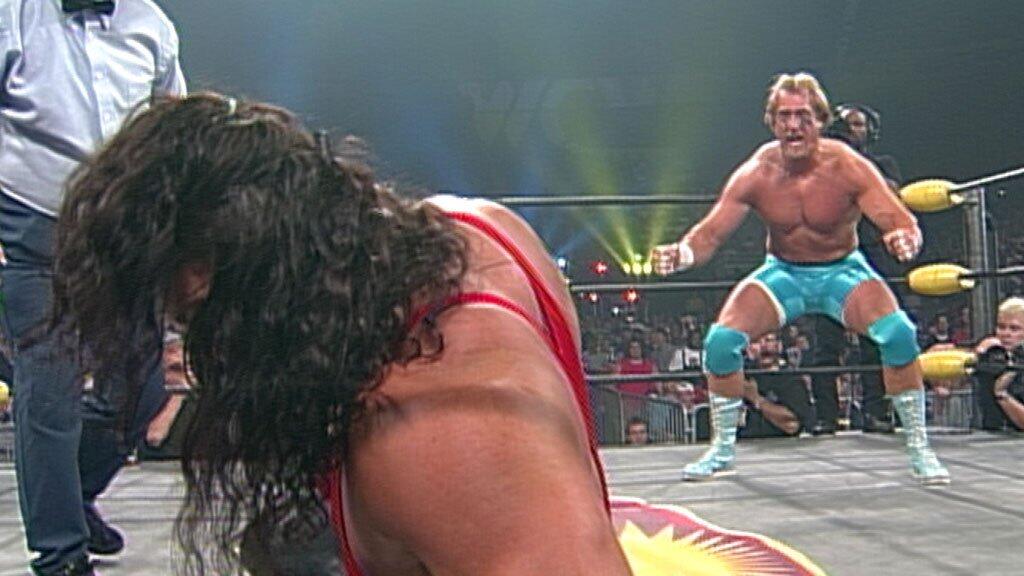
On May 18, 1997, Ric Flair returned to the ring in Charlotte, North Carolina, and for one night WCW stopped feeling like a company renting his legend and started feeling like a company built around it again.
That was the real weight of Slamboree 1997. Yes, it was another stop in the nWo era, with all the chaos, ego and backstage tension that came with that period. Yes, it was a pay-per-view built around a celebrity crossover, pairing Flair and Roddy Piper with Carolina Panthers star Kevin Greene against Scott Hall, Kevin Nash and Syxx. But the reason the night still matters is simpler than that.
Flair had been gone. He had been hurt. He was 48 years old. And when he finally walked back into a ring in his home territory, the building reacted like wrestling history had come back through the curtain.
Why Flair's return hit so hard
Flair had been out for eight months after suffering a torn rotator cuff in Japan. In pure wrestling terms, that was already significant. Flair was not just another veteran coming back for a nostalgia pop. He was a performer whose whole identity depended on movement, timing, rhythm and crowd control. Shoulder surgery at 48 was not some minor obstacle. It raised a very real question about whether the version of Ric Flair that fans remembered could still exist.
That uncertainty is what gave the return its charge.
By the spring of 1997, WCW was red hot commercially, but it was also becoming more and more defined by the nWo machine. The black-and-white invasion angle was huge business, but it could flatten everything around it. Flair was one of the few stars who could cut through that fog because he represented a different kind of wrestling power. He was not cool in the detached outsider sense. He was emotional, regional, theatrical and deeply tied to the Carolinas.
Slamboree brought that all back at once. Charlotte was not just another market for Flair. It was one of the places where his myth was built. So when he returned there, against the hottest heel act in wrestling, the match instantly meant more than a standard six-man tag ever should have.
A hometown main event with real stakes
The week's Wrestling Observer Newsletter treated the match as more than a sentimental comeback, and the numbers back that up. Slamboree drew 9,643 paid fans and a gate of $167,705, which made it the second biggest gate in Charlotte wrestling history at that point. Merchandise sales reportedly topped $100,000.
Those are not just nice details. They explain why this return mattered beyond applause.
Flair's comeback was business. WCW could still put the company on his shoulders in the Carolinas and expect the market to answer. That was a major statement in 1997, because this was not the same Flair who spent the 1980s wrestling 60-minute epics across the NWA map. He was older, more protected, and leaning on presence as much as pace. But presence counts in wrestling, especially when it is real enough to move tickets.
The match itself was built around exactly that truth. Flair did not need to work like 1989 Ric Flair for the night to succeed. He needed to feel like Ric Flair, the hometown hero back in the fight against the biggest threat WCW had ever created. Piper gave the match another layer of old-school star power, and Kevin Greene made the local connection even stronger. The nWo side, meanwhile, provided the perfect foil because they were designed to make every established WCW name look like a target.
When Flair ended the night on the winning side, the crowd got exactly what it came for.
What the match said about WCW in 1997
This is what makes Slamboree such an interesting historical marker. It showed both the best and the limitation of WCW at the same time.
At its best, the company understood that wrestling is not only about workrate or booking logic. It is also about emotional geography. Charlotte was Flair country. WCW knew it. The audience knew it. And by putting Flair's first match back in that building, the company created a main event that people were ready to invest in before the opening bell.
At the same time, the match also reflected a promotion that increasingly relied on star aura, celebrity attachment and political compromise to hold its top end together. Even in victory, the whole thing carried a slightly improvised quality that defined a lot of peak nWo-era WCW. The undercard was stronger bell to bell than the main event, but the main event was the attraction because of who Flair was and what his return meant.
That tension ran through the whole company in 1997. WCW had incredible in-ring depth, but its biggest emotional payoffs still often came from older stars, old rivalries and the pull of territory memory. Slamboree is one of the clearest examples.
Flair did not need to be prime Flair to matter
That may be the most important thing to remember about May 18, 1997.
People sometimes talk about later-period Flair through the narrow lens of whether he could still have a classic match on command. That misses the point. By 1997, Flair's greatness had changed shape. He was no longer carrying the same physical burden he had in his 30s, but he still knew how to turn a building into his stage and a comeback into a civic event.
That is a different kind of greatness, and in some ways a rarer one.
Plenty of wrestlers age into nostalgia acts. Very few age into symbols that still feel alive. Flair's return at Slamboree worked because the audience did not see him as a museum piece. It saw him as the person who embodied Charlotte wrestling, the man who could stand opposite the nWo and make the whole conflict feel personal.
He did not have to outwork Syxx or suddenly become young again. He had to make the moment feel big, local and worth caring about. He did all three.
The night WCW remembered one of its deepest strengths
WCW in 1997 is usually remembered through the broadest possible images: the nWo shirts, Sting in the rafters, Nitro winning the war, Goldberg waiting around the corner. All of that matters. But Slamboree is worth revisiting because it shows another truth about that era.
For all the talk about the future, WCW was still at its most powerful when it knew how to connect the present to the emotional memory of Southern wrestling.
Ric Flair's return on May 18 did not fix every contradiction in the company. It did not stop the politics. It did not reverse the growing habit of leaning too hard on spectacle. What it did do was remind everyone that when WCW put Flair in front of his people and let the occasion breathe, the promotion could still feel rooted, specific and impossible to fake.
That is why the night lasts.
Slamboree 1997 was not just Ric Flair wrestling again. It was Charlotte getting its guy back, WCW cashing in one of the strongest bonds it ever had with an audience, and a reminder that even in the middle of wrestling's wildest boom, some of the biggest reactions still came from history coming home.