
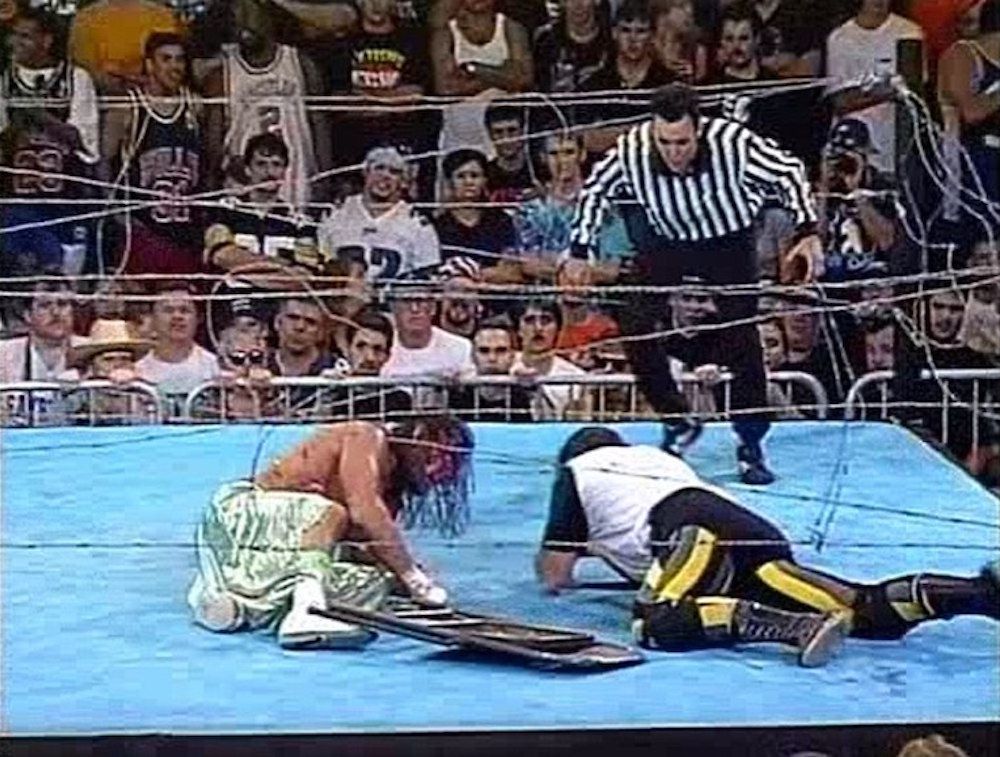
On August 9, 1997, ECW did not just stage another violent main event in South Philadelphia. It produced one of the matches that still gets talked about with a wince.
At Born to Be Wired, Sabu beat Terry Funk in a barbed wire match to win the ECW World Heavyweight Championship. That sentence is neat and orderly. The reality was anything but. By the time it ended, both men were covered in blood, the ring had become a trap, and the finish looked less like a clean piece of booking than two veterans dragging a crowd to the exact edge of what the promotion could sell as survival.
That was the strange genius of peak ECW. It was always trying to convince its audience that wrestling could feel more dangerous, more intimate, and more reckless than anything on national television. On this night, it succeeded so completely that the match almost stopped feeling like performance at all.
Born to Be Wired changed shape before the bell ever rang
The date matters because this was not the original grand plan for the month. Observer coverage at the time noted that ECW had reshuffled its lineup with Sandman unavailable, which pushed Sabu into the spot opposite Funk and altered the road to Hardcore Heaven a week later. In other words, the match was born partly out of necessity.
That kind of last-minute pivot was common in ECW, but this was more than a card shuffle. Funk was the reigning champion, the old master who could make chaos feel meaningful. Sabu was the promotion's human daredevil, the wrestler fans trusted to treat his own body like collateral damage. Put them in a ring surrounded by barbed wire, and the stipulation itself became the selling point.
It also fit the building. The ECW Arena was never about polish. It was about pressure, noise, sweat, and the sense that the audience was close enough to get hit by debris if things went wrong. A barbed wire title match in that room did not feel like a carnival attraction imported from somewhere else. It felt like the natural next step for a company that kept asking how much further it could go.
Sabu and Terry Funk made the violence impossible to ignore
The match is remembered for the injury, and there is no way around that. According to the Observer account, Sabu attempted one of his trademark chair-assisted attacks, Funk moved, and Sabu tore his arm badly enough that he reportedly needed 75 stitches backstage. Instead of stopping, he yelled for tape, patched himself up in the middle of the match, and kept going.
That image tells you almost everything about Sabu's mythology in one burst. He was never the smoothest talker or the cleanest technician. What made him feel singular was the willingness to turn pain into part of the spectacle without pausing to explain himself. He did not sell danger as an idea. He made it look immediate, then treated it like part of the job.
Funk, of course, was the perfect opponent for that kind of descent. He had spent decades understanding that a wild brawl only matters if the crowd believes the people inside it mean every second. Funk could look out of control while still guiding the emotion of a match. That is why so many of his bloodiest performances hold up. They are ugly, but they are not empty.
The finish sounded almost grotesque in its logic. With outside involvement from Rob Van Dam and retaliation from Tommy Dreamer, the match spiraled until Sabu and Funk were tangled together in the wire after a table spot. Sabu got the pin, but the image everyone remembers is what happened next. Officials had to use wire cutters to separate them.
That is the part that pushed the bout from merely notorious into wrestling folklore. Plenty of hardcore matches promise carnage. Very few leave behind the impression that the wrestlers and the match itself became physically inseparable by the end.
Why the title change mattered to ECW
The championship switch mattered for more than shock value. ECW had built its identity on convincing fans that emotional commitment mattered more than corporate gloss, and Sabu was one of the clearest expressions of that philosophy. Putting the title on him through a match this savage told the audience exactly what kind of promotion this was choosing to be in the second half of 1997.
It also gave Hardcore Heaven a different emotional center. Instead of simply moving forward with Terry Funk as the veteran champion, ECW turned the aftermath of August 9 into a fresh hook. The title was now attached to the man most associated with physical risk, and the path to the pay-per-view suddenly felt less stable and much more combustible.
There is another detail from the contemporary reporting that says a lot about how this match landed inside the business. The dressing room reportedly emptied to watch from the stage. That is a small thing on paper, but in wrestling it often signals respect. Not polite approval, real respect. The kind reserved for performers who have committed so fully to a main event that everyone else stops what they are doing to see the end.
That respect helps explain why this date still lives on, even in a promotion full of chaos, blood, and mythmaking. ECW had no shortage of violent spectacles. What made this one endure was that it felt like an extreme version of the company's entire self-image. Funk brought the old-school gravitas. Sabu brought the reckless physical sacrifice. The Arena gave them the right temperature. The result was a title change that felt less like a trophy exchange and more like an ordeal.
On paper, August 9, 1997 was a barbed wire match for the ECW championship. In memory, it became one of the clearest snapshots of what ECW wanted to be, a promotion willing to make beauty out of discomfort and turn its wildest instincts into history.