
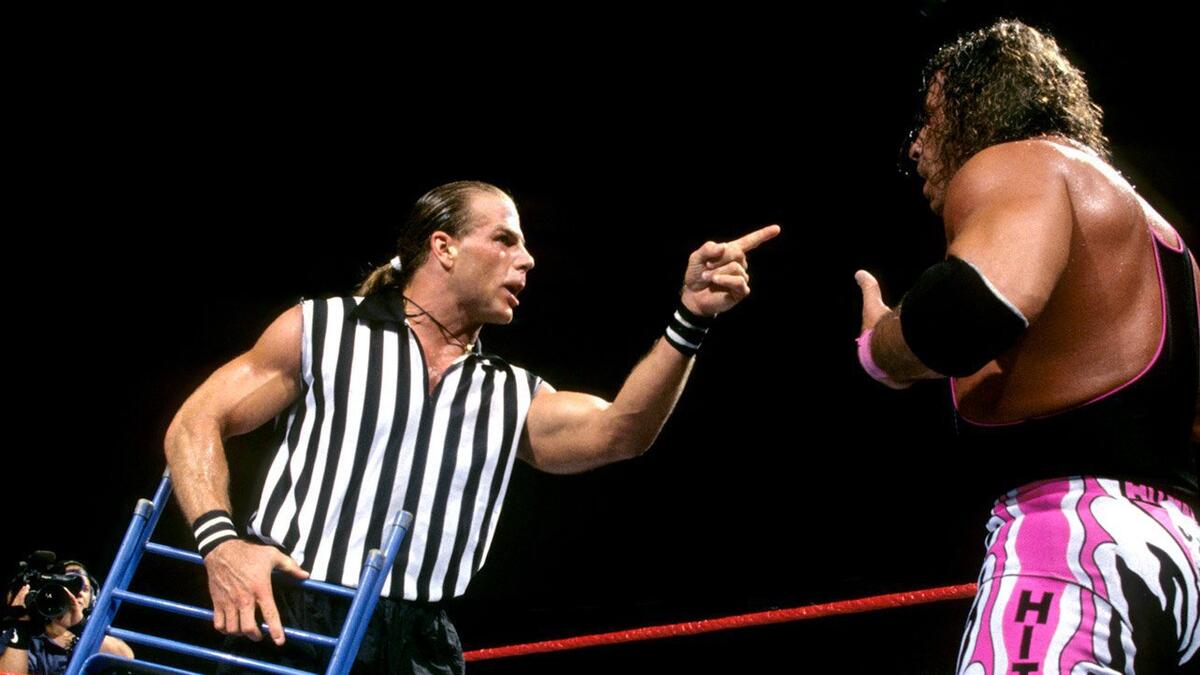
On August 3, 1997, WWF arrived at SummerSlam with the kind of momentum that made every major angle feel louder than life. Bret Hart was in the middle of his bitter U.S. versus Canada run. The Undertaker was the champion standing in his way. Shawn Michaels, who hated Bret enough to make the referee assignment feel dangerous before the bell ever rang, was placed right in the center of the main event. And Steve Austin, already becoming the hottest star in the company, was heading into a title match with Owen Hart that would take on a meaning nobody wanted.
By the end of the night in East Rutherford, Bret had the WWF Championship back for the fifth time, Michaels had become even more combustible, and Austin had suffered the neck injury that would follow him for the rest of his career. SummerSlam 1997 was sold as "Hart & Soul," and that turned out to be more fitting than WWF could have known. The show did not just advance a few feuds. It reset the shape of the promotion's biggest stories all at once.
Bret Hart finally got the belt back
The Bret Hart vs. Undertaker main event was built around distrust as much as the title itself. Bret had promised that if he failed to win the championship, he would never wrestle in the United States again. Michaels was ordered to call it down the middle, with his own future supposedly at stake if he showed favoritism. That was enough to give the match a constant edge before either man threw a punch.
When the finish came, it landed exactly where WWF wanted its drama, in the mess between Bret, Shawn and Undertaker. Michaels swung a steel chair at Bret, Bret moved, and Undertaker took the shot instead. Bret covered him and left with the WWF Championship. It was a simple finish on paper, but it had consequences everywhere. Bret got his crowning moment back after months of being framed as the angry anti-American villain. Undertaker had a ready-made grievance. Michaels now had another disaster tied to his name, except this time it happened in the middle of a world title match.
That mattered because Bret's 1997 run was never just about one belt. He was carrying the hottest political feud in the company, playing a hero in Canada and a villain in the United States, and WWF needed that character to feel powerful. Putting the championship back on him made the entire Hart Foundation story feel bigger. It also gave the company a volatile triangle at the top of the card with Bret, Undertaker and Michaels, which was exactly where WWF television was strongest that summer.
Steve Austin left with the Intercontinental title and a different future
If Bret's title win gave the show its ending, Austin's match with Owen Hart gave it its lasting shadow.
Austin challenged Owen for the Intercontinental Championship in one of the key matches on the card, and it should have been a showcase for a star who was exploding in popularity. Instead, Owen delivered a piledriver that dropped Austin badly, leaving him temporarily unable to feel his arms and legs. What followed was one of the grimmest moments ever seen in a major WWF match. Austin stayed in the bout, Owen stalled while trying to buy him time, and the planned finish had to be abandoned. Austin eventually managed a weak roll-up to win the title, then somehow stood long enough to raise the belt before getting to the back.
The visual of Austin surviving the match only made the moment more haunting in hindsight. He did not look triumphant. He looked like a man forcing himself through a fog because that was the only option he believed he had. In the short term, the scene added to the Stone Cold mythology. Fans saw a wrestler too stubborn to stay down, even after a terrifying injury. In the long term, it became one of the central turning points of his career.
Austin remained a massive star after SummerSlam, of course. In some ways he became even bigger. But the match with Owen hung over everything that followed. His in-ring style had to change. The neck damage never stopped mattering. When people talk about the cost of the Attitude Era's rise, this match is always near the front of the conversation for a reason.
One show, three huge consequences
What makes SummerSlam 1997 so memorable is that it captured WWF at the exact point where its major forces were colliding.
Bret Hart left as champion and as the centerpiece of the promotion's sharpest storyline. The Undertaker was pushed deeper into unfinished business with both Bret and Michaels. Michaels' role in the finish moved him closer to the selfish, chaotic version of himself that fit the company's changing tone. Austin, even in victory, came out of the night carrying the injury that would shape the rest of his run.
That is a lot for one pay-per-view to hold, and it is why the event still feels larger than its match list. SummerSlam 1997 was not a perfect show bell to bell. Even at the time, it drew mixed reactions as a full event. But wrestling history is not only built on perfect cards. Sometimes it is built on nights when the stakes were real enough, the stars were hot enough, and the aftermath was heavy enough that the whole business seems to tilt.
This was one of those nights.
The attendance, gate and merchandise numbers reflected how hot the company was becoming, but the bigger story sat in the ring itself. Bret Hart walked out with the WWF Championship. Shawn Michaels walked out with even more enemies. Steve Austin walked out hurt, and the industry would spend years feeling the consequences of that.
That is why August 3, 1997 still stands as one of the most important SummerSlam dates WWF ever produced. It was a title change, an injury scare, a character pivot and a warning sign for the future, all before the Attitude Era had fully hit its peak.