
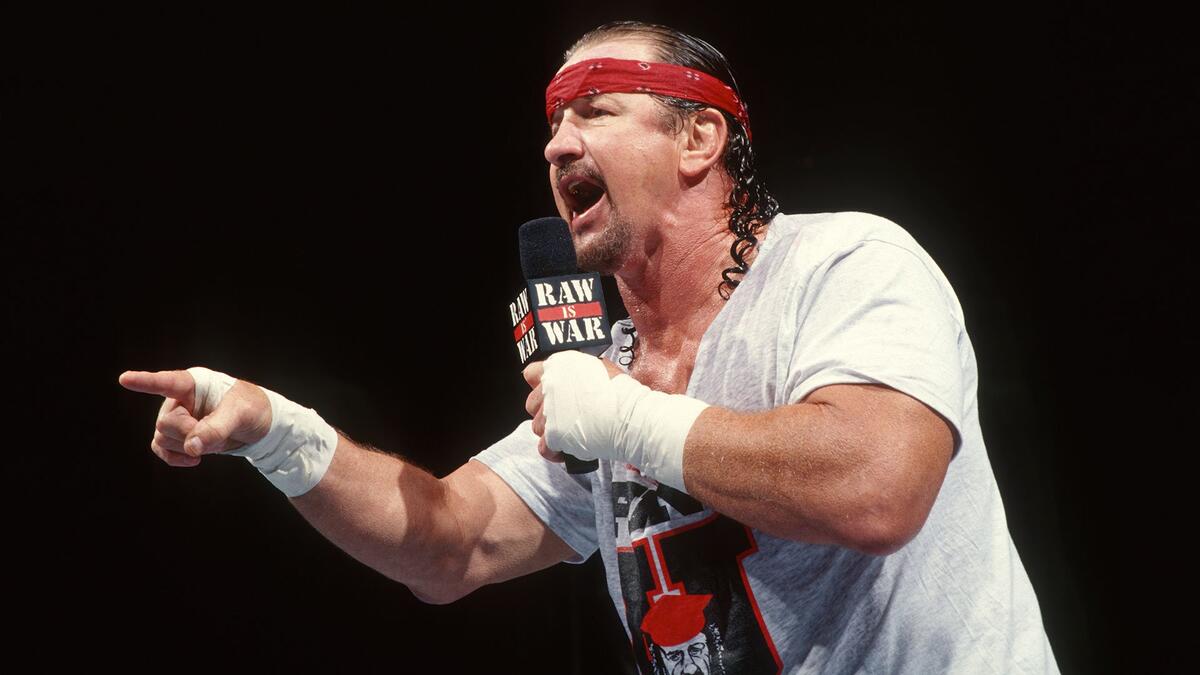
On May 10, 1997, Terry Funk walked into the ECW Arena with the world title, three dangerous challengers, and a company that still needed to prove its biggest moment was not a one-night burst of adrenaline.
He walked out with the championship still around his waist.
That result mattered more than it might look on paper. By the spring of 1997, ECW had already built a cult identity around violence, urgency and anti-establishment energy, but the promotion was still living week to week. Barely Legal had given it a pay-per-view breakthrough in April. What came next was the harder part. ECW had to show that its world title scene could keep feeling important once the novelty of the first PPV wore off.
That is where Funk came in.
By then, Funk was already a legend several times over, a former NWA world champion, a master of chaos, and somehow still willing to throw himself into the kind of fight younger wrestlers often hesitated to take. He was 52 years old on the eve of his 53rd birthday year, and he did not carry himself like a nostalgia act. In ECW, he felt like a bridge between wrestling's older blood-and-fire tradition and the louder, meaner revolution happening in Philadelphia.
Chapter 2 on May 10 was an ideal setting for that role. The ECW Arena was packed with roughly 1,100 fans, the kind of loud sellout crowd that turned the building into its own character. The undercard was a full ECW mix of violence, storyline escalation and last-second instability. Bam Bam Bigelow returned and aligned with Shane Douglas. Tommy Dreamer beat Louie Spicolli, only for Beulah McGillicutty to be left needing help after the match. Taz and Chris Candido beat Sabu and Rob Van Dam in another sharp reminder that nobody in the company got a quiet night.
By the time the main event arrived, the atmosphere was exactly what ECW wanted, tense, restless and ready for a finish that felt like it could slide in any direction.
Funk had to defend the ECW World Heavyweight Championship against Raven, The Sandman and Stevie Richards in a four-way dance, and that line-up captured almost every strain of the promotion at once. Raven was still one of the defining dark figures of the company, the brooding manipulator around whom so much of ECW's emotional misery had revolved. Sandman was the promotion's bruised folk hero, a brawler who always felt one beer can away from total anarchy. Richards, meanwhile, had grown from comic relief sidekick into something more complicated, especially once the Blue World Order act connected with fans in a way few expected.
Funk was the veteran champion in the middle of all of that, and he had to do more than just survive. He had to keep the whole mess feeling coherent.
That is the hidden skill of great veteran title reigns in chaotic promotions. The champion is not just there to win. He is there to make every rival seem dangerous, every near fall feel believable, and every detour around the ring feel like part of a bigger storm instead of random noise. Funk had spent decades learning how to do exactly that.
The finish told the story of ECW in miniature. Raven was eliminated first. Sandman did enough damage to look like he could bulldoze the match into his own kind of fight. Richards hung around longer than many would have predicted, and that was important. Reports from the time described him, even while working through a broken nose suffered the previous week, as having one of the strongest performances of his career. The crowd reportedly wanted to believe in him by the end.
Then Funk did what champions of his kind are supposed to do. He stayed alive through the disorder, weathered the younger chaos around him, and pinned Richards to retain the title.
That pin was not just the end of the match. It was ECW making a statement about who it wanted to be in the months after Barely Legal.
Funk's reign gave the company credibility at exactly the right moment. ECW was never trying to look polished in the corporate sense, but it still needed a champion who made the title feel like something bigger than an accessory in a brawl. Funk gave it that. He was wild enough for the room, respected enough for the role, and smart enough to let the younger stars around him rise without losing his own gravity.
That last part may be the most important thing about May 10, 1997. Funk retained, but the night was not built as a one-man monument. Richards came out of the match feeling more substantial. Sandman remained central to the promotion's emotional temperature. Raven still hovered over the title picture as a damaged ghost who never fully disappeared. Elsewhere on the card, Dreamer, Taz, Van Dam, Candido, Douglas and Bigelow all added more fuel to feuds that would keep ECW moving into the summer.
In other words, Funk held the top spot without freezing the rest of the roster beneath him. That was a huge part of why his 1997 ECW run worked so well.
There is also something fitting about the location. The ECW Arena was not a glamorous building, and that was the point. It was hot, loud, hostile and intimate, a place where fans did not politely observe wrestling so much as shove their will into it. Funk, for all his Texas legend status, understood that better than many wrestlers who were native to the ECW style. He did not enter that room acting above it. He sank into it. He bled with it. He made the crowd feel like its chaos was part of wrestling history rather than a rejection of it.
That is why this title defense still matters. Not because it was the most famous Terry Funk match, and not because it settled every ECW rivalry in one night. It matters because it showed how a truly great veteran can stabilize a promotion without sanding off its edges. ECW did not need a safe champion. It needed one tough enough and selfless enough to stand in the center of the storm and make the storm mean something.
On May 10, 1997, Terry Funk did exactly that.
He survived Raven, Sandman and Stevie Richards in Philadelphia, but more than that, he helped prove ECW's momentum was real. The company had already announced itself to the wrestling world. Keeping Funk on top through a night like Chapter 2 showed that the noise coming out of the Arena was not fading. It was only getting louder.