
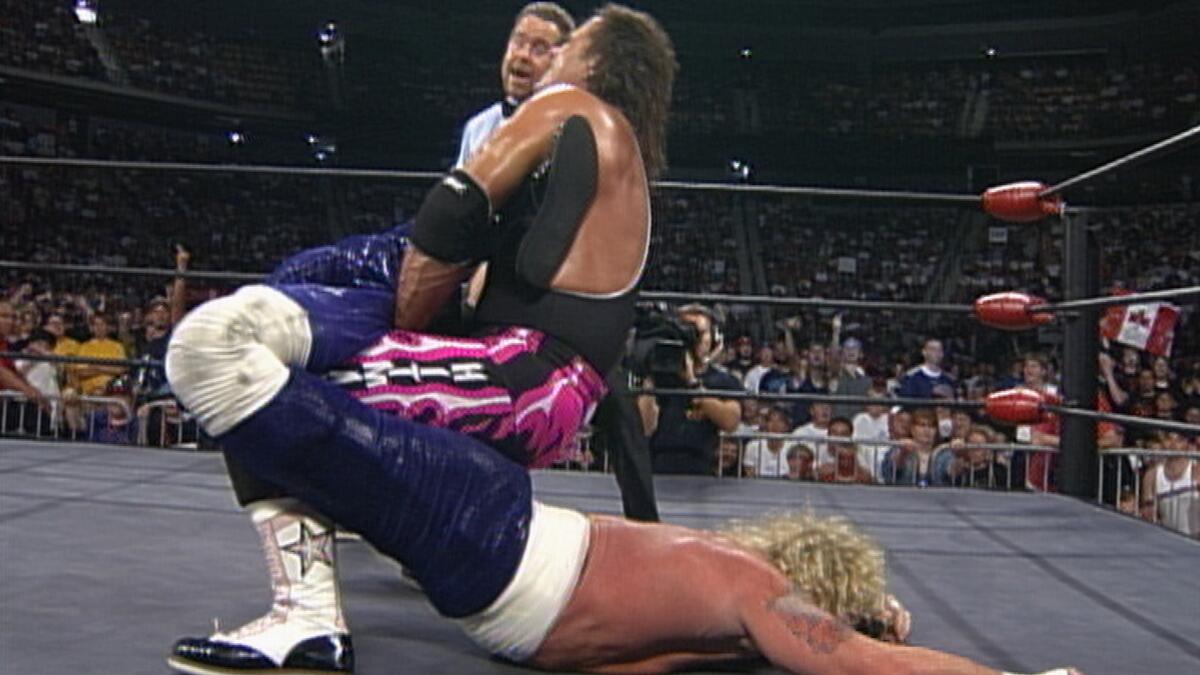
On July 20, 1998, WCW put two championship changes on one episode of Nitro and finally gave Bret Hart something tangible to hold onto. By the end of the night in Salt Lake City, Scott Hall and The Giant had taken the WCW World Tag Team titles from Sting and Kevin Nash, and Hart had beaten Diamond Dallas Page for the vacant United States title. In a company that often confused motion for progress, that combination actually meant something.
Hart's win mattered most. He had arrived in WCW at the end of 1997 with enormous expectations and almost immediately got lost in the noise. That was one of the strangest gaps in late 1990s wrestling. One of the best and most credible stars of his era had jumped companies after one of the most infamous exits the business had ever seen, yet his new promotion never seemed fully certain what it wanted him to be. He was too important to ignore, too established to rebuild from scratch, and too sharp a performer to use carelessly. So WCW did what WCW often did in that period. It drifted.
That is why July 20 stands out.
The U.S. title had been vacated after Goldberg's rapid rise to the WCW world championship earlier that month. Instead of treating the belt as an afterthought, Nitro used the opening to give Hart a real singles prize and a real singles moment. Beating Page for that championship did not suddenly fix WCW's creative contradictions, but it did give Hart his first WCW title and a much clearer place on the board. In a company full of factions, celebrity distractions and weekly swerves, that kind of clarity was valuable.
The matchup itself also says a lot about where WCW was in mid-1998. Page was one of the promotion's most organic success stories, a late-blooming star who had earned fan support through grit, personality and a sense that every climb mattered. Hart represented something different. He was elite from the moment he arrived, a wrestler whose reputation had already been cemented in world title programs, major pay-per-view main events and some of the smartest big-match work of the decade. Putting them together for the vacant U.S. title felt like WCW trying to make the middle of its card feel important again, not just the Hogan orbit above it.
Observer coverage from that week framed the Nitro as another wild chapter in a summer when WCW was still huge business even as the booking kept getting more unstable. That tension is a big part of why this date remains interesting. The company was hot enough to make almost anything feel major, but unstable enough that very little stayed settled for long. A title win on Nitro could feel like a step forward and a warning sign at the same time.
The earlier tag title change captured that same chaos. Hall and The Giant beating Sting and Nash was not just a switch of belts. It was another reminder that WCW in 1998 was built around shifting alliances, nWo splinters and star combinations that looked enormous on paper. Wolfpac and Hollywood were still playing tug-of-war with the promotion's top stars, and the belts moved inside that storm. On one level it kept the show lively. On another, it showed how hard it was for WCW to let any division breathe without getting pulled back into faction warfare.
Hart was especially vulnerable to that problem. He should have been one of the steadiest centerpieces in the company. Instead, much of his first WCW run felt like a search for the right lane. He could work with anyone, elevate almost any segment and make a title mean more just by holding it, but WCW rarely gave him a clean runway. The July 20 title win did not solve that larger issue. What it did do was briefly cut through the clutter. For one night, Hart was not just another major name in the mix. He was a champion with a defined role.
That role mattered because the U.S. title still carried weight when treated seriously. In WCW it had long been the belt that connected the main event to the wrestlers right below it, the championship that could make a rising star feel one great month away from something bigger. Hart did not need the belt to validate his career, obviously. The belt needed Hart. Putting it on him was one of the smarter symbolic decisions WCW made that summer because it suggested the company understood he could lend order and prestige to a division that needed both.
It also says something about Page that the match worked as the right vehicle for the moment. He was already credible enough that beating him meant something immediately. Hart was not handed a hollow win over a placeholder. He beat a wrestler the audience cared about, and that gave the title change more heft than a bracket final or a random television shortcut would have.
In hindsight, that may be the most revealing part of July 20, 1998. WCW still had all the ingredients. Hart, Page, Sting, Nash, Hall, The Giant, Goldberg waiting above the U.S. picture, and a crowd hot enough to make every title change feel like a real event. The problem was never a lack of star power. It was the promotion's inability to stay disciplined long enough to turn nights like this into lasting direction.
Even so, this Nitro deserves to be remembered. Hart's first WCW championship was not the peak of his run, and nobody would argue it became the foundation for a fully coherent second act. But it was a real moment, and in the middle of one of wrestling's loudest eras, real moments counted. For a few hours, WCW made Bret Hart feel central, made the U.S. title feel important and reminded viewers that Monday nights could still turn on one finish.
On this day in 1998, Bret Hart finally got his first piece of WCW gold. In a promotion that too often buried its own best ideas under noise, that alone was worth remembering.