
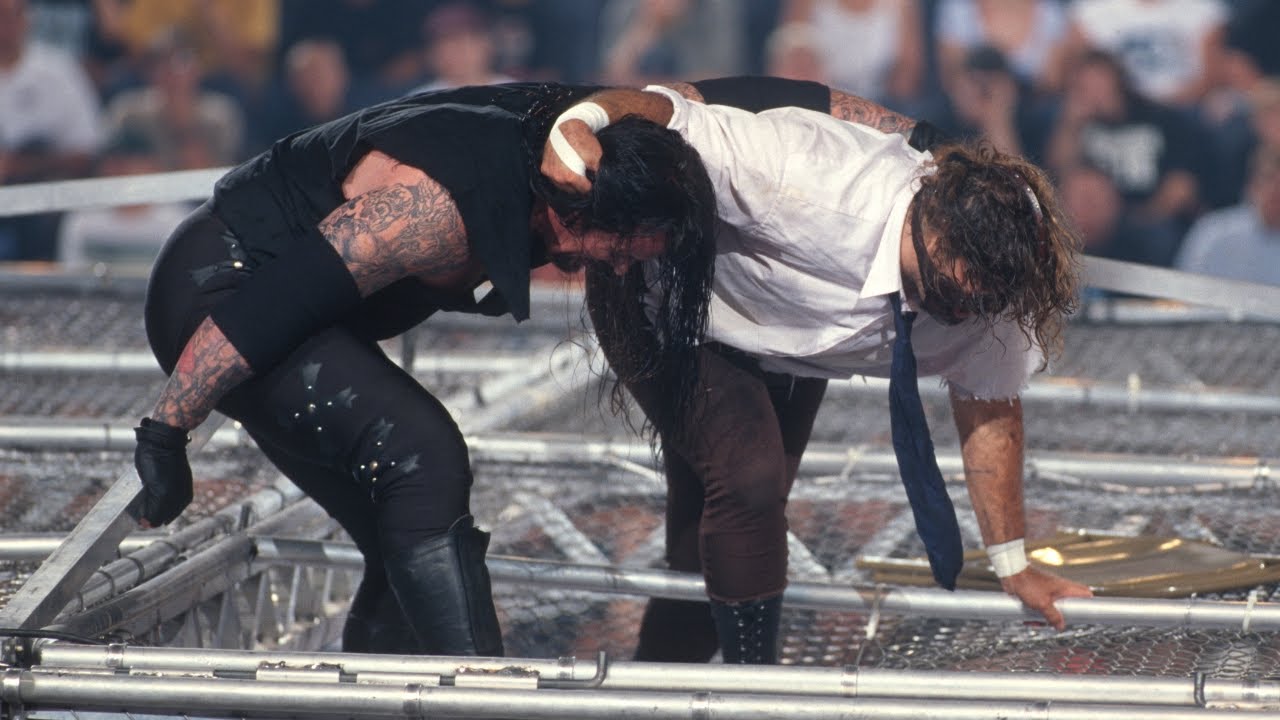
On June 28, 1998, The Undertaker and Mankind took a stipulation that was still new, still mysterious, and turned it into one of the defining images in wrestling history.
Hell in a Cell had only existed on pay-per-view for less than a year when the two met at King of the Ring in Pittsburgh. It was already supposed to be the match fans remembered from the card. What nobody could have fully expected was that it would become the kind of spectacle that lives on far beyond the era that produced it.
The match is still replayed because of the falls, and fairly so. But reducing it to shock value misses why June 28 still matters. This was not just a daredevil stunt show. It was the night Mick Foley cemented his legend, the night The Undertaker became the perfect monster for that legend to be built against, and the night Hell in a Cell stopped being just another gimmick and became a standard for wrestling excess that later generations have spent decades chasing.
The rivalry already had history behind it. Foley's Mankind and Undertaker had been circling each other since 1996, working through boiler room fights, buried alive chaos, and the kind of dark WWF storytelling that fit both characters. By the summer of 1998, the promotion had shifted fully into the Attitude Era, where violence was louder, pacing was faster, and the pressure to create unforgettable television kept rising. Putting these two inside the cell felt like the logical next step.
Instead, it became something much bigger than a next step.
The match famously began on top of the structure. That alone gave it a different kind of tension. The cage was no longer just a wall around the ring. It was the stage. Within minutes, Undertaker sent Mankind off the roof and through the Spanish announce table below. It is one of the most famous bumps in wrestling history because it still looks impossible. Foley did not take a dramatic tumble that felt safely choreographed. He seemed to vanish into open space, then crash in a way that made the entire match feel as if it had broken free of normal wrestling logic.
A lot of legendary spots lose force with repetition. This one never really has. You can know it is coming and still feel your stomach drop.
That first fall alone would have been enough to define the night. Instead, the match found another level of danger when Undertaker chokeslammed Mankind through the roof of the cell and into the ring. That moment was less clean, less cinematic, and in some ways more disturbing. The roof gave way awkwardly. The landing looked wrong. The violence stopped feeling theatrical and started feeling frightening.
Contemporary Observer coverage made clear just how battered Foley was afterward. He suffered a dislocated jaw, teeth were knocked loose, and he was taken to the hospital after the show. That detail matters because it explains why the match has always inspired two reactions at once. Fans remember the awe, but there has always been discomfort mixed in with the admiration. Even in the moment, this was not violence people could shrug off as routine.
That tension is part of what made the match historic.
Foley had long been respected as someone willing to endure punishment that few wrestlers would even consider. June 28 turned that reputation into immortality. He was no longer just a cult favorite or a beloved eccentric with a gift for chaos. He became the man tied forever to the most replayed act of self-destruction in modern American wrestling. There is a cost to that legacy, and Foley has spent years talking about it, but there is no denying how completely it fixed his place in wrestling memory.
Undertaker's role can get overshadowed because Foley absorbed the punishment, but the match does not become myth without him. Undertaker had the presence, the timing, and the credibility to make every moment feel enormous. He was not merely the opponent standing across the ring. He was the looming force that gave the whole performance its shape. Against almost anyone else, the match could have become mindless stunt escalation. With Undertaker, it felt like a violent descent into something bigger than a normal feud.
That is why the bout changed the stipulation itself. Before this, Hell in a Cell was a brutal cage concept with clear dramatic upside. After this, it became a symbol of wrestling at its most extreme. Every later cell match had to deal with the shadow of June 28, 1998, whether by trying to top it, trying to avoid its excess, or quietly admitting that it could never be matched. The standard became almost unfair overnight.
It also changed how fans talked about risk in wrestling. There had always been dangerous matches, dangerous wrestlers, and dangerous promotions. But this happened on a major WWF pay-per-view, in front of a massive audience, with clips that would be shown again and again for years. It was not a legend that spread through tape trading alone. It became part of the mainstream memory of the boom period.
That is a big reason the match still resonates even with people who were not watching live. It is one of those moments that escaped the usual boundaries of wrestling fandom. If someone knows one Mick Foley moment, it is probably this one. If someone needs a single example of Attitude Era excess, this is near the top of the list.
June 28, 1998 also endures because the match was more than its two terrifying highlights. Once it settled back into the ring, Undertaker and Mankind still had to finish an actual bout. They did, and they did it in a way that preserved the match as a contest instead of letting it collapse into pure shock. Undertaker won, but the finish almost feels secondary compared to the larger point. The real result was that both men left the arena attached to a piece of wrestling history that would outlast almost every title change and storyline from that summer.
On this day, Hell in a Cell stopped being just a stipulation and became folklore. Undertaker and Mankind did not simply have a famous match in Pittsburgh. They created the image that every future version of the cell would be measured against, and they did it at a physical cost that still makes the footage hard to watch all these years later.