
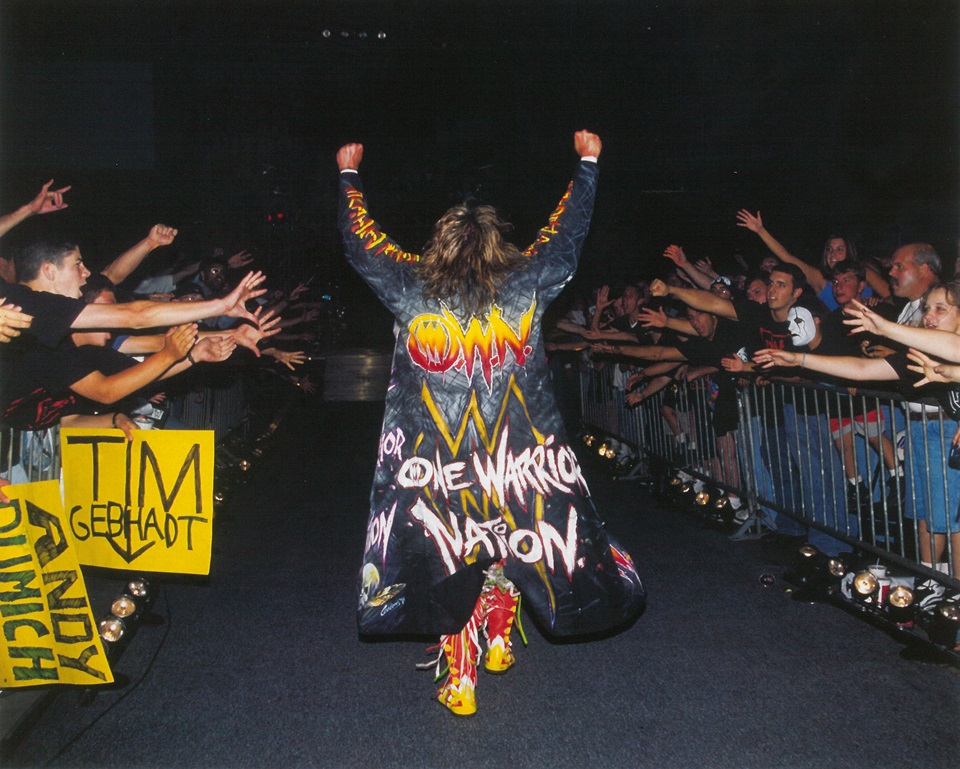
On August 17, 1998, WCW got exactly what it wanted from Warrior's debut on Monday Nitro. It got noise. It got curiosity. It got one of those live-crowd explosions that makes a wrestling company feel bulletproof for a few minutes. And, for one night at least, it got a serious edge in the Monday Night War.
That part of the story is easy to understand. By the summer of 1998, WCW was no longer the sleek machine that had steamrolled past WWF for 83 straight weeks. Goldberg was red hot, but the rest of the company was already showing the strain of trying to win every week by throwing one more surprise at the wall. Hogan was still a giant star, but he was also a symbol of an older era. So when WCW reached for Warrior, Hogan's old WrestleMania VI rival, it was trying to summon a memory as much as a man.
For one Nitro in Hartford, Connecticut, that memory worked.
Why the debut landed so hard
The first thing that made the moment feel big was the secrecy around it. WCW had not spent weeks hammering viewers with glossy advance promotion. Legal wrangling over the Warrior name and presentation kept the company from fully selling the return the way it normally would have. That uncertainty helped create the right kind of chaos. Fans had heard the rumours, the local crowd expected something, and the segment still landed with the kind of jolt that only comes when wrestling lets anticipation do some of the work.
When Warrior finally appeared opposite Hogan and Eric Bischoff, Nitro immediately felt bigger than its own weekly format. According to the Wrestling Observer Newsletter's reporting at the time, the segment drew one of the five biggest head-to-head quarter hours in Monday night history, pulling 4.712 million homes and crushing the portion of Raw airing against it. That was the number WCW wanted. It proved there was still real value in the name, still real curiosity about the old icon, and still a real appetite for seeing one more chapter in a feud fans remembered from the peak of both men's fame.
It also helped that the setting made the whole thing feel like a shot across enemy lines. Hartford was hardly neutral territory in the war between WCW and WWF. Nitro was running in the middle of WWF country, on a night when Raw had plenty of promotion behind it, and Warrior still managed to tilt the conversation. For a promotion that lived on symbolism in the Monday Night War, that mattered almost as much as the rating.
The segment that exposed WCW's weakness
The trouble is that the debut did not just create excitement. It also exposed the exact creative problems that were eating away at WCW in 1998.
Warrior's arrival should have been simple. Hogan talks too big, an old rival appears, the crowd roars, and the company spends the next two months building toward a blockbuster match. Instead, the segment drifted. Warrior talked for too long. The promo became more about the strangeness of Warrior being Warrior than about creating a sharp, urgent reason to watch next week. By the end of it, the reaction was still strong, but the warning signs were already there.
Even worse, the segment undercut other pieces of the show while it was happening. Diamond Dallas Page had earlier tried to frame the mystery arrival as his answer to Hogan, only for Warrior's own words to brush that aside. Hogan was meant to look threatened, but the scene also made the eventual singles match feel oddly secondary, because Warrior treated beating Hogan as if it were old business rather than a mountain still left to climb. That was classic late-period WCW. A huge angle would happen, and within minutes parts of the company would start stepping on their own setup.
The show itself bent around the debut in ways that were hard to miss. Timing shifted. Other material had to be shortened. The main event rhythm got thrown off. What should have felt like a carefully placed masterstroke instead felt like WCW landing a bomb and then scrambling through the smoke.
One giant rating, one short runway
That is what makes August 17, 1998 such a fascinating date to revisit. Warrior's debut was not a flop on arrival. Far from it. For one night, it succeeded in the most important short-term ways possible. It drew a huge reaction, delivered a major quarter-hour win, and reminded everyone that old-school star power could still move numbers in a hurry.
But the debut also showed how little margin WCW had left. The company was increasingly built to chase impact instead of sustain momentum. Bringing in Warrior was a move rooted in nostalgia, spectacle and war-with-WWF symbolism. Those things could still pop a rating. They could not, by themselves, solve the deeper problems in the booking.
That is why the moment feels so revealing in hindsight. Warrior did his job that night. He made the building buzz. He made viewers stop flipping channels. He made Nitro feel dangerous again for a few minutes. What WCW could not do was turn that jolt into a story with the same force as the entrance.
In that sense, August 17 was both a success and a warning. It was proof that WCW still knew how to create a wrestling moment people had to see live. It was also proof that the company had become too unstable to trust itself with the aftermath.
Warrior's WCW run would not last long, and it would never come close to matching the size of the debut. But the debut itself remains an important piece of Monday Night War history because it captured late-1998 WCW in one scene. The company was still powerful enough to create a national talking point with one surprise appearance. It was just no longer disciplined enough to make that talking point carry the company forward.
That is the real memory of the night. Not just that Warrior arrived, and not just that Nitro won big for a quarter hour. It is that WCW found one more burst of electricity from the past, then immediately showed why electricity alone was no longer enough.