
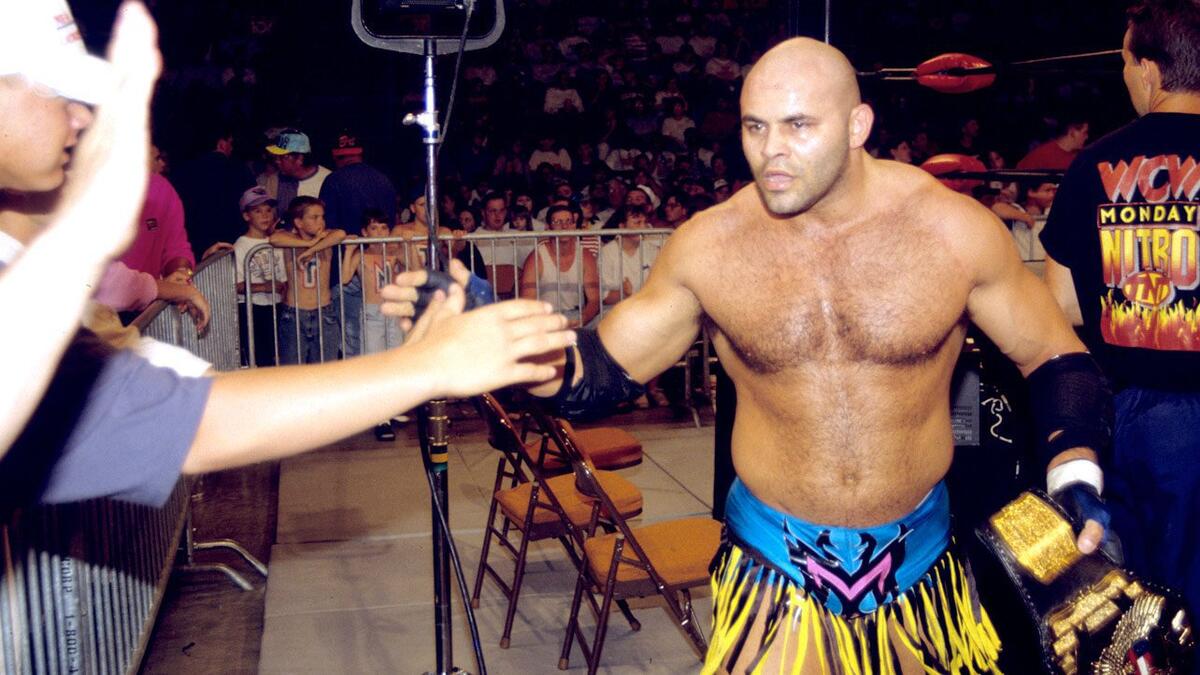
On May 4, 1998, WCW took the biggest act of the Monday Night War, cracked it down the middle and briefly made it feel dangerous again.
That was the night the nWo stopped being one massive black-and-white blob and became a civil war. Hulk Hogan's side stayed in the familiar colors and posture of power. Kevin Nash's side went red and black, brought Randy Savage and Konnan with it, and gave WCW a new identity to sell at exactly the moment the company needed fresh heat.
It is easy now to remember the Wolfpac mostly through shirts, catchphrases and nostalgia compilations. In the moment, though, the split mattered because the original nWo formula was losing some of its shock. The group had changed wrestling when it first arrived, but by spring 1998 it had grown bloated, repetitive and too comfortable at the center of everything. WCW still had stars. It still had momentum. What it needed was a new shape for its biggest storyline.
May 4 gave it one.
As reported in the Wrestling Observer Newsletter at the time, Nitro that night in Indianapolis drew a sellout crowd of 14,033, and the show formally presented the red nWo Wolfpac as Nash's answer to Hogan's grip on the faction. The idea had been teased in the previous week, but May 4 was when the split became real on television, with the new group framed as a separate power center instead of just restless members sniping from within.
That distinction is why the date holds up.
Wrestling history is full of angles that are announced one week and forgotten the next. This was not one of those. The Wolfpac had a look, a sound and a purpose immediately. The red logo on black shirts did not feel like a minor cosmetic tweak. It was a visual declaration that fans were being asked to choose sides inside a story they already understood. Hogan's version of the nWo was still the corporate, controlling supergroup built around paranoia and dominance. Nash's side felt looser, cooler and, crucially, easier to cheer.
That part was not an accident. WCW had spent so long pushing the nWo as the center of the universe that the audience had already learned to enjoy the group's swagger. Splitting the faction let the company keep that cool factor while redirecting fan energy away from Hogan's stale orbit and toward something that felt more rebellious. The Wolfpac were not clean-cut heroes, and that was the point. They were anti-heroes, the guys who still broke rules but seemed to be breaking them against the bigger bullies.
Konnan's place in that first version of the group is a big reason the act clicked as fast as it did. Nash and Savage brought star power, but Konnan gave the Wolfpac texture. He had credibility from years as a top draw in Mexico, a distinct voice on the microphone and a style that made the act feel less like another reshuffle of the same old main event names. Once he was in that spot, he was no longer just another talented piece on the undercard. He was part of the hottest presentation in the company.
That mattered for WCW beyond one night's angle. The Wolfpac gave the promotion a bridge between different parts of its roster and audience. Nash was a main event giant. Savage was chaos in human form. Konnan had his own connection with younger fans, lucha fans and the part of the audience that wanted something more modern in tone. Put together, they felt less polished than Hogan's camp and more alive because of it.
The timing also helped. WCW in mid-1998 was not yet in total collapse. Goldberg was rising. Sting still carried enormous presence. Crowds were hot for big moments. There was still room for an angle to catch fire nationally if it hit the right nerve. The Wolfpac did exactly that. Later coverage in the Observer's Konnan biography noted that by the middle of 1998, the group had become the hottest thing in the promotion and its shirts were the company's best sellers. That does not happen just because a logo changes color. It happens when fans feel the shift.
And they did.
The Wolfpac also gave WCW one of the last times it genuinely felt plugged into pop instinct instead of just repeating its own formulas. The company understood that audiences did not want the nWo to disappear yet, but they were ready to stop seeing the same version of it monopolize the screen. The split turned internal tension into a consumer choice. Black and white or red and black. Hogan or Nash. Old nWo or new nWo. It was simple enough for casual viewers to get in seconds and broad enough to power months of TV.
Of course, the long-term picture is messier. The nWo concept had already been stretched too far, and splitting it did not solve every structural problem inside WCW. The promotion still leaned too hard on faction politics. The booking still swerved in circles too often. In hindsight, the Wolfpac can look like one of the last brilliant paint jobs on a machine that was already starting to shake apart.
But that does not make May 4 any less important. If anything, it sharpens the point.
For a while, the Wolfpac split worked because it gave WCW back a sense of motion. It created one of the era's defining pieces of iconography. It refreshed Nash. It elevated Konnan's presence. It gave fans a version of the nWo they could roar for without pretending Hogan had suddenly become the good guy. And it helped set the emotional backdrop for one of WCW's last truly white-hot stretches before the decline became impossible to stop.
There are bigger title changes in wrestling history. There are bloodier betrayals and more famous heel turns. But not every important date is about a belt or a bell. Some nights matter because a company finds a new pulse, even if only for a season.
On May 4, 1998, WCW found one in red and black.
For a few months after that, the Wolfpac felt like the coolest thing in wrestling.