
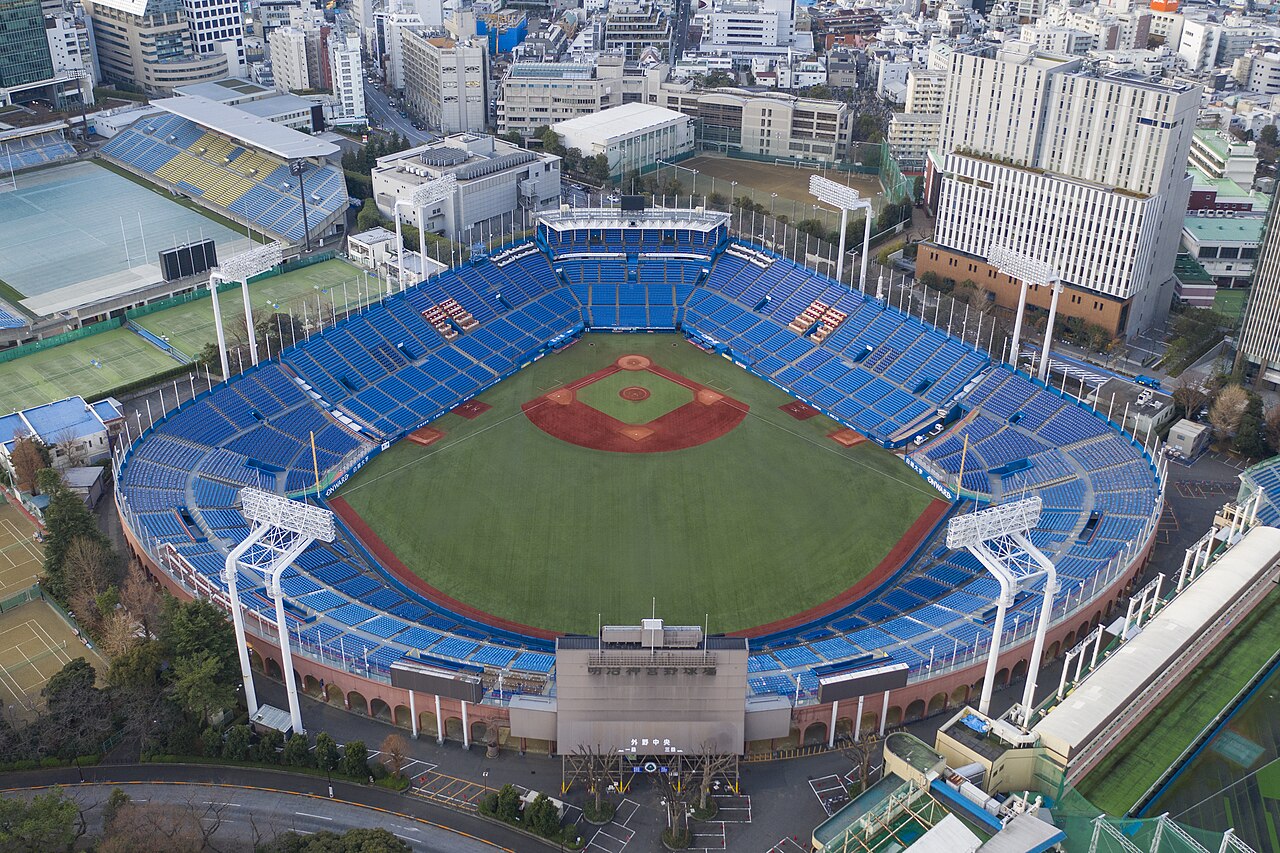
On August 28, 1999, New Japan Pro-Wrestling put one of the boldest cards in its history into the open air at Meiji Jingu Stadium and trusted spectacle to carry the night. The result was Battle of Last Summer, a show headlined by Great Muta against Great Nita in an exploding death match, and a night that drew an announced 48,000 fans to set a Tokyo outdoor attendance record for pro wrestling.
That number is still the first thing people remember, and for good reason. New Japan was not filling the Tokyo Dome here. It was filling a baseball stadium with a card that had star power, curiosity and a sense of danger, but also real uncertainty. The undercard was not considered especially strong, Nobuhiko Takada had already pulled out of a heavily promoted match with Kensuke Sasaki, and the promotion needed the Muta vs. Nita dream match to feel like a genuine event.
It worked.
In contemporary Observer coverage, the show came across as a major gamble that paid off at the box office even if regular fans were split on the in-ring results. That tension is part of what makes Battle of Last Summer worth revisiting. It was not simply a great card. It was a revealing card, one that showed how powerful image, myth and curiosity could be when attached to the right names.
Great Muta and Great Nita were built for this kind of collision
Keiji Muto's Great Muta persona had long been one of wrestling's most theatrical creations, a character that could move from big-match main event wrestling to something darker and more chaotic without losing its aura. Atsushi Onita's Great Nita was essentially a warped mirror of that idea, taking the visual excess and pushing it fully into death match territory.
Putting those two versions of wrestling spectacle into the same ring felt almost too perfect. It was not just a match between stars. It was a clash between two branches of Japanese wrestling excess, one born from Muta's charisma and one twisted through Onita's appetite for violent theater.
The stipulation matched the occasion. This was billed as a no rope explosive barbed wire barricade explosive land mine death match, the sort of concept that sounds impossible until you remember how much late-1990s Japanese wrestling could thrive on scale, noise and danger. Great Nita even arrived in a casket, because subtlety was never the point.
The match itself lasted 13 minutes and 32 seconds, with Muta ultimately defeating Nita after the explosions, weapons and chaos had run their course. By the end, Muta had taken control, scored the pin and effectively ended the Nita gimmick in the process. Even people who did not love the bout as a wrestling match could see the larger effect. It gave New Japan a stadium centerpiece people had to talk about.
The crowd mattered as much as the match
What makes August 28, 1999 stand out is that the attendance story was every bit as important as the finish. The announced 48,000 surpassed the previous Tokyo outdoor wrestling mark of 46,187, which had also been set at Jingu Stadium in 1993 for Nobuhiko Takada vs. Vader. Before that, the historic outdoor benchmark in Tokyo had been the famous Rikidozan vs. Lou Thesz meeting in 1957.
That is serious company. Battle of Last Summer was not just another big gate. It inserted itself into a very short list of outdoor wrestling events in Tokyo that meant something beyond the house count.
The timing made it even more remarkable. Tickets were not moving particularly fast in advance, and Takada's withdrawal damaged the card's original shape. New Japan reportedly spent the final stretch hoping for good weather and a strong walk-up crowd. The rain held off, the building filled and the promotion got the image it wanted, a packed stadium waiting for explosions.
That image mattered in 1999 because Japanese wrestling was crowded with major names, ambitious promotions and competing ideas of what a super show should be. New Japan decided that if the traditional card strength was not overwhelming, it could make up the difference by giving fans something they could not see anywhere else.
The rest of the card helped steady the night
Battle of Last Summer was not only the death match. The undercard had enough meaningful results to give the event some wrestling substance.
Shinjiro Otani and Tatsuhito Takaiwa retained the IWGP Junior Heavyweight Tag Team Championship against Jushin Liger and El Samurai in what was widely regarded as one of the strongest pure wrestling performances on the show. Kendo Kashin then defeated Koji Kanemoto to win the IWGP Junior Heavyweight Championship, the first singles title win of Kashin's career. Manabu Nakanishi and Yuji Nagata also captured the IWGP Tag Team Championship, another sign that New Japan was trying to build around a younger core while still leaning on established names at the top.
Even that mix tells you something about the night. The stadium show was selling spectacle in the main event, but the company was also trying to reshape its future underneath it. Battle of Last Summer sat in the middle of two impulses, New Japan as grand dramatic attraction and New Japan as promotion trying to refresh its roster hierarchy.
Why Battle of Last Summer still matters
The easiest way to remember this event is as the exploding barbed wire oddity where Great Muta fought Great Nita in a baseball stadium. That is true, but it undersells the point.
What really happened on August 28, 1999 was that New Japan proved it could turn a risky concept into a historic business success. The promotion lost a major advertised match, went into the night with weather concerns and relied on a main event that was more about fascination than technical excellence. It still filled the building and made the show feel important.
That says a lot about Muta's drawing power, Onita's ability to sell chaos and New Japan's instinct for presentation when it needed one unforgettable image. A packed Jingu Stadium watching explosions in the dark was never going to represent the whole of professional wrestling. It did not have to. It only had to capture a moment that felt too large to ignore.
That is why Battle of Last Summer remains one of the most memorable late-1990s Japanese supercards. Not because it was flawless, and not because every match delivered at the highest level, but because it showed how wrestling can become an event simply by convincing people that they might miss something singular if they stay home.
On that night in Tokyo, 48,000 people decided they were not going to miss it.