
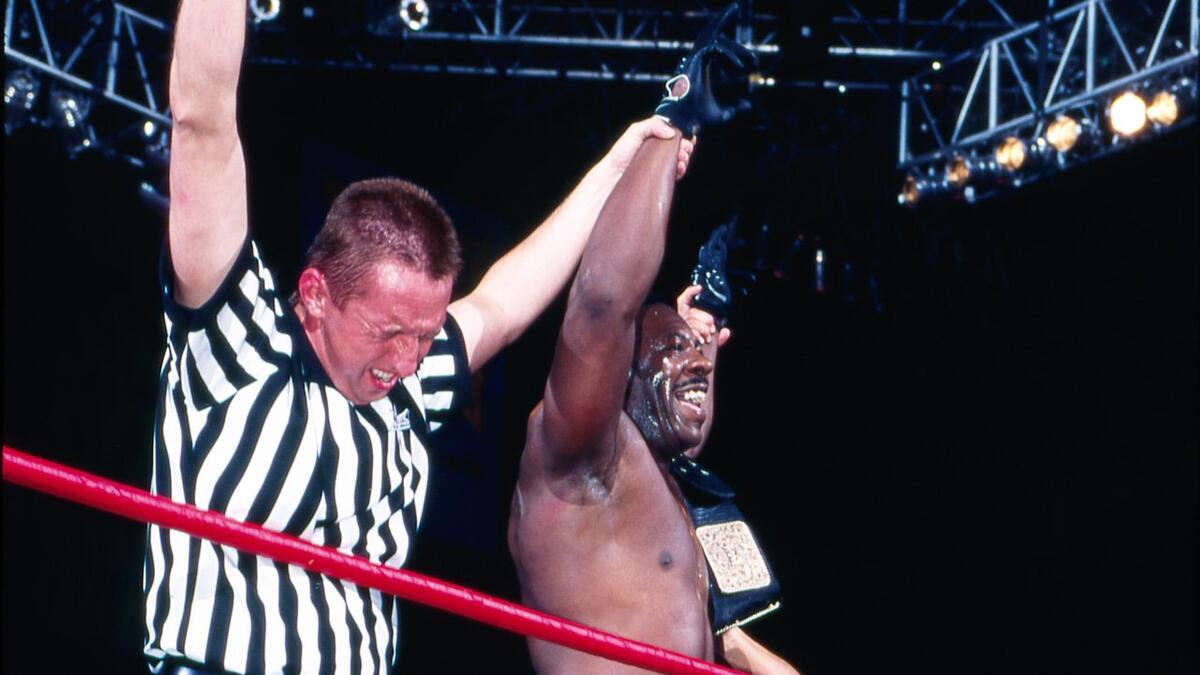
On July 9, 2000, WCW somehow produced two world title changes, a worked-shoot meltdown, and the first world championship win of Booker T's career, all in the same pay-per-view. That alone explains why Bash at the Beach 2000 still gets brought up a quarter century later. It was a night when the company tried to turn real backstage tension into television, and in the process buried the most important success story it had left.
Booker T defeating Jeff Jarrett for the WCW World Heavyweight Championship should have felt like a turning point. In one sense, it was. Booker had climbed from tag team specialist to one of the company's most reliable singles acts, and by the summer of 2000 he had the crowd support, athletic credibility, and star presence WCW badly needed. But the title win arrived only after Hulk Hogan and Jarrett had gone through a bizarre staged collapse, Vince Russo stormed back to the ring to torch Hogan on the microphone, and the whole promotion seemed to be daring fans to decide what was real and what was nonsense.
That tension is what makes July 9 so fascinating. Booker T reached the top on a night that should have been about him, but instead became a symbol of how far WCW had drifted from the things it did well.
Booker T won the belt in the middle of chaos
The pay-per-view in Daytona Beach is remembered first for the Hogan and Jarrett fiasco, and fairly enough. Hogan came out for his scheduled world title match, Russo ordered Jarrett to lie down, and Hogan pinned him with a foot on the chest after the belt was thrown into the ring. Jarrett got up and walked off. Hogan grabbed a microphone, blasted the situation, and left with the title belt in a scene that looked designed to blur the line between angle and argument.
Russo then returned to the ring and effectively declared that the championship Hogan had just taken was dead. He blasted Hogan, framed the whole thing around Hogan's political leverage, and ordered Jarrett back out to defend a replacement version of the world title against Booker T later that same night.
That left Booker with a nearly impossible job. He was asked to make sense of the biggest mess on the show and turn it into a real main event. The match with Jarrett was not a classic, but it did what it had to do. The announcers treated it like the championship still mattered. Booker and Jarrett worked through a nervous crowd and a lot of pressure, and Booker finally won with the uranage to claim his first WCW world title.
In cleaner circumstances, that would have been the whole story. Booker T, after years of climbing, had finally broken through. Instead, his coronation felt like the company trying to sprint away from its own wreckage.
Why Booker T still mattered to WCW
That is exactly why the title win still deserves attention.
By mid-2000, WCW was burning through ideas, authority figures, swerves, and insider references at an exhausting pace. Booker T was one of the few acts who did not need that clutter to connect. Fans believed him in the ring. He looked like somebody who belonged in big matches. He could work with heavyweights, keep up with faster opponents, and carry himself like a headliner without needing the show to stop and explain why he mattered.
The company had flirted with pushing him before, but July 9 was the moment it finally had to follow through. Even in the middle of all the nonsense, putting the belt on Booker made sense because he represented a future WCW should have committed to sooner. He was younger than the promotion's fading old guard, more credible than many of the stunt-booking ideas around him, and naturally popular in a way that could not be manufactured by another backstage-style promo.
That is the bittersweet part of the story. WCW accidentally made the correct call on the same night it made itself look ridiculous.
Bash at the Beach became a mirror of WCW's decline
The date carries extra sting because Bash at the Beach had once represented the opposite kind of moment for the company. Four years earlier, the same event hosted Hulk Hogan's heel turn and the birth of the nWo, one of the hottest angles wrestling had ever seen. On July 9, 2000, Bash at the Beach again felt historic, but for the wrong reason.
Instead of a bold creative breakthrough, fans got a company exposing every insecurity it had. The booking leaned on backstage politics. The commentary had to sell confusion as drama. The world title scene became less about who the best wrestler was and more about which executive or star had seized control of the segment. Even when the promotion landed on the right champion, it could not stop stepping on the moment.
That is why the show has lasted in wrestling memory. It was not just messy. It was revealing. WCW still had talented wrestlers, still had famous names, and still had an audience willing to react when given something worth caring about. What it lacked was the discipline to let a big moment stay simple.
Booker T winning the belt should have been simple. A deserving star beats the champion and begins a new chapter. Instead, fans had to process contract politics, a public burial, and a title scene that seemed to rewrite itself in real time.
Why July 9 still belongs to Booker T
For all the noise, the lasting image from the night should not only be Hogan leaving with the belt or Russo trying to turn scandal into television. It should also be Booker T finally getting his turn.
His first WCW world title win mattered because it proved he was more than a great hand or a tag team legend. He was good enough to carry a major promotion's top championship, and over the months that followed he kept proving it. In a company that often mistook shock for momentum, Booker offered something sturdier: a wrestler fans could actually believe in.
That is what keeps July 9, 2000 from being remembered only as a disaster. The show absolutely was a disaster in many ways, and history has every right to treat it as one of WCW's clearest signs of collapse. But tucked inside the confusion was a real achievement, and it belonged to Booker T.
Also on this date in the archive, Mayumi Ozaki defeated Dynamite Kansai in a violent JWP street fight in 1995, and Meiko Satomura beat Aja Kong on the debut show for Sendai Girls in 2006.
On this day in 2000, though, the story that still stands tallest is Booker T reaching the top while the ring shook around him. WCW could not get out of its own way, but for one night its future still managed to win the title anyway.