
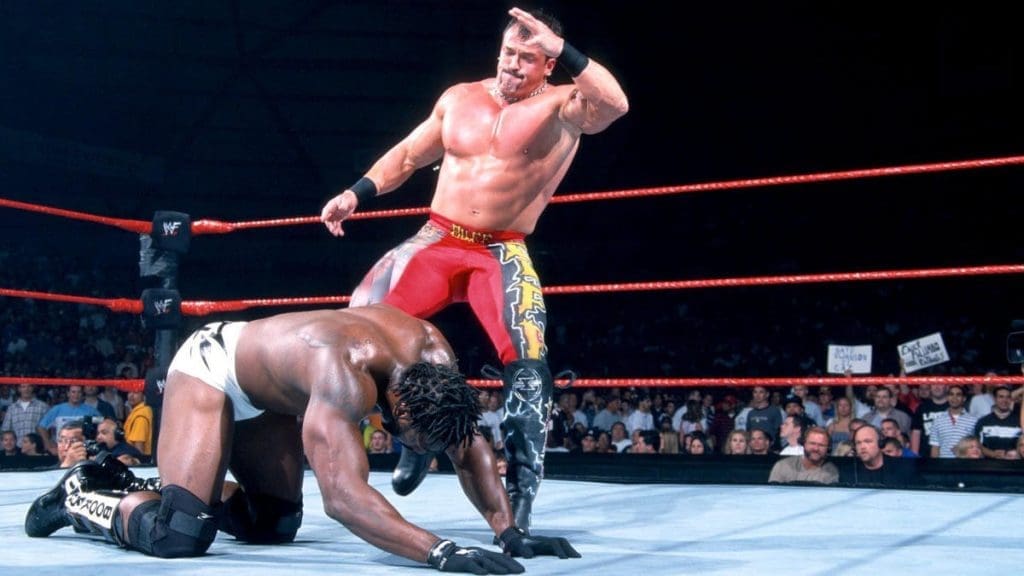
On July 2, 2001, World Championship Wrestling was supposed to feel alive again.
That was the promise behind Booker T defending the WCW Championship against Buff Bagwell in the main event of Raw from the Tacoma Dome. On paper, it looked like a bold move. Vince McMahon had bought WCW only a few months earlier, Shane McMahon was fronting the invading side on television, and the company was trying to convince fans that this was not just a few former rivals walking into a WWF ring. The idea was bigger than a single match. This was supposed to be the night WCW looked like a real national force again.
Instead, it became one of the clearest warning signs in modern wrestling history.
What happened in Tacoma was not simply that a match underperformed. Bad matches happen all the time, and major angles can survive them. The real problem was that the audience rejected the entire presentation before the match ever had a chance to win them over. Contemporary Observer coverage painted a brutal picture of the scene, with the crowd booing the setup, mocking the action, chanting for Goldberg, and then reacting more positively to Steve Austin and Kurt Angle crashing in than to anything WCW itself offered.
That response mattered because the company was not thinking small. The working plan in that period was to turn Raw into a WCW-branded show, complete with a fresh look, different announcing voices and a stronger separation between the two promotions. In theory, that was the only way the story could really work. If WCW was going to become a true second brand and not just a costume change, fans had to believe it had equal weight. Tacoma was the night that belief cracked in public.
Booker T was not the problem by himself. In fact, he was one of the few WCW names in the mix who felt credible enough to carry something important. He arrived as WCW champion and had the poise of a real star, even if he was still in the awkward position of representing a company that no longer actually existed. Bagwell, meanwhile, was cast in a role far larger than the moment could support. That alone put extra pressure on the main event, because the match was being asked to do more than entertain. It had to sell an entire business premise.
That is why the famous chants from that night still echo in the memory of wrestling fans. The boos, the "boring" chants, the cries for refunds, and the crowd drifting toward the exits were not just a verdict on one pairing. They were a verdict on the early invasion formula. WWF had framed WCW as the enemy for years, then suddenly asked its own audience to accept a thinner, incomplete version of that rival as a major attraction. Fans could feel the difference immediately.
There was another problem, too. The invasion angle was backwards in a way fans instinctively picked up on. The WCW side did not feel dangerous enough. It did not feel like an invading army that might actually take over. On that July 2 show, the biggest reactions came when Austin and Angle, the established WWF heels, stormed in and wrecked both WCW wrestlers. The invaders were supposed to look threatening. Instead, they looked vulnerable, outnumbered and second-rate. When the crowd cheers the home team's villains for humiliating the supposed outsiders, the story is telling on itself.
That made Booker T vs. Bagwell such an important date. The match did not kill the invasion on its own, and it would be unfair to put the weight of an entire creative failure on two wrestlers in one bad spot. But it exposed the central weakness of the whole project. This version of WCW was being presented as a historic threat without the depth, momentum or emotional credibility to feel like one. The company wanted a second Monday night war. The audience was seeing a rushed imitation of one.
It is easy now to treat Tacoma as a punchline, mostly because the footage is so uncomfortable and the larger invasion angle remains one of wrestling's great missed opportunities. But the night deserves more than mockery because it shows how fragile wrestling mythology really is. You cannot just announce that a war has resumed and expect people to feel it. Fans have to believe the sides matter. They have to believe the stars are real threats. They have to believe the promotion being revived still has an identity worth fearing or loving.
On July 2, 2001, the crowd made it clear they did not buy that version of WCW.
That is also what makes Booker T's place in the story a little tragic. He would go on to have a major run in WWE and eventually become a Hall of Famer, but on this night he was asked to carry the symbolism of an entire company during one of the most unstable creative pivots imaginable. He was not just working a main event. He was carrying the burden of making fans believe a ghost was still alive.
The aftermath is why the date endures. The invasion continued, the pay-per-view still happened, and there were pieces of the angle that worked. But Tacoma stands as the moment when the grandest version of the idea stopped feeling possible. Once the audience rejected the relaunch in real time, the ceiling lowered. The invasion could still produce moments, but it was much harder to imagine it becoming the full-scale brand war it had originally teased.
So when wrestling fans look back on July 2, 2001, they are not really remembering a no contest between Booker T and Buff Bagwell. They are remembering the night a crowd in Tacoma told the most powerful wrestling company in the world that it could not manufacture a second WCW just by putting the letters on Raw. For one night, the fantasy of reviving the Monday Night War ran headfirst into the truth, and the truth won.