
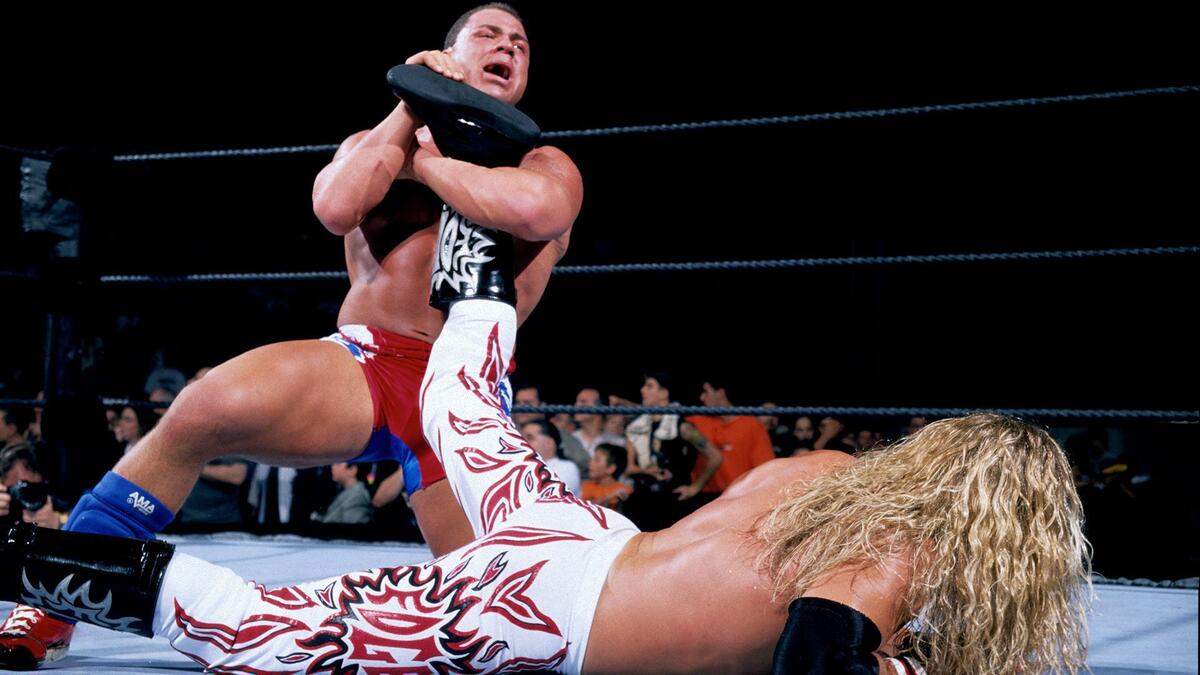
On June 24, 2001, Edge won the King of the Ring tournament in East Rutherford, New Jersey, and the crown ended up meaning more than the costume jewelry that came with it.
It was the night WWF finally treated him like something more than half of a great tag team act. Edge had already spent the previous two years proving himself in ladder matches, TLC wars and one of the deepest tag divisions the company ever had. What he had not fully done yet was step out of the shadow of Edge and Christian as a duo and look like a wrestler the company could build around on his own.
That changed at King of the Ring.
The timing mattered. By the summer of 2001, WWF was in a strange transitional moment. The Attitude Era stars were still everywhere, but the company was also trying to sort out who belonged in the next wave. Steve Austin was on top as champion. The Invasion angle was about to consume television. Tag wrestling was still hot, but singles stars were always the real currency at the top of the card. For a wrestler like Edge, that meant a tournament win could be more than a nice accolade. It could be a public signal.
Edge was not entering the show as the obvious favorite. The final four that night were Kurt Angle, Christian, Rhyno and Edge, which made the tournament bracket feel more like a battle of hard-edged heels than a coronation for a smiling underdog. Edge beat Rhyno in the semifinal after Rhyno missed the Gore, while Angle advanced by beating Christian with help from Shane McMahon. That set up a final that was as much about survival and timing as it was about clean athletic triumph.
Observer coverage of the event made clear that the tournament itself was not presented as the dominant story of the pay-per-view. Even so, the final carried a very specific kind of importance. Angle came in as the defending King of the Ring winner and the more established singles name. Edge came in as the wrestler still trying to prove he belonged in that company.
Their final reflected both realities. Angle threw Edge around and looked like the more complete singles performer for long stretches. Edge sold from underneath, took punishment, and kept the match moving toward the idea that he belonged on that stage even if he was not yet the finished product. The finish came after referee chaos and Shane McMahon interference, with Edge planting Angle with the Impaler DDT for the pin. It was messy, very WWF, and completely effective in the one way that mattered most. Edge won the tournament on June 24, 2001.
What makes the date worth revisiting is not that the final was the greatest King of the Ring match ever. It was not. What matters is what the win said about Edge's place in the company. For years, he and Christian had been inseparable in the minds of fans, brilliant as smug opportunists and even better as stunt-match specialists. Winning King of the Ring gave Edge his first major singles milestone that felt like more than an experiment.
That distinction is important because some tournament wins feel ornamental. This one did not. The 2001 show also featured Kurt Angle's violent street fight with Shane McMahon and the surprise arrival of Booker T, so Edge's moment had to fight for oxygen on a crowded night. In a way, that made it even more revealing. WWF still chose to put the crown on him. The company did not need to do that if it saw him only as a tag wrestler who could occasionally fill time in singles matches.
The audience already knew Edge could work. The question was whether he could carry a different sort of emotional investment without Christian next to him, without the wink of the five-second pose, and without a ladder under his feet. King of the Ring was the first strong proof that he could. He was still recognisably the same performer, fast, opportunistic, energetic, but there was a little more grit to him and a little more sense that fans could rally behind him rather than just enjoy the act.
Looking back now, the win reads as an early checkpoint on a much bigger career. Edge would go on to become a far more decorated singles star than anyone could have confidently promised in June 2001, but the important part is that the path becomes visible here. Before this, his upside was easy to describe in theory. After this, WWF had a concrete result it could point to.
It also helped that King of the Ring had real history behind it. Bret Hart, Owen Hart, Steve Austin, Triple H, Ken Shamrock, Billy Gunn and Kurt Angle had all won the tournament in previous years. Some benefited more than others, but the event still carried the idea that the winner was being marked for something bigger. Edge joining that list gave him a different kind of credibility overnight. He was no longer just one of the best parts of a loaded tag scene. He was a tournament winner in a company that still used those victories to define who mattered.
There is another reason June 24 stands up well as a historical marker. Edge's win came at a point when WWF needed fresh singles depth badly. The top of the card was strong, but the promotion's future depended on more than just the established names from the late 1990s. Edge was younger, different in style, and easier to imagine growing with the next version of the roster. He did not have to become Austin or Rock. He just had to become unmistakably himself.
That is what this win started to do. It was not a final arrival, and it was not supposed to be. It was the kind of victory that told fans and management the same thing at once: this guy is ready for a larger lane.
On this day, Edge did not just win a tournament. He separated himself from a successful past and opened the door to the singles career that would define the rest of his time at the top.