
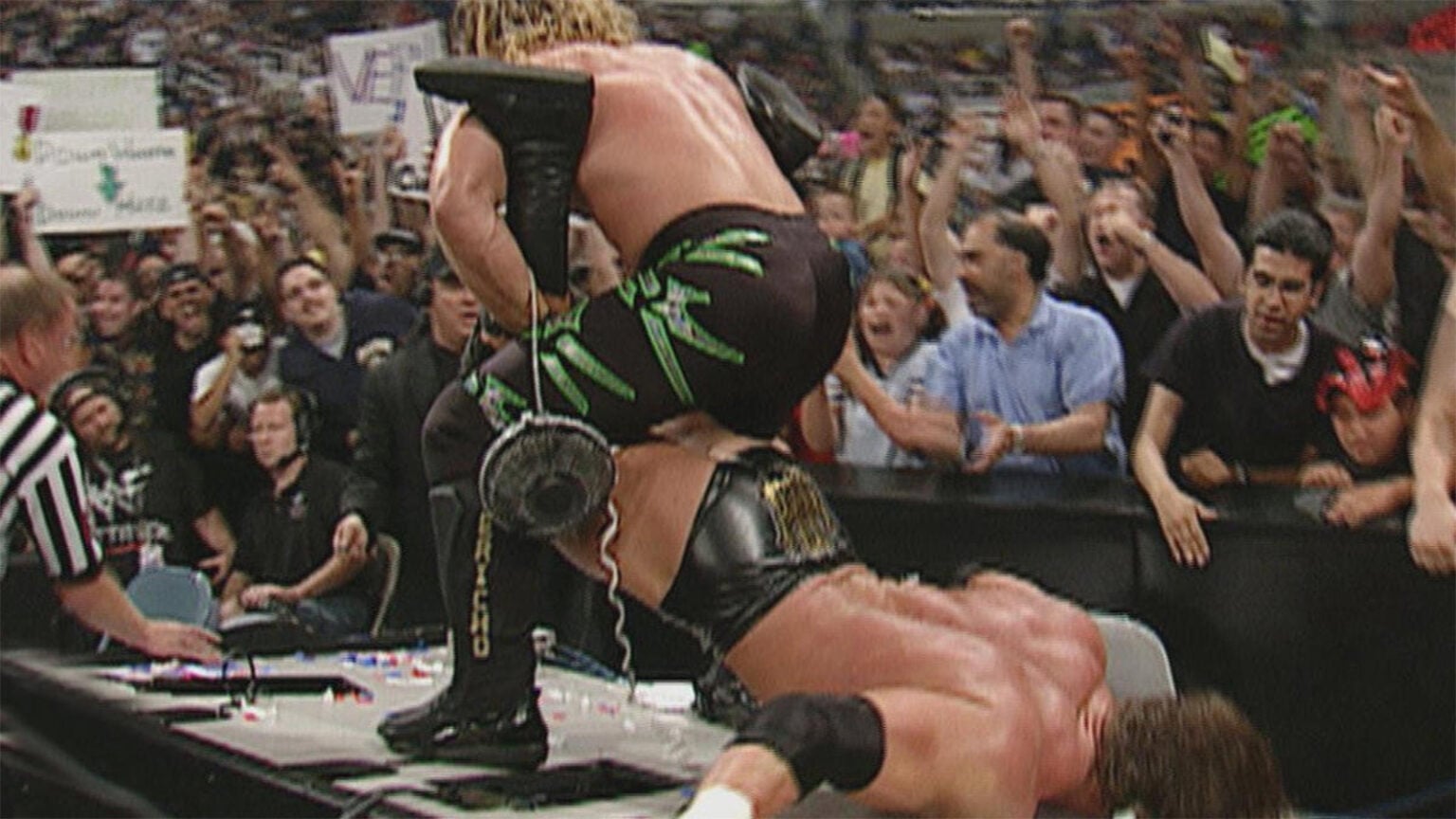
On May 21, 2001, WWF put one of its best television main events of the era on free TV and accidentally changed the shape of its entire summer.
That night on Raw in San Jose, Chris Jericho and Chris Benoit defeated Steve Austin and Triple H for the WWF Tag Team Championship. On paper, it looked like a hot television match designed to juice a Monday rating. In practice, it became something bigger. Jericho pinned Austin. Benoit looked every bit like a top-level running mate. Triple H tore his quadriceps and still finished the match. And a company that badly needed fresh movement suddenly had no choice but to start moving.
A company that had started to feel stuck
WrestleMania X-Seven had only happened a few weeks earlier, but the mood around WWF was already changing. Austin's heel turn had not given the promotion the creative jolt it wanted, the WCW purchase was still more idea than fully formed invasion, and the top of the card was beginning to feel smaller than it should have for a company with that much talent.
Triple H and Austin, the Two Man Power Trip, were positioned as the center of everything. That gave WWF star power, but it also narrowed the whole promotion around the same handful of names. Jericho had been losing too often to feel like a true breakthrough main eventer, and Benoit, even with the respect he carried as an in-ring wrestler, still felt more like a trusted elite worker than a man the company was ready to build around.
That is what made May 21 stand out. The promotion needed a night that felt consequential. It needed someone from just below the glass ceiling to crack through it. According to the Wrestling Observer Newsletter, morale the day before at Judgment Day had dipped badly enough that some in the company were already feeling the same kind of creative frustration that had hung over late WCW. The next night, Raw gave them something very different.
The match that changed the night
Jericho and Benoit did not win with a cheap distraction roll-up that everyone forgot by the following week. WWF built the match like it mattered. The challengers were presented as if they were on the verge of breaking through all the way through the closing stretch, and the announcers treated the tag titles like something worth fighting for instead of just another prop in the middle of a crowded show.
That mattered, because fan faith in Jericho as a serious threat had started to slip. He was still over, still charismatic, still unmistakably a star, but there is a difference between being popular and being trusted with the top end of the card. This match repaired some of that in a hurry.
The finish was memorable because it felt chaotic without feeling hollow. Austin was caught in Jericho's submission. Triple H stepped in to save his partner and, in the process, suffered the serious leg injury that would define the night in hindsight. Even after the tear, he stayed in the match long enough for the closing sequence to land. Moments later, a sledgehammer swing meant for Jericho backfired and hit Austin instead. Jericho capitalized and scored the pin.
It was one of those wrestling finishes that managed to protect the losing side just enough while still giving the winners a real lift. Jericho pinning Austin on television was not a small thing in 2001. Benoit standing beside him made the result feel even more substantial, because the team looked like they belonged in that spot rather than like placeholders waiting for the real stars to come back.
Why this May 21 mattered beyond one result
The easiest way to remember the match is as the night Triple H tore his quad and somehow kept going. That is still a huge part of its legacy, and fairly so. The toughness required to finish those final moments became one of the defining stories of his career.
But the more interesting part is what the result said about WWF at that exact moment.
For one night, the company acknowledged that its main event scene needed oxygen. Jericho's pin on Austin immediately raised his standing and pointed him toward a world title challenge at King of the Ring. Even if WWF did not fully commit to a long-term reset, the match showed there was life in pushing someone other than the usual names at the very top.
At the same time, Triple H's injury took away one of the promotion's most important safety valves. If there had been thoughts of leaning harder into a future Austin vs. Triple H split, or using him as the next major course correction, those plans were gone the moment his leg gave out. The company was suddenly thinner at the top, not deeper. That made the decision to elevate Jericho feel less like a luxury and more like a necessity.
That is why the match lives on as more than just a famous injury clip. It was a pressure point. WWF had been drifting toward a version of itself that felt repetitive and closed off. On May 21, it finally opened one door, then immediately lost one of the men who had been carrying the house.
The strange power of the match is that both truths exist at once. It was a breakthrough and a setback. It gave Jericho one of the biggest pins of his career and took Triple H off the board for months. It made Raw feel electric and reminded WWF how vulnerable its main event depth really was.
More than two decades later, that is why the bout still holds up as a genuine turning point and not just a famous piece of wrestling trivia. The action was excellent. The stakes felt real. The consequences lasted well beyond the final bell. Wrestling television rarely gets remembered that way unless it actually changes something.
And on this night, it did.
Also on this date
May 21 produced other notable moments across the years. In 2000, Triple H left Judgment Day still holding the WWF Championship after the chaotic Iron Man match with The Rock and Shawn Michaels. In 2017, Shuji Ishikawa beat Kento Miyahara to win the All Japan Triple Crown, ending one of the promotion's defining title reigns of the decade.