
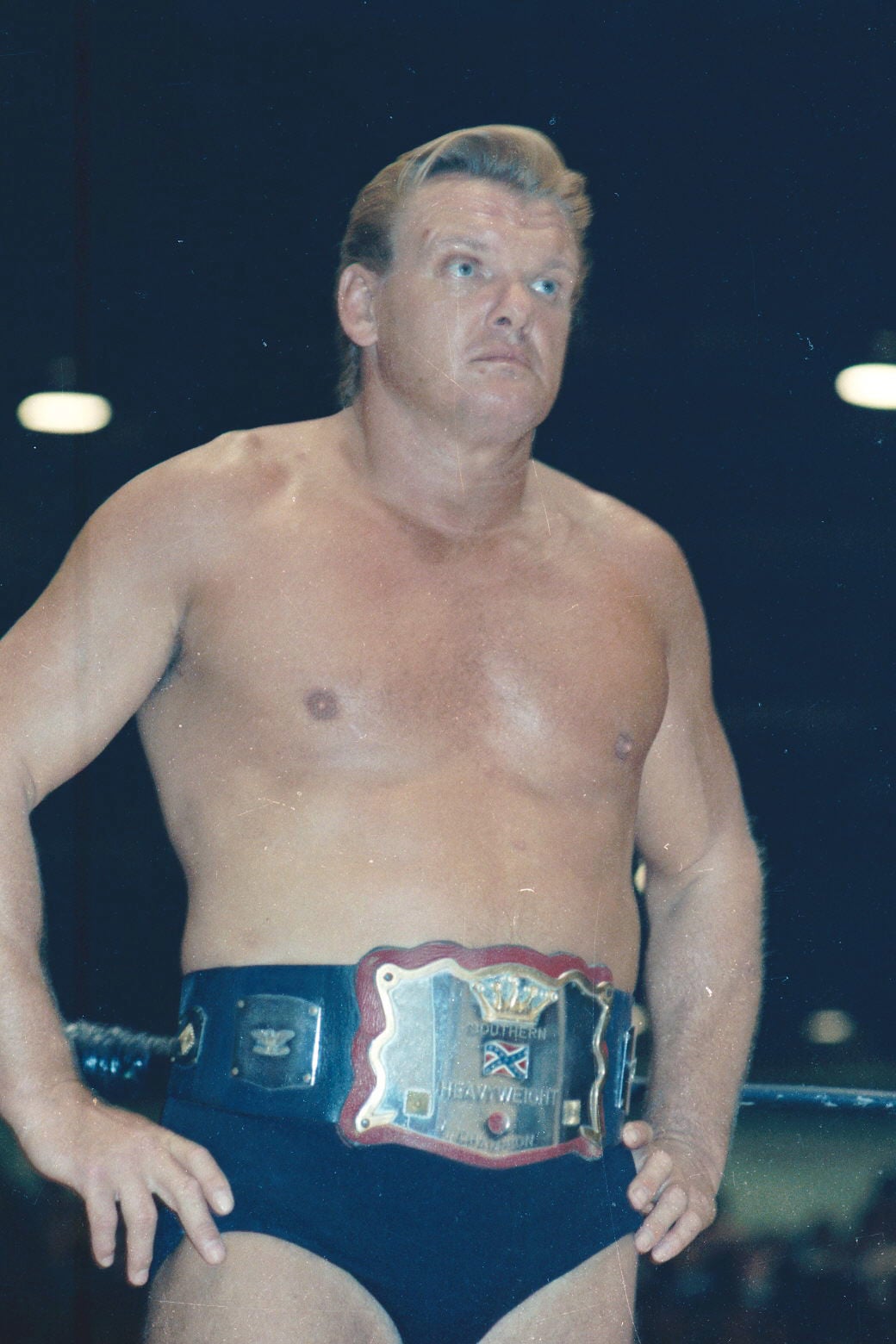
On April 24, 2001, Johnny Valentine died at 72, and wrestling lost one of the rare figures whose reputation still carried real weight long after his working days were over.
Valentine is not always the first name modern fans reach for when they talk about the giants of the territorial era. He should be closer to the front of the line. In his prime, he was the kind of wrestler other wrestlers measured themselves against, not because he was flashy or because his name survived in endless highlight packages, but because he was believable in a way few men ever were. He looked mean, he wrestled mean, and almost every story told about him circles back to the same point. Johnny Valentine felt real.
That mattered across multiple generations of the business. He was one of the great traveling main event heels of the old NWA system, a man who could move from territory to territory, slot into a top feud, and immediately make the local hero's comeback feel bigger. He won titles in Florida, Texas, St. Louis, Toronto, Japan and the Mid-Atlantic region, and he carried himself with the kind of menace that made those championships feel hard-earned. Even in an era built on larger-than-life personalities, Valentine stood out as someone who did not need much embellishment.
His death hit differently for that reason. Wrestling has lost plenty of stars, but not many who were spoken about with the kind of respect Valentine inspired from peers. He was often described as one of the toughest men the business had ever produced. That was not just old-timer mythmaking. It was central to how he worked and how fans saw him. He threw forearms and elbows that looked ugly in the best possible way, sold pain without surrendering his aura, and built whole matches around the idea that beating him ought to feel like surviving something.
The scope of his career also explains why his passing mattered. Valentine was one of those territorial anchors whose influence spread wider than a single home base. He had major runs in the Northeast before the national expansion era, worked a long list of title programs around the United States and Canada, and helped give younger stars credibility simply by sharing a ring with them. His matches with Antonio Inoki in Japan were important to Inoki's development. In Mid-Atlantic, he became one of the defining villains of the promotion's rise, the sort of heel who could set the table for babyfaces while still feeling like the center of the fight.
That Mid-Atlantic chapter is probably the clearest window into his legacy. By the early 1970s, Valentine had become one of the promotion's essential stars, and his presence helped the territory harden into one of wrestling's most influential regions. He fit the atmosphere perfectly. Mid-Atlantic wrestling in that era thrived on violence that looked personal, grudges that felt lived-in, and heroes who had to fight uphill. Valentine gave that world one of its best antagonists. The reputation of the territory as a place for serious, intense wrestling owes a lot to men like him.
There is also no telling Johnny Valentine's story without the plane crash that ended his in-ring career in October 1975. He was aboard the Cessna crash near Wilmington, North Carolina that also injured Ric Flair, David Crockett, Bob Bruggers and Tim Woods. Valentine suffered catastrophic back injuries and never wrestled again. The timing made it even crueler. He was still a major star, still holding the United States title, and still at a point where plenty of people believed he had more big years ahead of him.
That accident became one of wrestling history's hinge moments. Flair recovered and went on to define an era. Valentine did not get that second act. Instead, his legend froze in a different form. He became the hard case older wrestlers talked about with a mix of fear and admiration, the star whose peak was cut off before the national television age could preserve him on a wider scale. In some ways, that made his reputation even stronger. The people who saw him never seemed to forget him.
There is a sadness in that, because Valentine was also more than the wreckage that followed him. He was not just a tragic what-if or a footnote in another man's origin story. He was a major star in his own right, the father of Greg Valentine, the man many regarded as the greatest wrestler never to win the NWA world heavyweight title, and one of the wrestlers most responsible for making old-school heel work feel dangerous instead of theatrical. He did not have to wink at the audience. He made them believe they were watching someone cruel enough to enjoy the punishment.
That is why April 24, 2001 still lands as more than an obituary date. Johnny Valentine's death marked the loss of a wrestler who represented a whole standard of performance from the territorial era. He belonged to a time when top heels were expected to look like they could spoil your night the moment they walked into the building, and when violence, timing and presence mattered more than catchphrases or branding. Plenty of wrestlers since have been tougher athletes. Very few have projected toughness the way Valentine did.
His legacy lives on in more familiar names. You can trace pieces of him through Greg Valentine's grim, punishing style, through the hard-edged Mid-Atlantic main events that shaped Flair's rise, and through the broader idea that a heel can be unforgettable without ever trying to be cool. Johnny Valentine did not need the audience to like him. He needed them to believe he was a problem, and for years they did.
That is a kind of greatness wrestling never fully outgrows.
Also on this date in 2000, Diamond Dallas Page beat Jeff Jarrett on Nitro in Rochester to win the WCW world title, one of the final strange turns in the chaotic closing stretch of the company.