
On July 22, 2001, WWF finally found the scale fans thought the invasion angle was supposed to have all along.
InVasion came to the Gund Arena in Cleveland with 17,876 fans in the building and all the easy hype in the world. WWF had bought WCW in March. ECW had now been folded into the same fight. On paper, the company war storyline should have been the richest angle pro wrestling had ever seen. In practice, the early weeks had felt smaller, stranger and far less dangerous than the premise promised. Too many of the biggest WCW names were absent, too much of the presentation felt makeshift, and the supposed takeover had not yet turned into the kind of must-see television people expected.
That is what makes InVasion such a fascinating show to revisit. It was not the night the angle became great. It was the night the angle briefly felt great.
WWF got there by doing something simple and smart. It put Steve Austin back at the center of the story and let fans believe, for one more night, that the old Austin had returned for real. One week earlier, he had come back to fight off the invading side and give WWF the kind of reckless antihero energy the storyline had been missing. That mattered because the heel Austin from WrestleMania X-Seven had never fully clicked as a box office force. Fans did not want a paranoid, guitar-playing champion when the company was supposed to be under siege. They wanted the guy who could stomp through chaos and make the whole promotion feel hotter by himself.
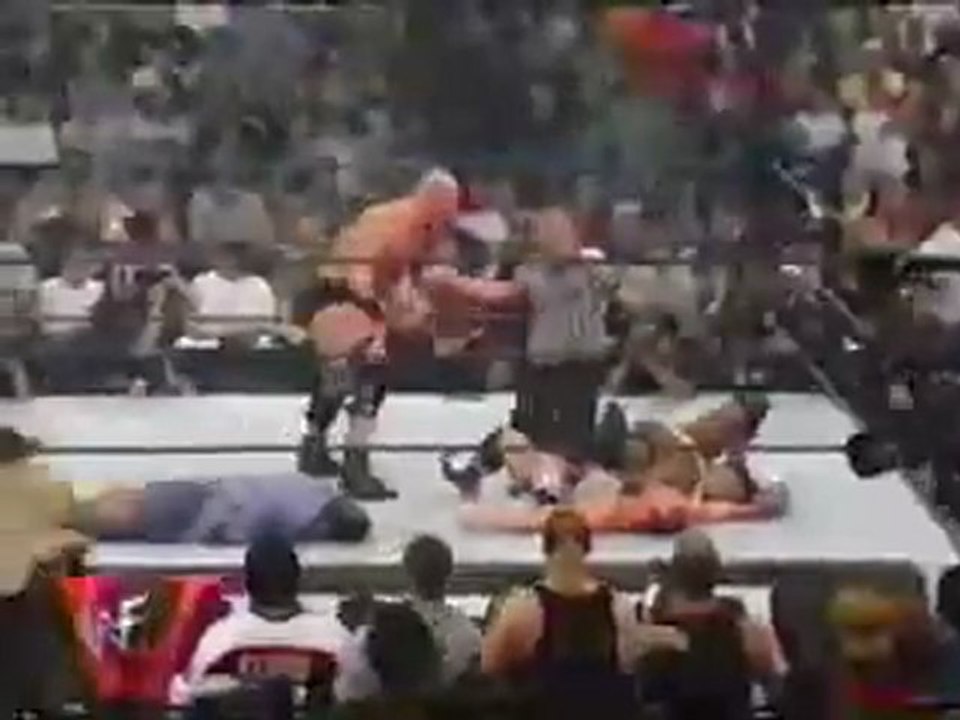
That setup gave the main event its charge. Team WWF sent out Austin, Kurt Angle, Undertaker, Kane and Chris Jericho against Booker T, Diamond Dallas Page, Rhyno and the Dudley Boyz. It was not a perfect symbolic version of WWF versus WCW and ECW, because the war had already become too compromised for that, but it was big enough to feel important. Angle was especially crucial. He worked the match like a man clawing for respect, and by the end of the night he looked far more like the company's next heroic centerpiece than he had at the start of the summer.
The finish is the reason the show still lives in wrestling memory. With the match breaking down and victory in reach, Austin did not save WWF. He stunned Angle instead, handed the advantage to Booker T, and turned the entire pay-per-view on its head. Team WCW and ECW won the Inaugural Brawl, and the invasion story suddenly had the kind of twist it had been missing. Austin's betrayal did more than give the heel side a victory. It gave the feud a true top-level defection, the sort of ending fans had been waiting for since the moment WCW first appeared on WWF television.
It also made the rest of the card easier to remember than it probably deserved. Rob Van Dam beating Jeff Hardy for the Hardcore Championship was the standout undercard match and the one bout from the show that most clearly matched the audience's appetite for wild, high-risk action. Elsewhere, the show was more uneven. That was part of the strange charm of InVasion. It was a one-match concept, plus one great title fight underneath, wrapped around a lot of material that was merely decent. But when a wrestling card sells you on one central question and pays it off in a way that jolts the room, the weak spots stop mattering quite as much.
The business side is what really elevates July 22, 2001 from memorable pay-per-view to genuine historical marker. Contemporary Observer coverage described the event as a major success and noted that the next night's Raw drew a 5.35 rating, its best number since April 9. Later reporting put the show at roughly 760,000 pay-per-view buys, which made it the fifth biggest pro wrestling pay-per-view to that point, trailing only the WrestleManias from 1999 through 2002. That is the part worth sitting with. Even after months of criticism, and even with the invasion already viewed as a compromised version of the dream match-up, fans still turned out in huge numbers once WWF gave them the sense that something truly major might happen.
There is a slight sadness in that success now, because InVasion also stands as evidence of how much bigger the whole story could have been. The show proved there was still enormous appetite for the concept. It also exposed how much money had been left on the table by the rushed creative, the missing stars and the decision to stage a war before the invading side really looked formidable. Austin joining the Alliance was dramatic, but it was also a workaround. WWF had to turn its own biggest star to make the opposition feel major enough. That solved the immediate problem for one pay-per-view. It did not solve the larger structural one.
Still, wrestling history is full of nights that matter because of what they achieved in the moment, not because they led neatly to a masterpiece. InVasion belongs in that category. Kurt Angle came out of it as a stronger babyface. Rob Van Dam looked like he belonged on the biggest stage in North America. Austin delivered one of the defining swerves of his career. And for a single night in Cleveland, the invasion angle finally felt like the industry-shaking battle it had always been sold as.
That is why July 22, 2001 remains worth remembering. InVasion was not the pay-per-view that fixed everything WWF had broken in that storyline. It was the pay-per-view that showed how electric the idea still was when the company stopped fighting its own strengths and simply let Steve Austin blow the whole thing apart.