
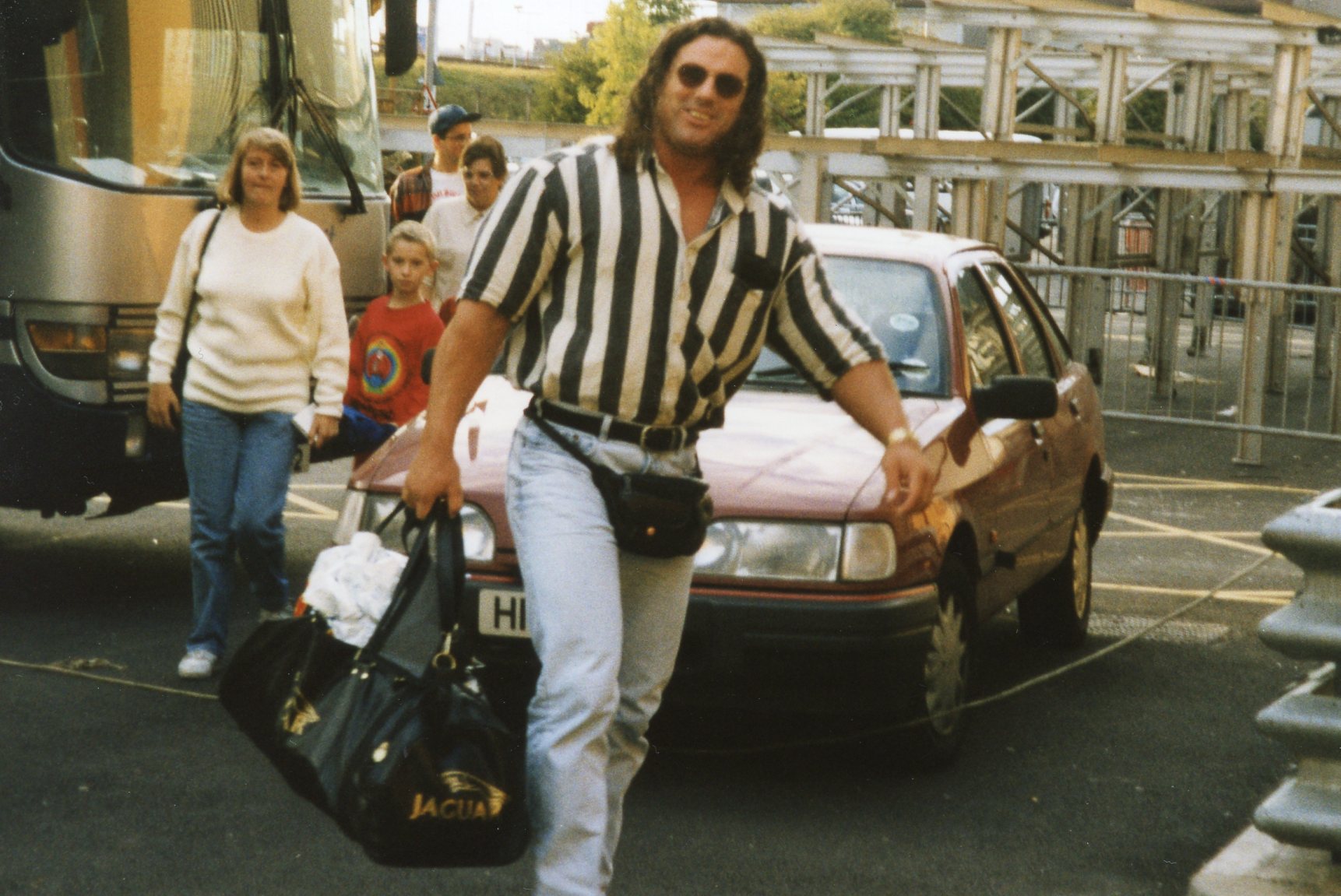
On May 28, 2002, Calgary stopped pretending that wrestling grief could be kept behind the curtain.
That day became the public farewell for Davey Boy Smith, the British Bulldog, just ten days after his death at 39. WWE was already in town for a SmackDown taping, which meant the wrestling world was there too. But this was not one more corporate tribute before a television show. It was a city, a family, and a business trying to make sense of losing one of the most recognizable stars of his era while the wounds around his final years were still painfully fresh.
The larger public memorial arranged by the Hart family drew hundreds of people, television cameras, and a long list of names from wrestling and beyond. Bret Hart was there. Vince McMahon was there. Hulk Hogan, Chris Benoit, Chris Jericho, Jim Ross and many others were there. Because of family disputes over the arrangements, Smith's body was not present. A large poster stood in instead. Even that detail captured the uneasy mood around the day. Nothing about the goodbye felt simple.
Why Davey Boy Smith mattered so much
Smith was never just another star from the late 1980s and 1990s boom period. He carried a kind of crossover appeal that made him feel important in several wrestling worlds at once.
In Britain, he was a homegrown success story, the kid who came out of the old World of Sport ecosystem and became something much bigger. In Calgary, he became part of the Hart family and part of Stampede lore. In the WWF, he was one half of the British Bulldogs tag team, a powerhouse babyface with real athletic credibility and a look that kids remembered instantly. Later, as a singles act, he reached a different level of immortality at SummerSlam 1992, when he beat Bret Hart for the Intercontinental title in front of a massive crowd at Wembley Stadium.
That match still sits at the center of his legend, but Smith's career was larger than one night. He was a rare wrestler who could feel equally at home in the bright, cartoonish WWF of the 1980s, the more athletic tag environments of Japan, and the family-drama-heavy main event scene that defined so much of the 1990s WWF. He was powerful, explosive, and immediately believable. Even when his body began to betray him, the aura never completely left.
That is part of why his death hit so hard in 2002. Fans were not mourning a faded curiosity. They were mourning a wrestler whose best moments were still vivid and whose name still meant something across generations.
Calgary became the place where the grief turned public
Smith's death on May 18 had already brought major coverage in Canada and England. By the time May 28 arrived, the sadness had mixed with family tension, unresolved questions, and the awkward reality that wrestling is never fully separate from public spectacle.
The day before, a smaller private service had been arranged. The May 28 memorial in Calgary was something else entirely. It was bigger, more public, and impossible to separate from the fact that WWE talent and executives were in the city for that night's taping. What could have been a quiet family occasion instead became one of those moments where wrestling's real and performative worlds collided in plain sight.
Several family members spoke. So did people close to Smith's career and personal life. Diana Hart, devastated but determined to focus on more than the bitterness of the previous two years, publicly thanked McMahon for trying to help Smith and thanked Bret Hart for what she saw as the greatest match of Smith's life. Smith's children also made the memorial feel painfully immediate. Georgia spoke. Harry Smith, still a teenager and years away from becoming a recognizable wrestler himself, talked about having teamed with his father and how nobody could take those memories from him. T.J. Wilson, another future WWE name, spoke as well.
That made the memorial more than a celebrity gathering. It was not just wrestling paying tribute to one of its own. It was the next generation of the Hart and Smith families standing in front of a crowd and absorbing what this loss meant in real time.
For Calgary, that mattered. The city had long treated the Harts as wrestling royalty, and Smith was woven deeply into that identity. He was English by birth, but wrestling fans in Calgary had long claimed him as one of their own. A memorial there, before a WWE television night, turned his passing into something communal.
The sadness of the timing
There was another reason May 28 landed with such force. Smith had been trying to come back.
In the weeks before his death, he had started wrestling sparingly again after a near-fatal motorcycle accident the year before. He had worked dates in Brandon and Winnipeg alongside his son Harry and reportedly felt good about being back in the ring. He was hardly the first veteran to chase one more run, but in Smith's case the comeback carried extra weight. His later career had been marked by injuries, addiction struggles, legal turmoil, and the feeling that his name had become attached to decline as often as glory.
A final comeback would not have erased any of that. Wrestling does not work that neatly. But it might have given him a different closing chapter, one in which he was remembered not only for the wreckage of his final years but also for the stubborn pride that had always defined him.
Instead, May 28 became the day people had to accept there would be no rewritten ending.
That is why the memorial still resonates. It was not simply a service for a famous wrestler. It was the public acknowledgement that one of wrestling's great physical presences, a man tied to Wembley, to the Bulldogs, to the Hart family, and to an entire era of WWF spectacle, was gone before anyone was ready to let go.
His Hall of Fame induction would come years later. His son would eventually carry the family name back into major wrestling rings. But on this day in 2002, none of that future comfort existed yet. There was only the crowd, the family, the poster at the front, and the sense that wrestling had lost somebody it could never quite replace.
Also on this date
May 28 produced other notable moments across the 1992 to 2020 archive, including the death of longtime heel Giant Tolos in 2009 and Rey Misterio Jr. unmasking Bandido in 1993 before Bandido later worked as Mohawk.