
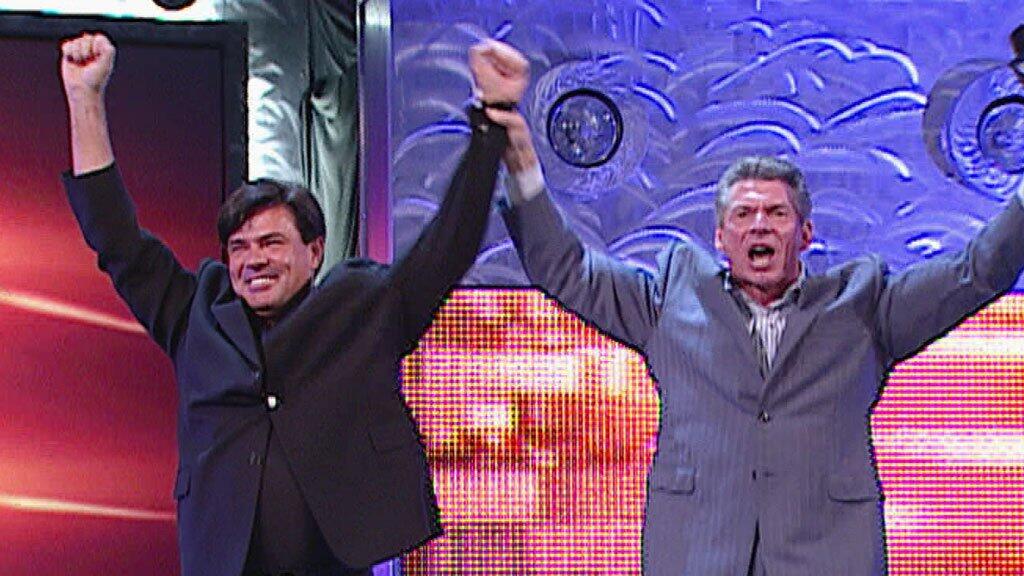
On July 15, 2002, WWE did something that would have sounded absurd only a year earlier. Vince McMahon stood on the Raw stage in East Rutherford, New Jersey and introduced Eric Bischoff, the former WCW boss and one of the central villains of the Monday Night War, as the new general manager of Raw.
It was not just a surprise cameo. It was one of those rare wrestling moments where real history walked straight into the storyline and did not need much help to feel huge. Bischoff had spent years as the face of the company that beat McMahon head-to-head for 83 straight weeks. He had signed away major names, mocked WWE on national television and helped define one of the nastiest competitive stretches the business had ever seen. For him to show up on WWE television at all was startling. For him to arrive as a power figure inside the company made it feel even stranger.
That strangeness was exactly the point.
By the summer of 2002, WWE needed a jolt. The first months of the brand split had not gone the way the company hoped. The rosters were supposedly divided, but the presentation still felt muddled. The Invasion angle had already come and gone without becoming the long-term blockbuster many expected. Steve Austin had walked out weeks earlier. Kevin Nash was hurt. The Rock was in and out. The company was still searching for a way to make Raw and SmackDown feel distinct while also convincing fans that weekly television mattered in a fresh way.
Bringing in Bischoff gave WWE an instant supply of tension it could not manufacture from scratch. This was not some anonymous executive character with a generic agenda. Fans already knew who he was. They knew what he represented. Even if younger viewers did not carry the full emotional baggage of the Monday Night War, the segment still landed because the company treated him like a man who was never supposed to be there.
The reveal was staged as a genuine bombshell. Bischoff's face appeared on screen during the show, and moments later McMahon formally brought him out. According to contemporary Observer coverage, very few people in the company knew it was happening in advance, which helped the surprise feel real in the building and backstage alike. The live crowd reacted to the shock first. Then came the surreal image of McMahon and Bischoff standing together on a WWE stage after years of being cast as enemies.
Bischoff leaned straight into the history. He talked about trying to put McMahon out of business. He framed himself as the man who had come closer than anyone else to ending WWE as fans knew it. He carried himself with the same smugness that had made him such an effective on-screen antagonist in WCW, and that mattered because WWE did not need to explain why he should be booed. His reputation had done the setup work already.
What made the debut more important than a simple nostalgia pop was the role attached to it. Bischoff was not there for a one-night handshake or a quick cameo built around a cheap headline. He was installed as Raw's general manager, with Stephanie McMahon positioned opposite him on SmackDown. That gave WWE a new structure for its television almost immediately. Instead of the old owner-versus-owner framing or the collapsing leftovers of the Invasion period, the company now had two authority figures who could shape their brands in different ways.
Bischoff fit the role because he understood how to act like a television executive in wrestling. He could be oily without trying too hard. He could talk like a man with power, and just as importantly, like a man who enjoyed using it. Raw would spend the next stretch of its life built around that energy. Whether fans loved the booking or hated it, Bischoff became one of the defining authority figures of the era because he never felt like a neutral administrator. He always felt like someone with an angle.
There were flaws to the debut, and they were obvious even at the time. The segment drew a major ratings jump, with viewers clearly tuning in to see why Bischoff was suddenly on Raw, but the curiosity did not automatically fix the rest of the show. The surprise was bigger than the surrounding product. There was also an unavoidable contradiction in the way WWE presented it. The most compelling version of a Bischoff arrival would have been a dangerous outsider forcing his way into the company. Instead, McMahon introduced him, hugged him, and gave him the job. That softened some of the edge.
Even so, wrestling is often about choosing the right contradiction to live with. In this case, the upside was worth it. WWE got a real shock to the system at a moment when the promotion badly needed one. It also got something more lasting: an admission that its recent past still had value. Instead of pretending the Monday Night War was finished and buried, the company pulled one of its central figures back into the picture and used that history as fuel.
That is why the moment has held up.
Bischoff's debut was not important because it solved every problem WWE had in 2002. It did not. Raw was still uneven, the roster was still in transition and the company would keep reworking its direction more than once. But on one July night in New Jersey, WWE found a way to make its own history feel alive again. It took a rivalry that had once been about survival and turned it into weekly television. That was smart wrestling, even if the execution was not perfect.
It also said something about Bischoff himself. For years, he had been the symbol of the opposition. On July 15, 2002, he became proof that in wrestling, the line between enemy and employee can disappear the instant there is money, drama and television value on the table. Few debuts have ever carried that much baggage, and fewer still have used it so effectively.
Also on this date, John Cena and Dolph Ziggler won the Money in the Bank ladder matches in Phoenix in 2012, and Jon Moxley retained the AEW world title against Brian Cage at Fight for the Fallen in 2020. Both mattered. Neither carried quite the same sense of disbelief as the night Eric Bischoff walked onto Raw and made the old war part of WWE canon.