
On July 1, 2002, Jeff Hardy lost the biggest singles match of his career.
That is the official result. It is also only part of the story.
What happened that night on Raw in Manchester, New Hampshire mattered because Hardy walked into the match as a long shot, a flashy undercard babyface who had already been cooled off, and walked out feeling like somebody the audience could believe in at a much higher level. He did not leave with the Undisputed WWE Championship. He left with something that sometimes lasts longer in wrestling, proof.
WWE had made the challenge simple. A week earlier, The Undertaker beat Hardy quickly in a non-title match. Instead of shrinking after that, Hardy pushed back and asked for another shot, this time in a ladder match. That stipulation mattered. Ladder matches were already part of Hardy's identity, while The Undertaker was the bigger star, the champion, and the man who was supposed to punish a reckless younger wrestler for overreaching.
That was the tension that made the whole thing work. Hardy was not presented as an equal. He was presented as a kid trying to force the world to take him seriously.
Jeff Hardy had to make the audience believe first
The smartest part of the match was that it never pretended Hardy was suddenly on Undertaker's level from the opening bell.
Undertaker mauled him early, using his size and power to make the challenge look almost irresponsible. That gave the match its shape. Hardy was not there to trade control segments like a polished main eventer. He was there to survive, create openings, and make every burst of offense feel like a gamble that might change his life.
Once the ladders started to matter, the match found its heartbeat. Hardy threw himself into the kind of risks that had made him stand out in the first place, including a dive from the ladder onto Undertaker on the floor, and the crowd followed him the whole way. Every climb felt a little more plausible than the last. Every near miss made the building louder.
Contemporary Observer coverage noted that the live crowd was deeply invested in those near-falls even as WWE, in broader business terms, was going through a rough stretch and the television rating for the match itself fell sharply. That contrast is part of what makes the bout interesting to revisit. On paper, the company had reason to doubt how much Hardy meant. In the arena, fans were treating him like a star waiting to happen.
That disconnect gave the match real emotional bite. Hardy was wrestling both Undertaker and the idea that he had already been slotted into a ceiling.
The loss was the point, but so was what came after it
Undertaker eventually won the match the way a champion of his stature was expected to win it. He stopped Hardy's last run, sent him crashing off the ladder, and kept the title.
If the segment had ended there, it still would have been remembered as a strong television main event. It became something more because Hardy was allowed one last stand.
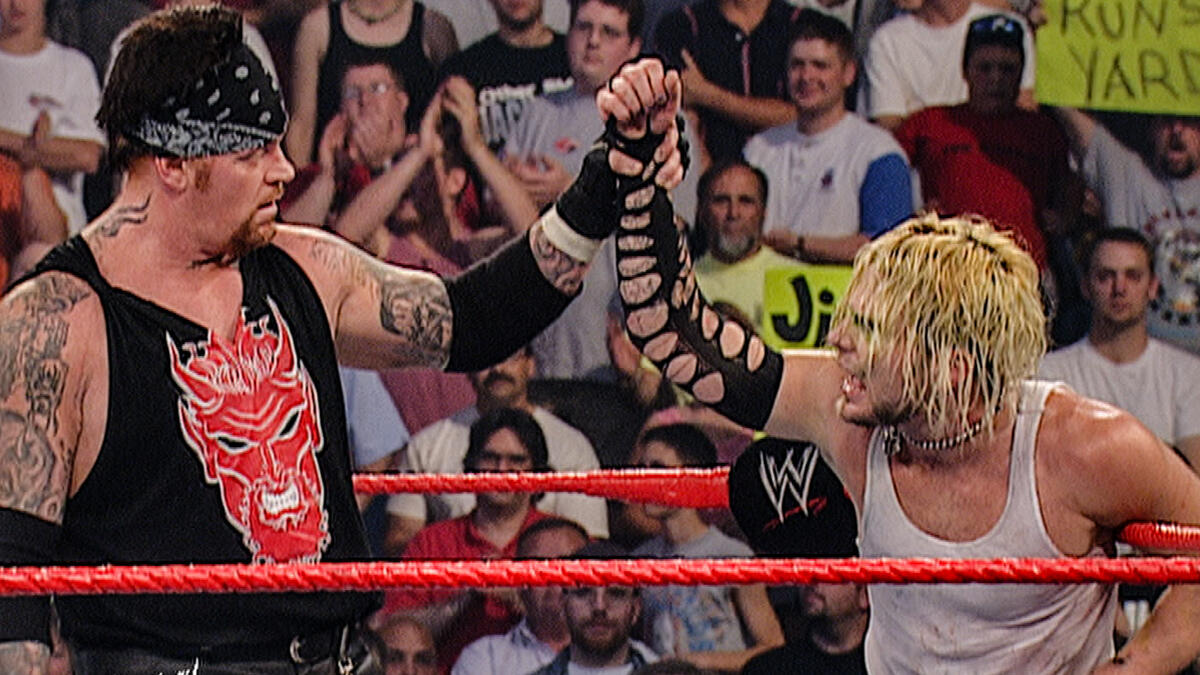
After the match, Undertaker kept dishing out punishment and left Hardy in the ring. Then Hardy grabbed a microphone and insisted he was still standing. That was the whole story in one beat. He had lost, he had been hurt, and he refused to accept that defeat meant humiliation.
Undertaker came back, teased more violence, and then changed the scene with a handshake and a raised arm.
Wrestling has plenty of post-match respect angles, but this one landed because it felt earned. The point was not that Undertaker suddenly saw Hardy as his equal. The point was that Hardy had taken the beating, the loss, and the pressure of the moment without folding. He had climbed into the ring with a champion who was supposed to crush him and forced that champion to acknowledge him.
That is why the match has held up for so long. Fans do not remember it because Hardy won some moral victory that replaced the actual result. They remember it because WWE, for one night, told a very clean story about resilience and upward movement. Hardy was still the underdog when the show ended, but he was no longer just another underdog.
Why this Raw still matters in Jeff Hardy's career
A lot of memorable wrestling television is really about timing. Hardy and Undertaker hit this match at exactly the right moment.
WWE in mid-2002 was trying to rebuild faith in its roster and sort out who could feel fresh near the top of the card. Hardy was not yet the fully formed singles attraction he would become later, but this was the night that possibility stopped being theoretical. The match showed that his appeal could extend beyond daredevil tags and highlight-reel bumps. He could carry sympathy, drama, and a serious main-event atmosphere against one of the promotion's biggest names.
It is also worth noting that the company did not immediately turn the moment into a permanent rocket push. In that sense, the match is a little bittersweet. It showed exactly what Hardy could be before WWE fully committed to treating him that way every week. But that does not lessen its importance. If anything, it sharpens it.
When people talk about the matches that made Jeff Hardy feel like more than a great stunt performer, this is near the top of the list because it translated his charisma into something sturdier. He looked gutsy without being cartoonish. He looked vulnerable without seeming weak. Most importantly, he made the audience think he might actually pull it off.
That is one of the hardest reactions to create in wrestling, especially when the finish is still a loss.
Hardy did not win the championship on this day. He won a different kind of argument. For one night on Raw, he proved he belonged in bigger matches than the company had been giving him, and Undertaker's handshake turned that feeling into something impossible to miss.
Also on this date
July 1 brought a few other notable moments as well. In 2017, NJPW's first self-promoted U.S. show sold out the Long Beach Convention Center and marked a major step in the company's American expansion. In 2007, CIMA beat Jushin Liger in Kobe to win the Open the Dragon Gate Championship.
Both were significant moments. Neither has stayed in North American fan memory quite like the night Jeff Hardy lost to The Undertaker and still felt bigger when it was over.