
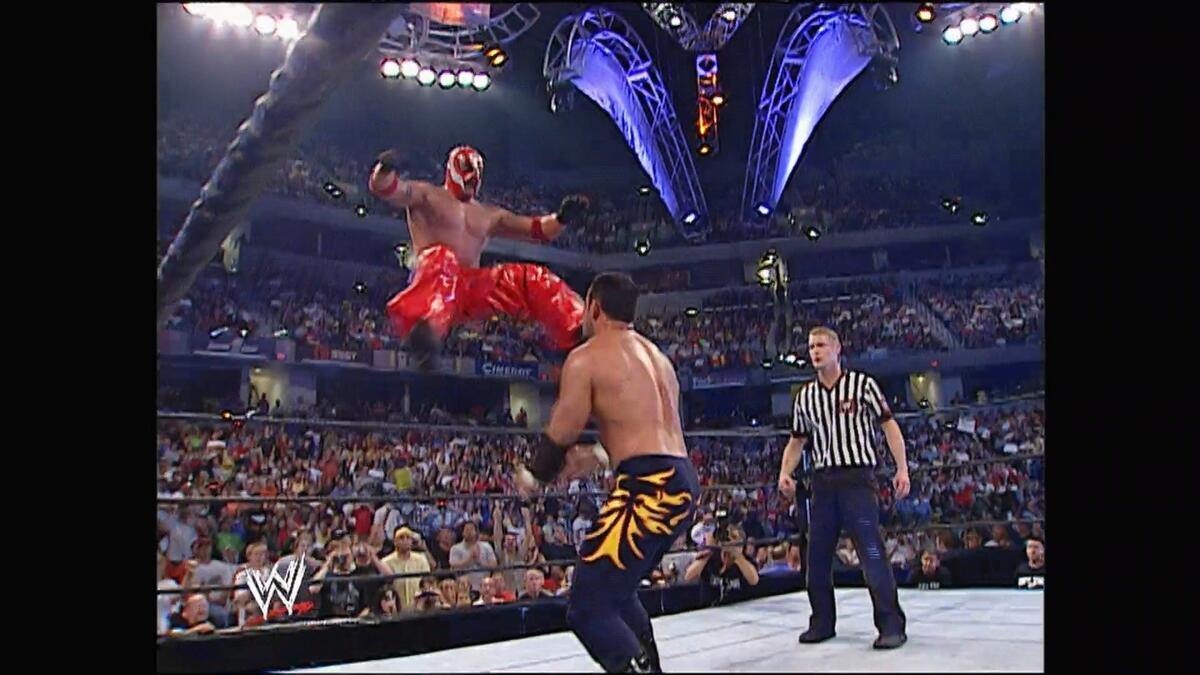
On July 23, 2002, WWE taped a SmackDown in Indianapolis that felt different from the minute it started. The show was leaner, more wrestling-heavy, and built around the idea that fresh names could matter. By the end of the night, that feeling had a face, or rather a mask. Rey Mysterio had made his WWE debut, beaten Chavo Guerrero, and finished the taping standing in the ring with Edge and John Cena as if the company had accidentally shown viewers part of its next era all at once.
That closing image looks even more striking in hindsight than it did at the time. Edge would become one of WWE's defining stars of the 2000s. Cena was still early in his run, not yet the franchise centerpiece he would soon become. And Mysterio, already world famous to anyone who had followed lucha libre, ECW or WCW, arrived in WWE as a reminder that the company had been missing a particular kind of electricity.
That mattered in 2002. WWE had won the Monday Night War and absorbed much of its competition, but victory had not solved everything. The roster was deep, the star system was still driven by the same established names, and the promotion was trying to figure out what the post-Attitude Era version of itself should look like. SmackDown, especially, was starting to feel like the place where the company could experiment a little, emphasize in-ring work more heavily, and build talent that did not fit the old formula.
Mysterio was perfect for that moment. He was already a proven attraction, but he did not look like a traditional WWE headliner. He was much smaller than the men who had historically been pushed as top stars, and his offense depended on speed, angles and timing rather than sheer force. None of that was new to fans who had seen him in the 1990s, but WWE was now presenting him to its own audience as something special, with weeks of vignettes and the sense that his arrival was supposed to mean something.
The match choice was smart. Chavo Guerrero was not just a solid opponent, he was the right opponent. The two had long history, they understood the same rhythm, and Chavo could help frame Mysterio's style for a WWE audience without making it feel alien. Instead of debuting Rey in a throwaway squash or hiding him inside a multi-man segment, the company let him show what made him different. He won the match, gave the crowd the kind of motion and urgency they had been waiting for, and immediately looked like more than a novelty act.
What made the night memorable, though, was that the debut did not end there. Later in the show, Edge and Chris Jericho met in a steel cage match. Afterward, the ring filled with chaos until Mysterio launched himself from the top of the cage to make the save. Cena joined in too, and the three babyfaces closed the taping together. It was a dramatic way to underline the point. Rey was not being introduced as a midcard curiosity who might get over if everything broke right. He was being placed, immediately, in the middle of the action.
Contemporary Observer coverage noted that the entire SmackDown taping felt designed to create new stars. There was less talking, less wasted motion, and more emphasis on getting wrestlers over through action. In that environment, Mysterio's debut stood out not only because he won, but because the show itself treated movement and momentum like they still mattered. WWE did not need Rey to cut a long promo explaining who he was. The company let him wrestle, let him fly, and let the audience understand him that way.
There was also a deeper layer to the debut that made it resonate. In WCW, Mysterio had helped redefine what American television wrestling could look like in the cruiserweight division. He had also been unmasked there, one of the more controversial creative decisions of that era. By the time he arrived in WWE, the mask was back, and that visual instantly restored something essential. Rey Mysterio without the mask was still a great wrestler. Rey Mysterio with it felt mythic. It gave him shape, mystery and history in one glance.
That is why this debut holds up as more than a cool memory. It was not just the start of a successful WWE run. It was a moment when the company briefly showed unusual clarity. It recognized that Mysterio did not need to be remade in its own image. He needed a stage, a little trust, and the room to be recognisably himself. For a promotion that often struggled with wrestlers who came in from elsewhere already fully formed, that was not a small thing.
The payoff over the years was enormous. Mysterio became one of the most beloved stars of his generation, won world titles, anchored major storylines, sold mountains of merchandise, and connected with children and longtime fans in equal measure. He became living proof that a wrestler did not need to fit the old heavyweight template to become central to WWE. Plenty of people had chipped away at that idea before him, but Mysterio made it impossible to ignore.
There is another reason July 23, 2002 still matters. The debut captured a version of WWE that fans are always hoping to see again, the version that spots a real talent at the exact right time and pushes the door open without overthinking it. Rey beat Chavo. Rey flew off the cage. Rey stood tall at the end. None of it was complicated, and none of it needed to be.
Sometimes wrestling history turns on swerves, betrayals or title changes. Sometimes it turns on recognition. On that night in Indianapolis, WWE recognized that Rey Mysterio could make its shows feel faster, brighter and more alive, and it acted like it knew it. Twenty-four years later, that debut still feels less like a first chapter than a statement of intent.
July 23 has produced other strong wrestling milestones too, including the 1,000th episode of Raw in 2012 and Kenta Kobashi's emotional return for NOAH in 2011. But Rey Mysterio's WWE debut remains one of the clearest examples of a company introducing a star and getting it right from the start.