
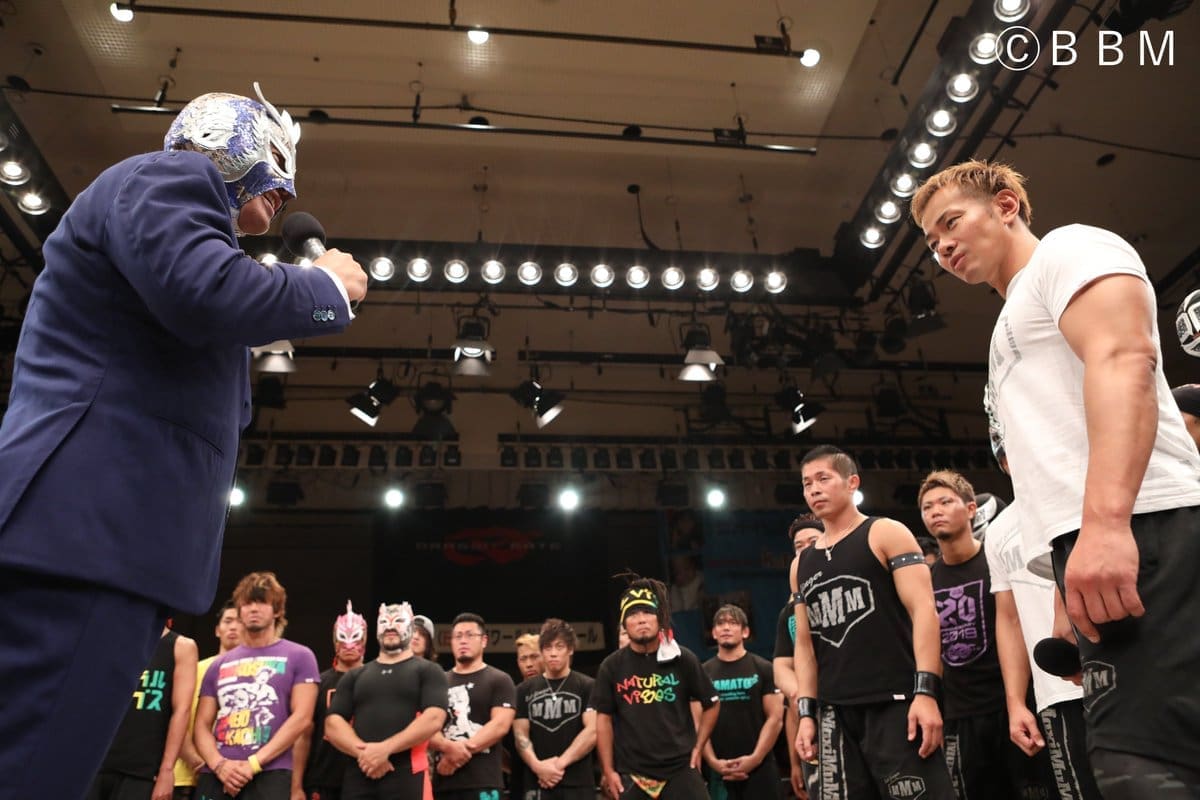
On May 6, 2003, Toryumon put one of its deepest truths right in the middle of the ring at Korakuen Hall.
CIMA defeated Ultimo Dragon with a mad splash in 20:04, and on paper that reads like a clean, simple result. In reality, it was much bigger than one wrestler beating another. It was a student beating the founder, the present stepping past the past, and a promotion quietly admitting that its future no longer belonged to the legend who created it.
That is why the match still matters.
Toryumon had been built as Ultimo Dragon's vision, a fast, flashy hybrid of lucha libre and Japanese junior heavyweight wrestling that helped shape a whole generation of talent. It produced a distinct style and an even more distinct identity. The promotion felt younger, faster and more mischievous than most of the major Japanese groups around it. It also produced its own breakout star in CIMA, the wrestler who most naturally embodied everything the project was trying to become.
By the spring of 2003, that much was becoming impossible to miss.
The Wrestling Observer Newsletter described the May 6 result as the official torch passing to CIMA as the promotion's top star. That framing fits because the decision was not subtle. Ultimo Dragon had already signed with WWE, and the expectation around the match was that he would lose on the way out and formally signal that a handover was underway. CIMA was not being elevated as an experiment. He was being acknowledged as the man the audience already saw as the center of the company.
That part is important, because wrestling history is full of ceremonial passes that never really take. Sometimes the veteran loses but keeps the aura. Sometimes the younger wrestler gets the win without truly inheriting the room. This felt different. CIMA had earned the role before the bell even rang. The match just made the promotion say it out loud.
There was also something fitting about the opponent. Ultimo Dragon was not just another established name on the roster. He was the architect of the entire world around them. Toryumon existed because of his reputation, his eye for talent and his ability to blend wrestling cultures into something that felt new. For one of his own students to beat him in the promotion's top singles match was not only a booking move. It was a statement about succession.
And it was a necessary one.
CIMA was already the kind of wrestler who could carry that burden. He had the speed, charisma and swagger to headline a promotion built around motion and personality. He could work at a blistering pace without losing the crowd, and he understood how to make the style feel emotional instead of just athletic. In a system full of gifted wrestlers, he felt like the one most ready to be the face on the posters and the answer when fans asked who mattered most.
What makes May 6 even more interesting in hindsight is how clearly it pointed toward what came next. The following year, Toryumon split and became Dragon Gate after Ultimo Dragon's exit. CIMA, as the last holder of the Ultimo Dragon Gym Championship, effectively carried that lineage forward and became the first Open the Dream Gate champion. In other words, the match at Korakuen was not just a symbolic passing moment that later became easy to romanticize. It was a real hinge point. The company that would emerge from the break was built around the man who won that night.
That gives the result a weight beyond nostalgia. A lot of promotions have one match you can circle as the moment their future ace stopped looking like a possibility and started looking inevitable. For this lineage, May 6, 2003 is that night.
It also says something about how wrestling promotions survive change. The easy version of history is to focus only on founders and visionaries. Those people matter, obviously. Without Ultimo Dragon, there is no Toryumon and no Dragon Gate as fans came to know it. But promotions last when the next generation becomes strong enough to stop being a tribute act. They need someone who can take the style, the audience and the expectations and make them feel alive without the creator standing at the center of every major decision.
CIMA was that wrestler.
That is why this was more than a respectful mentor-student showcase. If anything, its value came from the opposite. It drew a hard line. Ultimo Dragon was leaving. CIMA was staying. The promotion had to choose whether its identity was something preserved in glass or something that could move forward under new leadership in the ring. It chose movement.
You can trace a lot from there. Dragon Gate's eventual reputation for relentless pace, faction warfare and smaller wrestlers working main event matches in front of loud, loyal crowds did not appear out of nowhere. It needed a bridge from the founder's concept to the promotion's mature form. CIMA became that bridge. He was talented enough to honor what Toryumon had been, but forceful enough to make the next version of it feel like its own thing.
That is what makes the match feel bigger with distance. At the time, it was a high-level result in a promotion that many casual North American fans barely understood. Looking back now, it reads like one of those dates where a wrestling family tree visibly forked. One branch followed Ultimo Dragon into the next chapter of his career. The other stayed in Japan, hardened into Dragon Gate and kept growing under the man who beat him.
The cleanest wrestling history often comes in the simplest form. One ring. One finish. One result that tells you the future before everyone else can fully see it.
On May 6, 2003, CIMA pinned Ultimo Dragon at Korakuen Hall.
Toryumon was still the name on the building, but the future standing in the middle of it already looked a lot like Dragon Gate.