
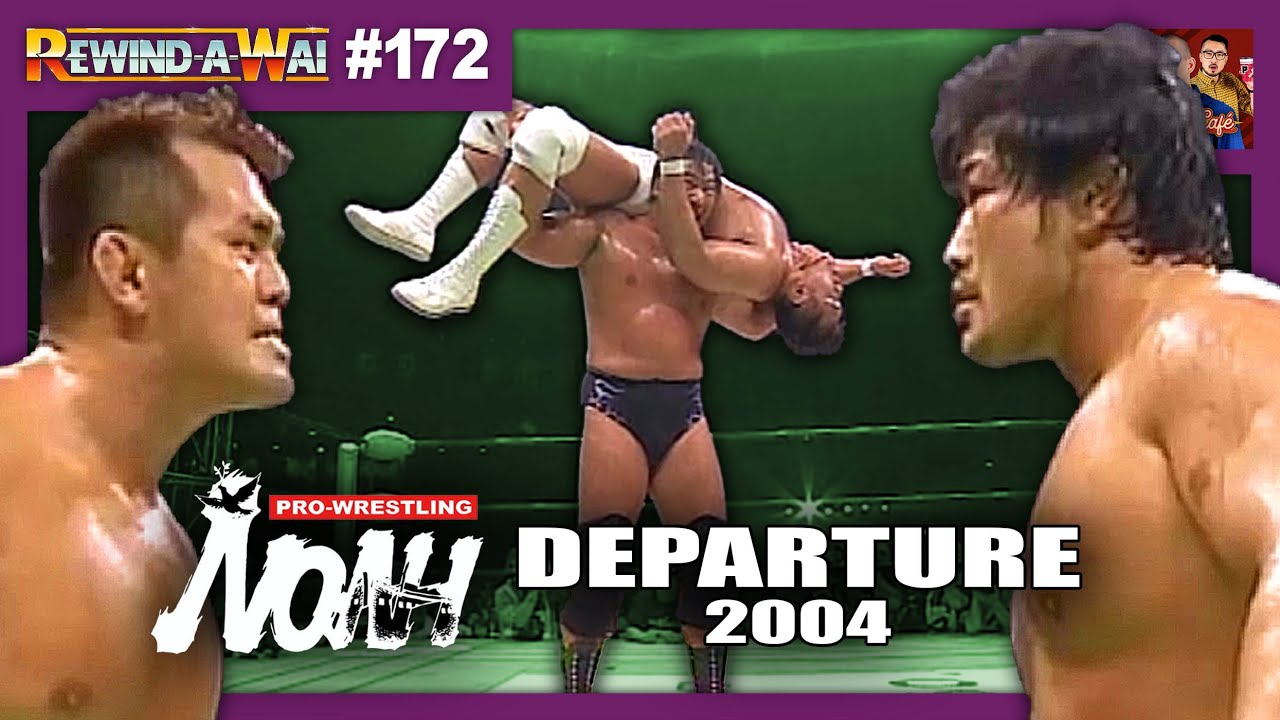
On July 10, 2004, Pro Wrestling NOAH walked into the Tokyo Dome for the first time and bet its biggest stage on the match it had spent years keeping in reserve.
Kenta Kobashi vs. Jun Akiyama was not a novelty attraction. It was not a crossover stunt. It was the kind of main event that told the audience exactly what NOAH believed it was: a promotion built on rivalry, memory, title prestige and the idea that one great match could carry an entire night.
That mattered because NOAH was still a young company in 2004. Mitsuharu Misawa had founded it only four years earlier after the All Japan exodus, and the promotion had quickly built a fierce reputation with fans who still wanted serious, high-level wrestling presented like a sport. Budokan Hall had become its home base, but the Tokyo Dome was something else entirely. Running that building meant declaring that NOAH was no longer just the keeper of an old tradition. It was trying to prove it belonged on the largest stage Japanese wrestling had to offer.
The right main event had to feel worthy of that jump, and Kobashi vs. Akiyama did.
Their history stretched far beyond one title defense. Akiyama's professional debut came against Kobashi on September 17, 1992. He lost that night, but even then he was clearly being marked as a serious prospect. Over the next decade they became linked to the same wrestling lineage, first in All Japan and then in NOAH, sometimes as rivals, sometimes as allies, always with the sense that another major singles match between them would mean something. By the time they met at the Dome, it was their first singles match against each other since December 23, 2000.
A lot had changed in the years between. Kobashi had become the heart of NOAH's championship identity, defeating Misawa for the GHC Heavyweight Championship on March 1, 2003 and carrying the belt with a rare kind of aura. Akiyama, meanwhile, had once looked like the natural future ace of the company, the man meant to carry it forward as Misawa and Kobashi aged. By mid-2004, he was still a major star, but the question around him had shifted. He was no longer just the chosen successor. He was the man trying to prove he could still seize the spot that seemed destined for him.
That gave the Dome match its tension. Kobashi was the champion everybody respected. Akiyama was the challenger who knew this might be his clearest path back to the very top. NOAH could have chased spectacle that summer. Contemporary Observer coverage noted that an earlier concept involved Kobashi defending against Bob Sapp, the kind of mainstream dream booking that would have made commercial sense. Instead, NOAH trusted its own identity and built the show around the match its audience had wanted for years.
That decision gave the night its soul.
The Dome card had major supporting pieces. Misawa and Yoshinari Ogawa defended the GHC Tag Team titles against Keiji Muto and Taiyo Kea in a historic inter-promotional attraction. Yoshinobu Kanemaru faced Jushin Thunder Liger. KENTA and Naomichi Marufuji defended the junior tag titles. But the event still lived or died on the final match, and Kobashi and Akiyama delivered exactly what the stage demanded.
Kobashi retained the GHC title in 35 minutes, 34 seconds, and the match became one of those performances that seems to leave every viewer describing the same feeling: exhaustion mixed with awe. Observer coverage from the time described it as a match-of-the-year level performance that drained the building by the end because the wrestlers kept finding another gear. That is the right way to understand it. This was not a carefully restrained championship match. It was two veterans emptying the tank because the company had put the Tokyo Dome on their backs.
The details are still ridiculous even now. Kobashi reached for a moonsault, something he was not throwing around casually by that stage, and Akiyama kicked out. Kobashi blasted him with the short-arm lariat and Akiyama survived that too. There was a brainbuster on the floor from Kobashi, the kind of spot designed to convince the audience they had seen the night's defining image, and somehow it was not the last one. Akiyama answered with an exploder off the top rope to the floor, a spot so violent that Kobashi barely beat the count back in and bled from the mouth afterward. Akiyama kept pressing, stacking exploders and nearly choking the champion out with a guillotine. Only after all of that did Kobashi finally put him away with the burning hammer.
That finish mattered. Kobashi did not escape. He did not steal one. He survived the best version of Akiyama and still finished him decisively. Then, in a small touch that fit the emotion of the moment, he acknowledged Akiyama over the house microphone after the match with the kind of respect only a rival of that depth can command.
What made July 10, 2004 so important was not only that the main event was excellent. It was that the match justified NOAH's entire gamble. The company did not need an outsider, a gimmick or a borrowed identity to make its first Tokyo Dome show feel major. It needed Kobashi, Akiyama and a title match rooted in years of shared history. That was enough.
It also said something lasting about Kobashi as champion. Wrestling has had plenty of long title reigns, but not all of them create myth. Kobashi's did because each big defense seemed to deepen his reputation instead of merely extending a number. By beating Akiyama in NOAH's biggest match to that point, he turned an already great reign into something closer to legend.
For Akiyama, the loss was painful but clarifying. He did not leave the match diminished. If anything, it confirmed why he remained so vital to the era. He was the perfect foil for Kobashi here, dangerous enough to make the title feel vulnerable, credible enough to make every near fall land, and tough enough to help create a main event that still stands as one of NOAH's signature statements.
That is why the match endures. It was a great bout on its own, but it was also a snapshot of a very specific wrestling ideal, one where legacy, championship status and emotional accumulation mattered as much as spectacle. On this day, NOAH reached the Tokyo Dome and proved that its most valuable asset was not size or flash. It was the ability to make a wrestling match feel like history.