
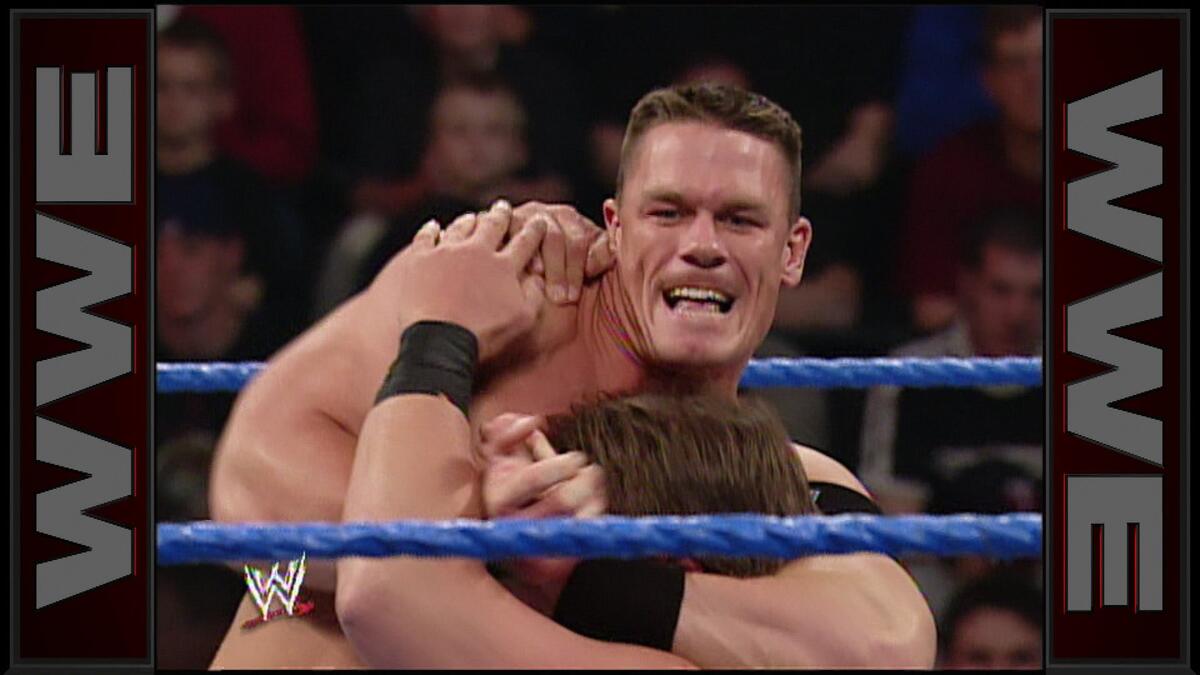
On May 22, 2005, John Cena did more than beat JBL again. He survived him, bled with him, and finally looked like a WWE champion fans could believe in.
That is what made Judgment Day matter. Cena had already beaten JBL at WrestleMania 21 to win the WWE Championship, but title changes and true acceptance are not the same thing. WrestleMania can crown a new face of the company. The harder part is convincing people that the guy can actually carry the role once the celebration is over.
At Judgment Day in Minneapolis, Cena and JBL solved that problem the messy way. They had an I Quit match, they used half the set, and they left with a bout that felt less like a standard WWE pay-per-view main event and more like a public stress test for the man WWE wanted leading SmackDown.
Why JBL was the right first test for John Cena
JBL was a perfect final boss for early champion Cena because he represented everything the old order still trusted. He could talk people into the building, he understood how to play the entitled bully, and he knew how to drag a fight into ugly territory if that was what the moment required.
Cena, by contrast, was still in the stage where people believed in parts of the act more than the whole package. The charisma was obvious. The promos connected. The crowd reaction was there. But in 2005, there were still real questions about whether he could make a top title run feel substantial once the chase was over.
That is part of why the stipulation mattered so much. An I Quit match is not built around finesse. It is built around pain, humiliation, and nerve. It asks the crowd to decide who they think is tougher when the shortcuts stop working. For Cena, that was ideal. He did not need a graceful technical masterpiece that night. He needed a fight that made people see him as durable, vindictive, and impossible to break.
JBL gave him exactly that kind of fight.
The night Judgment Day turned into a bloodbath
The match kept growing until it swallowed the whole ringside area. It started with brawling and mat work, then moved into the kind of escalating chaos that made the stipulation feel earned. JBL whipped Cena into the post, choked him with his belt, and busted him open with a chair. Cena answered by sending JBL through furniture, smashing him into the limo, and turning the arena floor into a junkyard.
By the end, both men were covered in blood and using the environment like they were trying to settle something personal rather than simply retain or win a title. Cena threw JBL through a television monitor. They fought over the limo and around the production setup. Then came the image people still remember, Cena stalking JBL with the exhaust pipe pulled from the truck as the challenger finally gave up before the next shot could land.
That finish was clever because it fit JBL's entire character. He had spent the better part of a year acting untouchable, loud, and superior. When the beating reached the point where he knew he could not bluff his way through it, he surrendered. The Wrestling Observer Newsletter called it probably the best match of either man's career and noted how strongly it established Cena as a tough-guy babyface. That was the key point. Cena did not just retain. He came out of the match feeling harder and more complete.
Even the post-match violence helped. Cena hit JBL with the pipe anyway and sent him crashing through the set. In another context that might have undercut the hero. Here it did the opposite. Fans did not want mercy from Cena in that moment. They wanted payback.
The match that made Cena feel like more than a coronation
A lot of title wins are remembered for the pop, the confetti, or the image of the belt being raised. The more important question comes a month later: did the champion feel more real after the first defense than he did on the night he won it?
For Cena, the answer on May 22 was yes.
WrestleMania 21 had made him champion, but Judgment Day helped define what kind of champion he was going to be. He was not presented as a cool antihero floating above consequences. He was positioned as a bruising, stubborn babyface who could take punishment, absorb the crowd's expectations, and still stand tall at the end. That was crucial for a performer WWE was asking to anchor a post-Lesnar, post-Attitude Era version of SmackDown.
It also closed the book on JBL as Cena's proving ground. JBL had been the established champion, the heat magnet, and the veteran foil. Once Cena beat him decisively in an I Quit match, there was no real argument left that the title still belonged to the previous era. WWE had made its choice, and the company now had a main event template for Cena that would follow him for years: put him in a fight, let him absorb a frightening amount of punishment, and trust that the crowd would rally to the idea that he simply would not stay down.
That formula became familiar later. In May 2005, it still felt fresh.
There is a reason this match holds up better than a lot of mid-2000s WWE pay-per-view main events. It was not just violent for the sake of spectacle. It clarified a star. Cena needed one night where the company and the audience could meet in the same place and agree on what he was supposed to be. Judgment Day gave him that.
Not every coronation becomes a reign. On this night, Cena's did.
Also on this date
May 22 has delivered other notable wrestling moments through the years. In 2001, Hayabusa beat Tetsuhiro Kuroda in Sapporo to win the WEW World Championship in one of FMW's defining late-era matches. In 2013, British legend Mick McManus died at 93, closing the story on one of the most famous villains U.K. wrestling ever produced.