
On July 18, 2005, Pro Wrestling NOAH went back to the Tokyo Dome with a card loaded for an important statement night. Mitsuharu Misawa was facing Toshiaki Kawada for the first time in five years. KENTA was challenging for the GHC junior heavyweight title. The company needed to prove that its first Tokyo Dome success had not been a one-off. And yet when people look back on that night now, the image that tends to survive above everything else is Kenta Kobashi and Kensuke Sasaki standing in the middle of the ring and hitting each other as hard as they possibly could.
That match was not just the standout bout on the show. It became one of the defining heavyweight fights of the 2000s, the kind of performance that still gets brought up whenever fans talk about modern Japanese classics. Kobashi won in 23:38, but the result is only part of why the date still matters. The larger story is that NOAH put two of the most feared, respected stars of their era in the same ring for the first time and got a match that felt as big as the building around it.
The first thing that made it special was the timing. Kobashi was already deep into one of the great peak runs any wrestler has ever had. He had won Match of the Year honors in 2003 against Mitsuharu Misawa and again in 2004 against Jun Akiyama, and by the summer of 2005 he was carrying the aura of a man who could make the impossible seem routine. Sasaki was the perfect opponent for that moment. He had built his reputation in New Japan, could match Kobashi physically in a way very few men could, and arrived in this match as the kind of outsider star who instantly made a NOAH Dome card feel even bigger.
Their first meeting also landed on a night when NOAH badly wanted a grand spectacle. Contemporary Observer coverage framed the show as the biggest money live event in wrestling at the time, with the promotion aiming to live up to the standard of its first Dome card the year before. The live crowd was reported at 52,000, with 62,000 announced, and the atmosphere clearly mattered. Observer coverage described Kobashi's entrance as blowing the roof off the Dome. That is not throwaway hype. It tells you the audience already understood they were about to see something important.
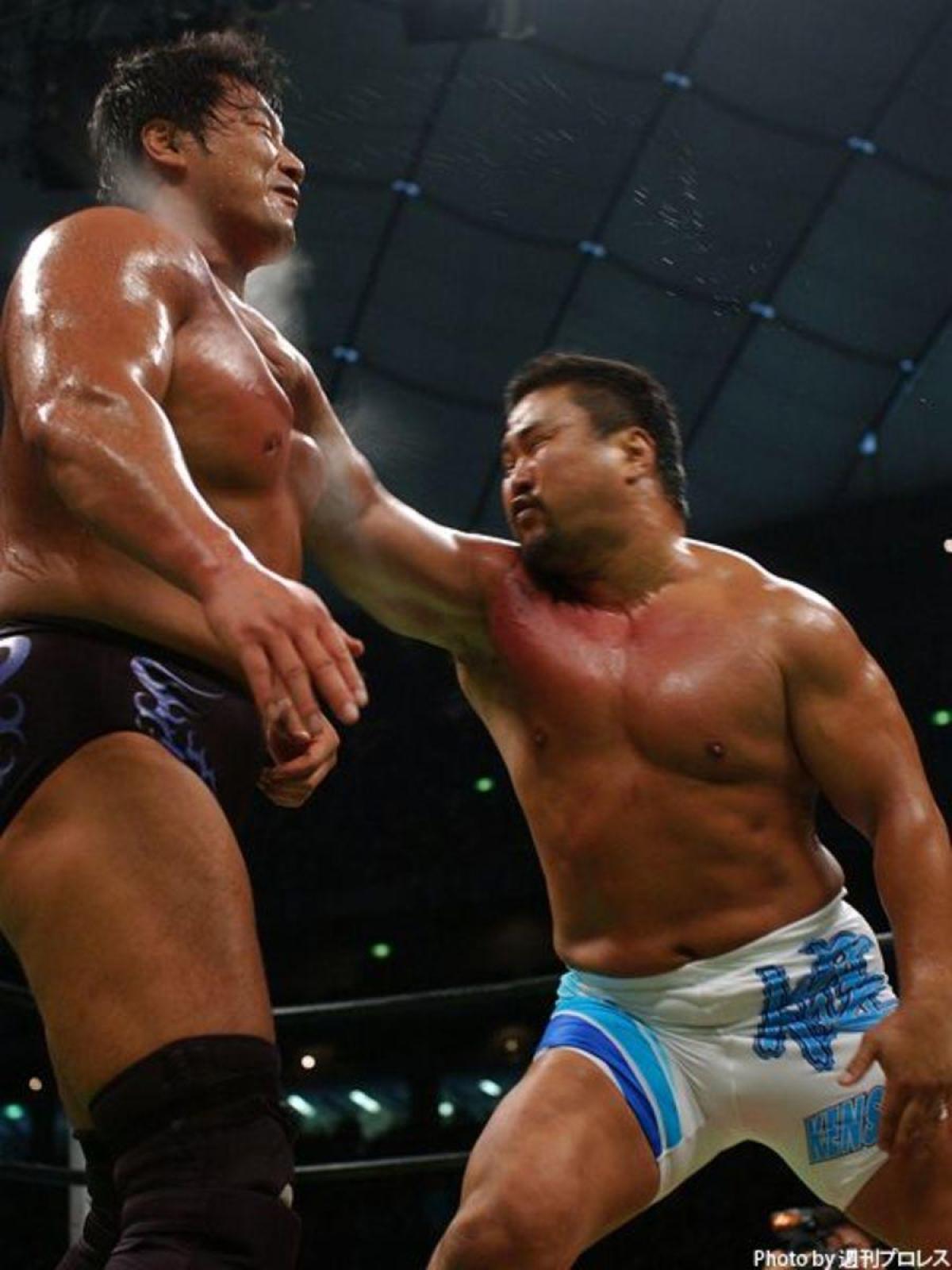
What followed was a match that seemed built to test how much punishment two men could absorb without ever losing their poise. Kobashi and Sasaki did not wrestle like they were trying to assemble a clever epic. They wrestled like two titans trying to establish whose violence meant more. Their chests were torn up early. They traded hard chops, lariats and suplexes with a level of force that made the match feel less like a performance and more like a dare.
The central sequence remains the reason the bout still feels alive all these years later. Around the midpoint, the two stood in front of each other and launched into an extended chop exchange that kept building instead of peaking quickly and moving on. The point was not just to show toughness. It was to let the crowd sit inside the absurdity of the struggle. Each man kept answering the other until the exchange stopped feeling like a spot and started feeling like the whole emotional center of the match. Observer coverage counted 189 chops in all and described the building reaching a fever pitch while the announcer practically pleaded for the moment to keep going.
The rest of the match never lost that edge. Sasaki hit a Northern Lights Bomb off the apron to the floor and nearly left Kobashi counted out. Kobashi answered with a top rope brainbuster, half nelson German suplexes and the sort of escalating punishment that had defined his best big matches. Sasaki kept finding near falls with his own power offense, refusing to let the match settle into any obvious finishing pattern. That is another reason the bout holds up so well. Even with two established legends working a giant stage, the match kept feeling unstable.
When the end finally came, it felt earned rather than arranged. Sasaki survived one Kobashi lariat. Kobashi then reached for the rare moonsault, only got a near fall, and had to keep digging. The finish came only after more spinning chops and two more lariats finally put Sasaki away. Then the fight gave way to something quieter. The two men embraced, and the match ended with a long standing ovation. That response matters because it captured what the audience had just watched. This was not simply a hard-hitting match that impressed people in the moment. It felt like a shared recognition that they had seen one of those performances fans spend years pointing back to.
The match also mattered for NOAH beyond the bell. This was a promotion still proving that its stars could fill the biggest buildings in Japan on their own terms, without sacrificing the identity that made the company hot in the first place. According to the Observer, people around the industry came out of the show feeling bullish about the future of Japanese wrestling, in part because the atmosphere reached a level even major combat sports events had struggled to match. Kobashi vs. Sasaki was the clearest proof of concept. If you protected top stars and gave people great wrestling, the ceiling was still there.
That is why July 18, 2005 holds its place. Misawa vs. Kawada was on the same card. KENTA won the GHC junior heavyweight title that night as well. On almost any other show, either of those developments could have been the lasting story. Instead, Kobashi and Sasaki produced the bout that swallowed the whole event. They turned a major Dome card into a monument to physicality, timing and crowd connection.
A lot of acclaimed matches age into museum pieces. People respect them more than they feel them. Kobashi vs. Sasaki is the opposite. It still feels immediate because the idea was so simple and the execution was so absolute. Put two giants in front of a massive crowd, let them fight for pride as much as victory, and trust that the force of what they do will carry the night. On this day in 2005, that faith paid off with a classic.