
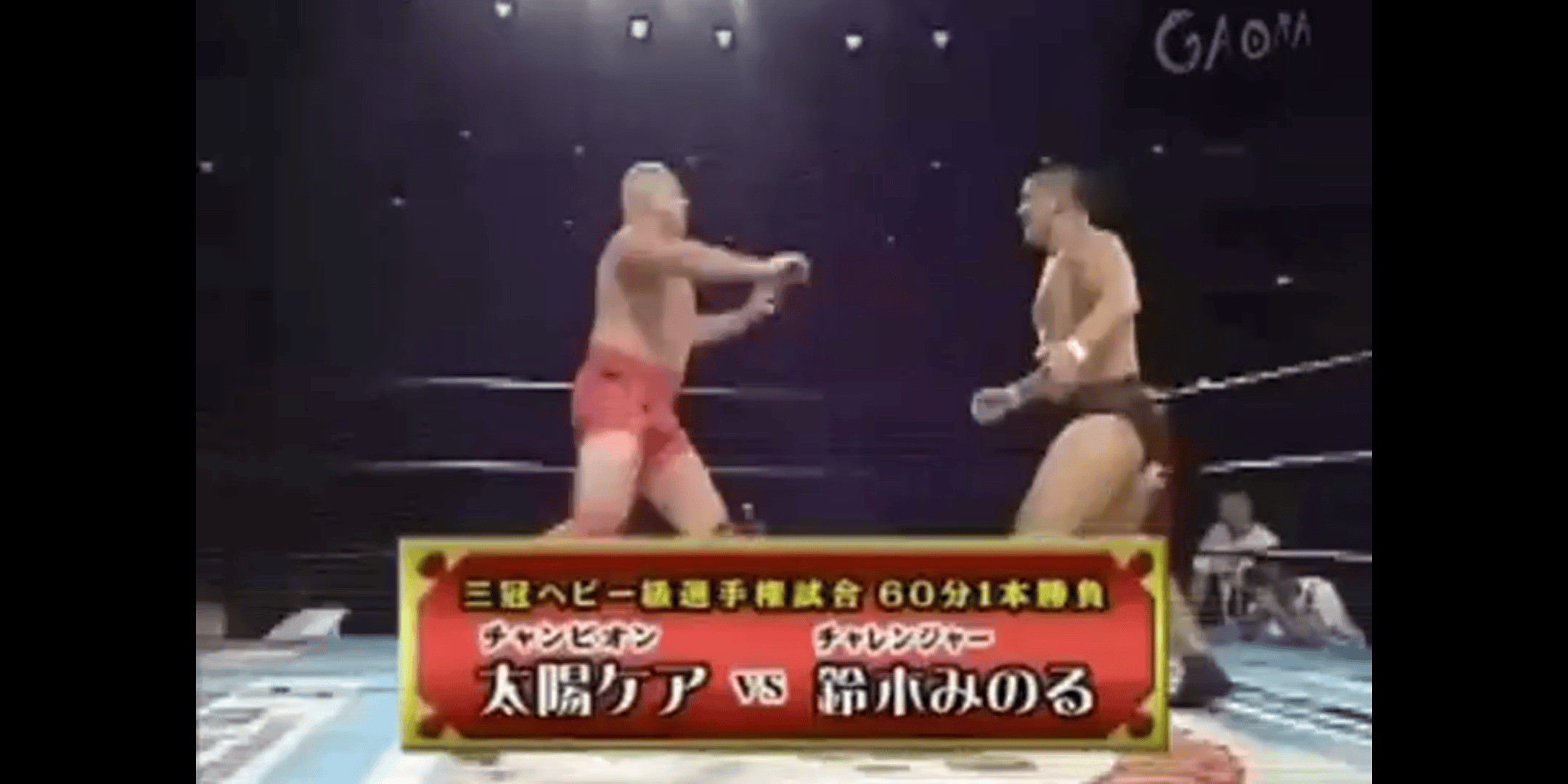
On September 3, 2006, Minoru Suzuki won the Triple Crown Heavyweight Championship from Taiyo Kea in Sapporo. That sentence sounds simple enough on paper. In practice, it felt like an attack on the idea of what an All Japan champion was supposed to be.
The Triple Crown had always carried a particular kind of weight. In All Japan, that belt lineage was tied to Giant Baba, Jumbo Tsuruta, Genichiro Tenryu, Mitsuharu Misawa, Toshiaki Kawada and the larger story of heavyweight wrestling in Japan. Even when the company changed, the title still represented a certain seriousness. It was supposed to belong to a wrestler who fit the house style, the house history, and the house sense of order.
Suzuki was almost designed to insult that order.
By 2006, he was already a legend for reasons that had very little to do with fitting neatly into a classic promotion structure. He had come out of the New Japan dojo, left with the UWF current, helped build Pancrase into one of the formative companies of mixed martial arts, and returned to pro wrestling with the aura of a man who did not particularly respect its politeness. When he walked into All Japan earlier that year, he did not arrive as a grateful guest or a respectful contender. He arrived as an intruder.
Suzuki's whole act was built to make All Japan uncomfortable
That was the genius of the 2006 run. Suzuki was not presented as a noble challenger trying to earn the old title. He was presented as an outsider from Pancrase, quicker than the roster, nastier than the roster, and openly dismissive of the roster.
The path to September 3 had been building for months. In March, Suzuki appeared in the aftermath of a Triple Crown title defense by Satoshi Kojima and immediately put himself in the middle of the title picture. In April's Champion Carnival, he tore through his block unbeaten, then mocked the promotion on the way, calling the All Japan wrestlers weak and talking as if the whole tournament existed for his amusement. Taiyo Kea, meanwhile, came through the same spring looking like the kind of man the company could trust. He beat Suzuki in the Carnival semifinals, won the tournament, and then defeated Kojima on July 3 to win the Triple Crown for the first time.
Kea mattered in this story because he represented survival.
He was not one of the towering Four Pillars stars from the 1990s, but he had grown up inside the All Japan system and stayed with the promotion through one of the most uncertain periods in its history. After the 2000 split reshaped the landscape, All Japan spent years figuring out what it still was. Kea was part of the answer. He had credibility, he had roots in the company, and by the summer of 2006 he looked like a champion who could carry tradition forward without pretending the calendar still read 1994.
That made Suzuki the perfect threat.
The finish mattered because Suzuki won like a vandal, not a savior
A week before the title change, Kea had beaten Toshiaki Kawada in a defense that was framed as a meaningful All Japan passing-of-the-torch moment. Then came Suzuki in Sapporo, and the mood changed completely.
Suzuki beat Kea in 34 minutes and 52 seconds, but the important part was how he won and what he turned the win into. He mocked Kea with a running clothesline, a deliberate nod to Giant Baba's old finish, then followed with his own choke, his choke suplex, and finally held the choke until Kea passed out. It was not just a title change. It was desecration used as storytelling.
That detail matters because the Baba clothesline was not random fan service. It underlined the point of the entire match. Suzuki was not trying to prove he belonged to the All Japan lineage. He was showing that he could grab its symbols, twist them, and use them against the promotion's own champion. In a company where heritage meant everything, that was a sharper weapon than a clean wrestling finish would have been.
Then Suzuki pushed it even further after the bell. He took the three belts to the back, stomped on them, and bragged that he could sell them on the internet. He also threw out challenges to Kojima and Keiji Muto, making it clear that winning the championship was only the beginning of the provocation.
That is why this title win still stands out. Plenty of championships change hands in wrestling history. Fewer of them manage to reframe the belt itself for a while. Suzuki did that here. For one night, the Triple Crown was no longer just All Japan's proudest emblem. It was evidence that the gates had been kicked open by a man who treated sacred objects like leverage.
Why the 2006 Triple Crown win still feels bigger than a single reign
Suzuki became the first wrestler to hold both the King of Pancrase crown and the Triple Crown, which by itself made the moment unusual. More than that, the win captured something important about Japanese wrestling in the 2000s. The walls between styles were thinner than they had been in earlier eras. Shoot-style credibility, mixed martial arts prestige, interpromotional movement, and old-school heavyweight lineage were all colliding. Suzuki was one of the few figures convincing enough to embody all of it at once.
For All Japan, the result was risky in exactly the right way. Kea as champion represented continuity. Suzuki as champion created tension. Continuity can steady a promotion, but tension is what gets people talking. In 2006, that mattered.
For Suzuki, the win was another reminder that he was never just an MMA curiosity visiting pro wrestling on the side. He could walk into one of the most tradition-bound main event scenes in the world and bend it around his own personality. That became a running theme of the later stages of his career, whether in All Japan, New Japan, NOAH, or elsewhere. The grin, the malice, the contempt for ceremony, all of it worked because there was always substance behind it.
September 3, 2006 was one of the clearest examples. Minoru Suzuki did not just win the Triple Crown. He made the championship feel vulnerable, and in doing so, made it feel important all over again.