
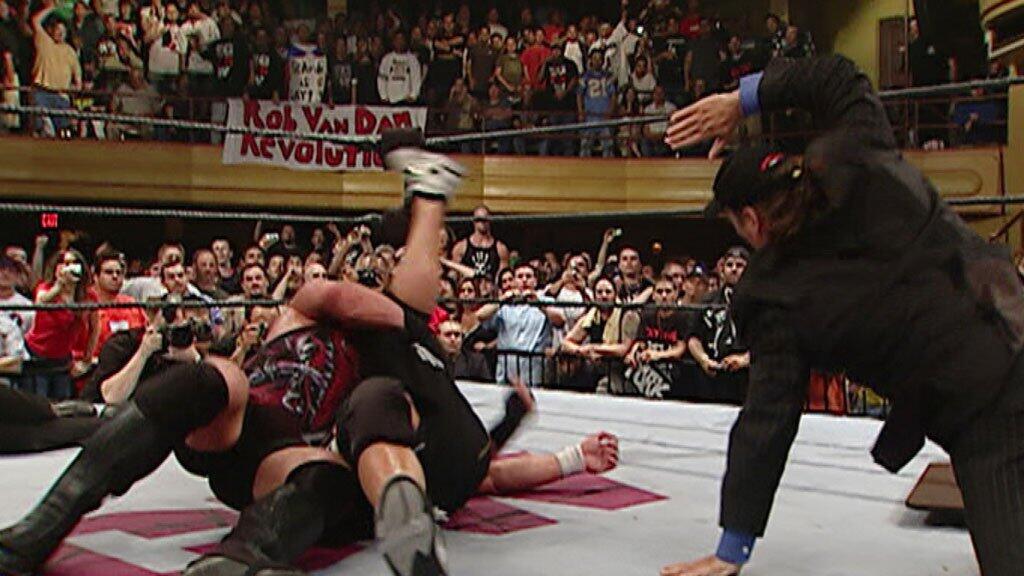
On June 11, 2006, WWE walked into the Hammerstein Ballroom with its top championship and one of its biggest stars. By the end of the night, Rob Van Dam was holding the belt, Paul Heyman was counting the fall, and John Cena had survived one of the most openly hostile crowds any company babyface has ever faced.
That is the clean version of what happened. The real reason the night still sticks is that it felt like two wrestling worlds crashing into each other in the same ring.
Van Dam had won Money in the Bank at WrestleMania 22 and did something that still felt unusual at the time. Instead of waiting to ambush a wounded champion, he picked his shot in advance. He told Cena he wanted the WWE Championship match at ECW One Night Stand, on ECW's own turf, in front of the fans who had spent years treating him as one of their own. That was not just a challenge. It was a promise that WWE's clean-cut franchise star was about to be dragged into the one room least likely to welcome him.
The timing mattered. WWE was not simply running another nostalgia reunion. It was relaunching ECW as a full-time brand, with a television debut set for two days later. That made the pay-per-view more than a tribute show. It was a test of whether ECW could still mean something beyond memory, and whether Van Dam could be the bridge between the old cult identity and the new corporate version WWE was trying to sell.
The atmosphere answered that question before the bell even rang. The crowd treated Cena like an invading force. Fans pelted him with toilet paper. When he threw his shirt into the audience, it came flying back. Then it happened again, and again, until the whole exchange turned into a ritual humiliation. Every chant carried the same message. This was not his building, not his audience and definitely not his night.
What made the match so memorable is that Cena never folded under any of it. He leaned into the role, kept his composure and worked like a man who understood that the reaction itself was the story. Van Dam gave the crowd the spectacular offense they wanted, from the rolling thunder onto a chair to the split-legged moonsault attempt and the Five-Star Frog Splash hanging over the finish. Cena, meanwhile, played the spoiler with exactly the kind of smug resilience the room hated. He kept trying to impose a WWE title match on an ECW riot.
The bout was hardly a pristine technical classic, and it did not need to be. It was built on tension, crowd energy and the feeling that the room might explode if the wrong man won. Late in the match, Cena locked on the STFU and looked like he might smother the dream right there. Van Dam reached the ropes. The referee got bumped. Then came the turn that made the finish feel like a street celebration instead of a normal title change. Edge emerged in disguise, speared Cena through a table, wiped out the replacement referee, and left the door open for Heyman to sprint in and count the pin after Van Dam hit the frog splash.
That finish told you everything about the night. In a strict sense, it was a protected win. In an emotional sense, nobody in that building cared. Van Dam got the three-count over Cena, won the WWE Championship for the first time, and gave the ECW faithful the payoff they had come to demand. The post-match scene mattered as much as the pinfall. Wrestlers and ECW figures flooded the ring, the celebration spilled outward, and for a moment the revival did not feel like a branding exercise. It felt like the old spirit had forced its way back onto center stage.
That is why the match matters historically. It was the peak of WWE's ECW revival, not because the revived brand would go on to fulfill all that promise, but because this was the one night where the idea fully connected. Van Dam was the perfect choice for that role. He had the credibility of an ECW original, the athletic style that fit the room, and enough mainstream WWE status to make the title win feel real. If WWE was going to ask fans to believe ECW still had bite, putting its top belt on Van Dam inside the Hammerstein was the strongest argument it could make.
The match also became an important chapter in Cena's story. He lost the title, but he left with something else. This was one of the clearest early examples of Cena understanding how to work against a crowd that rejected him on principle. He did not try to charm them into changing their minds. He let the hostility sharpen the performance. In that sense, One Night Stand became part of the foundation for the version of Cena who would spend years thriving in split arenas and impossible atmospheres.
Van Dam's reign did not last long, and the revived ECW never entirely became what either side of that audience wanted it to be. Even so, the image of Van Dam standing tall with the WWE Championship endures because it captured a rare moment when a company, a wrestler and a fan base all needed the same finish for different reasons.
ECW fans wanted proof that their world had not been fully absorbed. WWE wanted a dramatic launch point for a new brand. Van Dam wanted the biggest singles victory of his career. For one furious night in Manhattan, all three got it.