
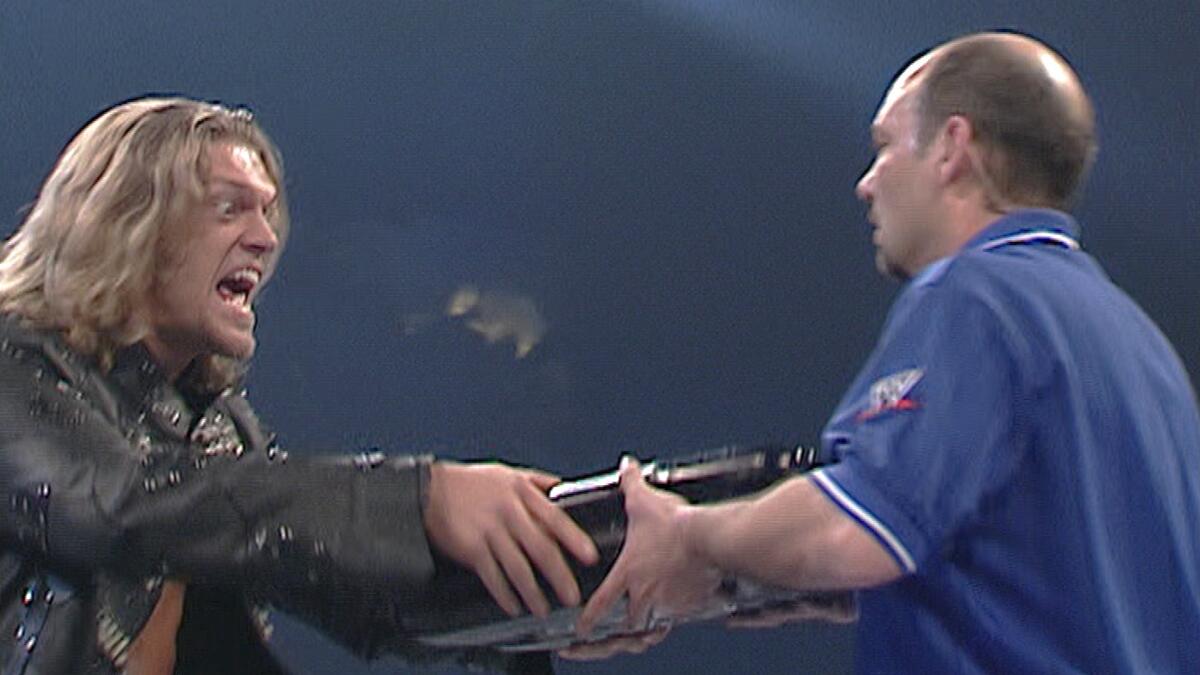
On May 8, 2007, Edge did what Edge was built to do. He found the chaos, waited for the exact second when somebody else had done all the suffering, and walked away with the World Heavyweight Championship.
That night in Pittsburgh, SmackDown closed with one of the sharpest pieces of opportunistic booking WWE ever pulled off. The Undertaker had only recently beaten Batista for the title at WrestleMania 23 and looked set for a major run as the blue brand's centerpiece. Instead, a torn biceps changed everything. By the end of the night, Undertaker was hurt, Batista was empty-handed, and Edge had turned an emergency rewrite into the first World Heavyweight Championship reign of his career.
The first part of the story was the steel cage match. Undertaker and Batista were already in the middle of one of WWE's strongest heavyweight rivalries of that period, and the rematch on SmackDown felt big enough that it could have headlined a pay-per-view. They wrestled like two men trying to break each other rather than simply win. The finish only added to the mayhem. Both men escaped the cage at virtually the same time, forcing officials to go to replay before ruling the match a draw.
In most cases, that kind of finish would have been the talking point all by itself. Instead, it only set the table.
Mark Henry returned and attacked Undertaker after the match, leaving the champion even more vulnerable. Then came Edge, who had only just taken possession of the Money in the Bank contract less than a day earlier after Mr. Kennedy's injury blew up the original plan. In storyline, it was ruthless. In practical terms, it was WWE solving one crisis by creating a much hotter one.
Edge did not need a long match, and that was the whole point. Undertaker had already survived Batista and then been mauled again. Once the bell rang, Edge blasted him with a spear and took the title. It was fast, mean and completely in character. There was no pretense of honor, no illusion that he had been the better man that night. He had simply been the smartest vulture in the building.
That is why May 8, 2007 still stands out. Plenty of title changes are remembered for greatness in the ring. This one is remembered for timing. Edge had spent years sharpening the "Ultimate Opportunist" identity, but this was the moment the gimmick hit its cleanest form. He did not just cash in a contract. He weaponized circumstance. The champion was injured, the challenger had softened him up, the backup attack had already landed, and Edge arrived at the exact second when the title was least protected.
There was also something uniquely effective about the way the real-life situation bled into the on-screen story. Undertaker's injury was serious enough that plans had to change quickly, and the company clearly needed a new direction at the top of SmackDown. Rather than papering over that instability, WWE leaned into it. The abruptness became part of the drama. Viewers were not watching a long coronation. They were watching a top star snatch control of a brand in the middle of a storm.
That mattered for Edge as much as it did for the championship. He was already an established main event name by 2007, but this title win gave him a different kind of authority. On Raw, he had been a headline heel. On SmackDown, this move made him the center of the show. It also gave the brand a villain fans could immediately invest in chasing, because nobody watching that scene was supposed to feel like he had earned anything honestly.
It also deepened the Undertaker side of the story. One reason the cash-in has lasted in wrestling memory is because it felt like a theft, not just a defeat. Undertaker was not beaten at full strength in a straight fight. He was trapped by the calendar, by injury, by Batista's punishment, by Henry's attack, and finally by Edge's timing. That made the moment sting more, which in wrestling usually means it works better. A hero's loss matters most when fans feel it was taken from him.
The ripple effect lasted well beyond that episode. Edge's reign helped stabilize SmackDown at a moment when the title picture could have easily felt patched together, and his feud with Undertaker became one of the defining programs of that era. In that sense, May 8 was not just a clever angle. It was a pivot point. A forced change became a genuine direction change.
There are more athletic world title wins in WWE history. There are cleaner classics and more emotionally uplifting moments. But this one endures because it captured professional wrestling's cruel side so perfectly. Great wrestlers do not always lose because somebody is better. Sometimes they lose because another star understands the rules of the game more coldly.
On that night in Pittsburgh, Edge understood them better than anyone. He saw a wounded champion, a disputed cage match, a returning monster, and a briefcase full of permission. A minute later, the World Heavyweight Championship was his.
That is why May 8, 2007 deserves its place in wrestling history. It was not just a cash-in. It was the night Edge turned opportunism into an art form.