
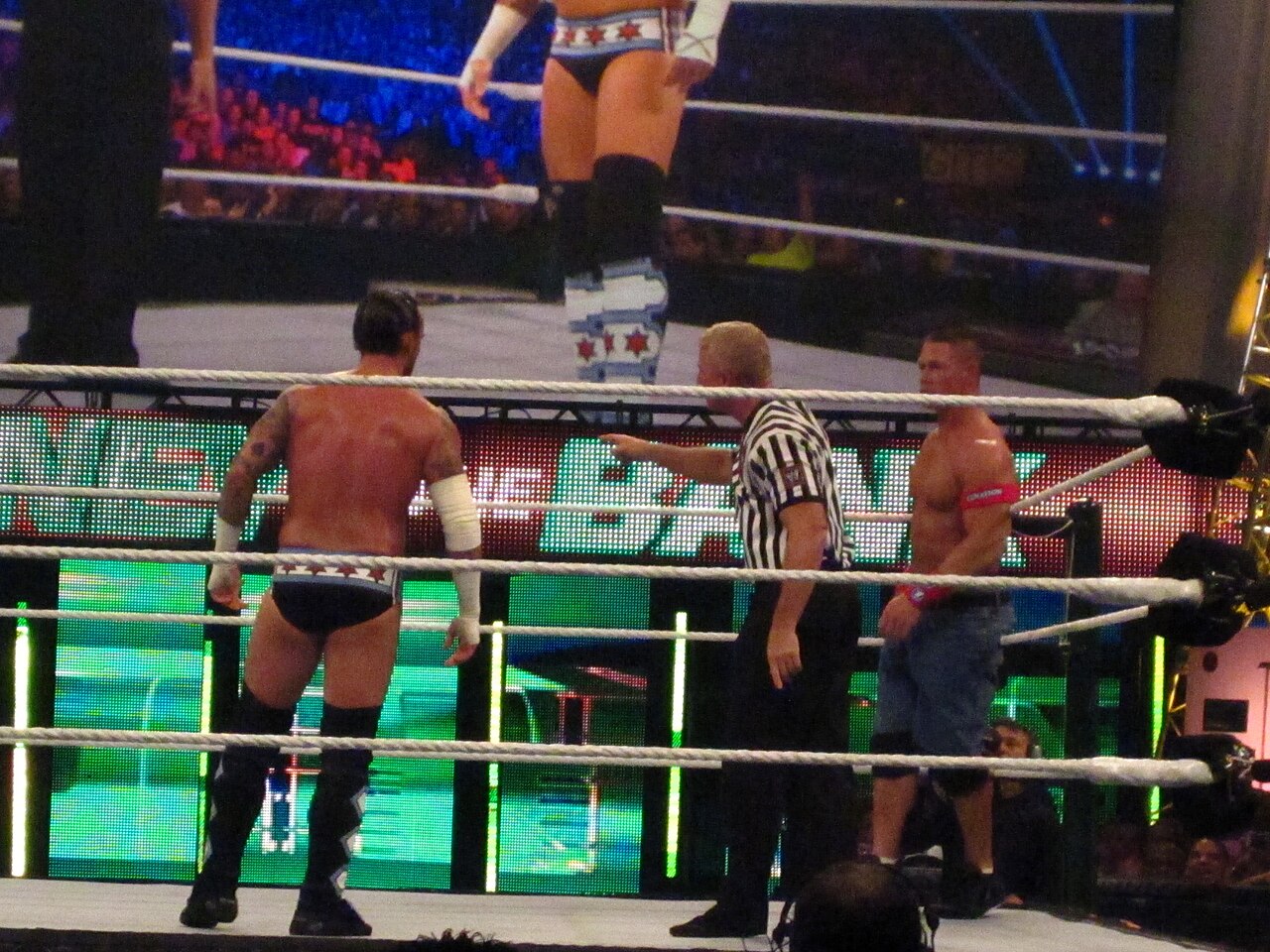
On August 14, 2011, WWE had the chance to give its hottest story of the year the kind of clean, lasting ending fans almost never get. For a few minutes at SummerSlam, it looked like that was exactly what was happening.
CM Punk beat John Cena in Los Angeles to settle the question of who the real WWE champion was. The crowd inside Staples Center got the result it wanted, Punk got his hand raised in the main event, and the company seemed ready to cash in on the momentum that had been building around him for weeks. Then Kevin Nash walked in from the crowd, dropped Punk with a Jackknife Powerbomb, and Alberto Del Rio cashed in Money in the Bank to leave with the title.
That finish is why the night still lingers. Punk and Cena delivered a match worthy of the buildup, but the image people remember is Del Rio stepping over the wreckage and turning a triumph into an ambush.
Punk and Cena arrived with WWE's biggest summer stakes in years
By SummerSlam, this was far more than a routine title match. Punk had already forced WWE into one of those rare moments where the company felt like it was reacting to the audience instead of dragging it behind the booking. Cena was still the central figure in the promotion, the man every major angle eventually had to orbit, but Punk had become the wrestler making the product feel urgent.
That made the rematch fascinating. Money in the Bank in July had given Punk a breakthrough victory and an atmosphere that felt bigger than a normal B-show main event. SummerSlam was supposed to answer the harder question: could WWE follow through once the shock of the first moment was gone?
The setup was simple and effective. Cena still held WWE's institutional authority. Punk held the emotional temperature of the audience. Triple H, now in his authority role and serving as guest referee, was there to guarantee an undisputed champion. WWE promoted the match like a major historical fork in the road, and for once that did not feel like empty hype.
There was a real sense that the company had wandered into something alive.
The match worked because the crowd never treated it like a rerun
The danger with a rematch this soon after a beloved first chapter is that fans start comparing every sequence in real time. Punk and Cena avoided that trap by leaning into what each man represented instead of trying to recreate the July magic beat for beat.
Punk had the support, the buzz and the sharper edge. Cena had the gravitational pull that came from being WWE's main character for so long. Even in a building that clearly wanted Punk to win, Cena still drew the loudest split reactions. That was part of the match's electricity. Punk was the cooler choice, the rebel choice, the crowd's choice. Cena was still the standard the company measured itself against.
So the bout became less about novelty and more about control. Punk had to prove his rise was not a one-night surge. Cena had to prove the story still ended with him. The following Observer issue noted that the crowd was behind Punk as a personality, but once the bell rang, so much of the live reaction still centered on Cena. That is what made Punk's eventual win matter. He was not beating a fading symbol. He was beating the man WWE still trusted most.
When the finish first came, it felt decisive enough. Punk hit another Go to Sleep, Triple H counted three, and the rematch was over. The complication was immediate, with Cena's foot clearly on the rope. WWE had protected its top star, protected the referee figure, and still put Punk over. It was classic company thinking, everybody covered, nobody fully exposed.
But even with that wrinkle, Punk had won the match that mattered.
For a few moments, that was enough.
Alberto Del Rio turned Punk's coronation into a theft
Then WWE made the choice that defines the night.
Nash returned, under his own name rather than the Diesel identity, and flattened Punk with the Jackknife. Del Rio, who had spent the previous year being positioned as a future top champion, rushed in with the briefcase, kicked the already-downed Punk, and pinned him in seconds.
In one sense, the booking was easy to understand. Del Rio got his title win. Punk stayed protected because he had to be blindsided before losing. Cena had his excuse because the referee missed the rope break. Triple H was immediately pulled deeper into the chaos. On paper, everybody still had somewhere to go the next night.
In another sense, it was exactly the sort of finish that made fans wary of trusting WWE's biggest moments.
Punk had just done the hard part. He had survived the scrutiny that comes after a breakout. He had beaten Cena again, this time on one of WWE's biggest stages. Instead of letting that accomplishment breathe, the company immediately moved the spotlight somewhere else. Del Rio became champion, but the emotional center of the night was not really his. It was the interruption itself, the sense that WWE could not quite leave a crowd alone with the result it wanted.
That is why SummerSlam 2011 feels so different in memory from Money in the Bank 2011, even though both shows are tied to the same story. Money in the Bank felt like a payoff. SummerSlam felt like a hedge.
Why August 14 still matters in WWE history
SummerSlam 2011 remains important because it captured both the best and worst instincts WWE had at the same time.
At its best, the company recognized it had stumbled into a genuine main-event feud and let Punk and Cena carry it like stars. The match was hot, the stakes were easy to understand, and the building felt like it knew it was watching something important. Observer coverage from the week after the show described SummerSlam as a good event overall, but the key point was that the booking around the main event was designed to protect everyone involved. That was probably true. It was also the problem.
WWE often trusts protection more than permanence. Punk beating Cena clean and standing tall at the end would have forced the company to live with one clear answer. Instead, SummerSlam produced a maze of answers. Punk won, except the referee missed the rope. Del Rio left as champion, except nobody really left talking about him first. Cena lost, except he was still insulated. Triple H had authority, except his authority instantly looked compromised.
That kind of layered finish can keep television moving. It can also drain the power from a night that should belong to one person.
And that is the enduring pull of August 14, 2011. It was the night CM Punk proved he could win on the biggest summer stage WWE had, and the night WWE immediately showed how uncomfortable it could be with simply letting that mean what it looked like it meant.
Also on this date, WCW held its 1995 New York press conference to formally launch Nitro as a national Monday night play, and Lita beat Mickie James for the WWE Women's Championship at Raw tapings in 2006. August 14 has produced its share of consequential wrestling turns, but SummerSlam 2011 still stands out because it gave fans a victory, then took away the clean feeling of it before the cheers had even died down.