
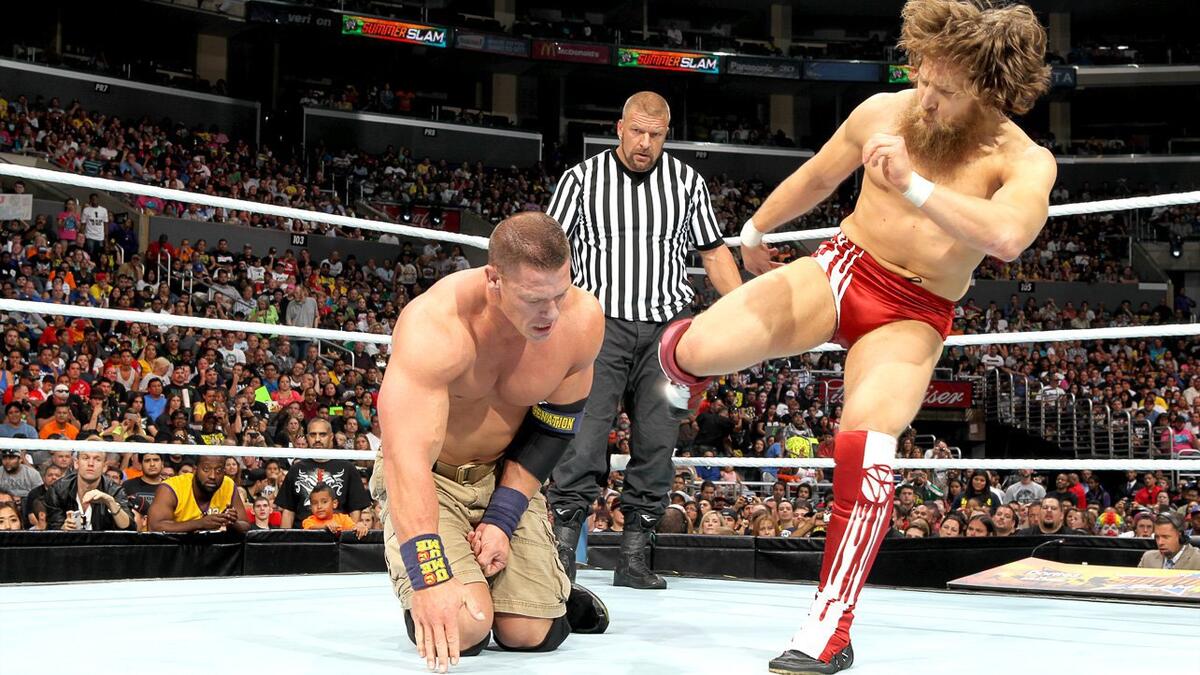
On August 18, 2013, WWE gave Daniel Bryan the kind of moment fans had spent all summer begging for, then took it away before the confetti had even finished falling.
SummerSlam at Staples Center in Los Angeles is remembered for the image people still replay in their heads: Bryan finally beating John Cena for the WWE Championship, arms raised, crowd in full voice, only for Randy Orton's music to hit and Triple H to turn the celebration into a setup. Bryan won the biggest match of his career that night. He also walked out having been used to launch a much bigger fight.
That is why this date still matters. It was not just a twist ending at a major pay-per-view. It was the night WWE fully learned how powerful Bryan had become with its audience, even while the company was still trying to control exactly what kind of top star he would be.
Daniel Bryan and John Cena gave SummerSlam its payoff
Bryan entered the match as the wrestler fans had chosen for themselves. The Yes movement was no longer a quirky chant or a side act. It had become the emotional center of WWE television. Cena, still the company's biggest full-time name, leaned into that reality by choosing Bryan as his SummerSlam opponent and treating the match like a genuine test rather than a novelty challenge.
That mattered because Bryan had spent months being talked down to on screen. Vince McMahon questioned his look, his polish and even whether he could represent the company as champion. The story worked because it reflected a very real tension in WWE at the time. Bryan was too good in the ring, too organic with crowds and too impossible to ignore for the usual image rules to settle the argument.
The match itself landed exactly the way it needed to. The following week's Observer coverage treated the show as one of the strongest SummerSlams in years, and Bryan against Cena was at the center of that praise. Cena was working through a torn triceps and still insisted on doing the job clean before leaving for surgery. Bryan beat him in the middle of the ring after 27 minutes with the running knee that was becoming one of the promotion's most protected finishes.
That clean win is the detail people sometimes forget because of everything that happened next. Before the swerve, Bryan had already made the leap. He did not steal one. He did not survive interference. He beat Cena straight up on one of WWE's biggest nights, with the crowd roaring for him almost from bell to bell.
Randy Orton and Triple H changed the meaning of the night
The genius of the angle was in the pause.
Orton came out with the Money in the Bank briefcase while Bryan was still celebrating. For a second, it looked like he might only be teasing the cash-in. Then he stopped, turned back, and the trap snapped shut. Triple H, who had refereed the match almost invisibly up to that point, hit Bryan with a Pedigree. Orton cashed in and won the title in seven seconds.
It was a classic WWE power play, but it worked because the crowd instantly understood what had been taken from them. Orton had been cheered in plenty of places that year, even when he was acting like a heel. Here, fans booed because the idea of Bryan's moment being stolen felt bigger than their feelings about Orton himself. The company had found the exact emotional nerve to press.
It also solved a business problem for WWE in storyline form. Cena was about to disappear for months. CM Punk was back on the babyface side. Bryan had become too hot to cool off. Orton, aligned with the McMahons, gave the company a corporate champion and Bryan a target bigger than a belt. What happened at SummerSlam was not just a screwjob finish. It was the opening scene for the power structure that soon hardened into The Authority.
Why SummerSlam 2013 still echoes through Bryan's career
If Bryan had simply won and gone home champion, it would still be a memorable night. What made August 18 feel historic is that the finish turned a title victory into a movement story.
Bryan was no longer just the best worker trying to prove he belonged. After SummerSlam, he became the wrestler fans saw as their answer to WWE's old instincts. Every time the company put another obstacle in front of him, the audience pushed harder. That reaction carried through the fall, survived the detours, and eventually fed into one of the loudest WrestleMania coronations the company has ever produced the following spring.
There is also a reason the angle has aged better than a lot of shock endings from the same era. It did not erase what Bryan achieved that night. In a strange way, it confirmed it. WWE only pulls the rug that hard when it knows the audience is deeply invested in the person standing on it. Bryan had reached the point where a seven-second cash-in could create outrage instead of resignation.
A lot of SummerSlam main events are remembered for who won. August 18, 2013 is remembered for something slightly different. It was the night Daniel Bryan proved he was already a top star, and the night WWE chose to make that truth fight its way through the system before it could be celebrated for good.