
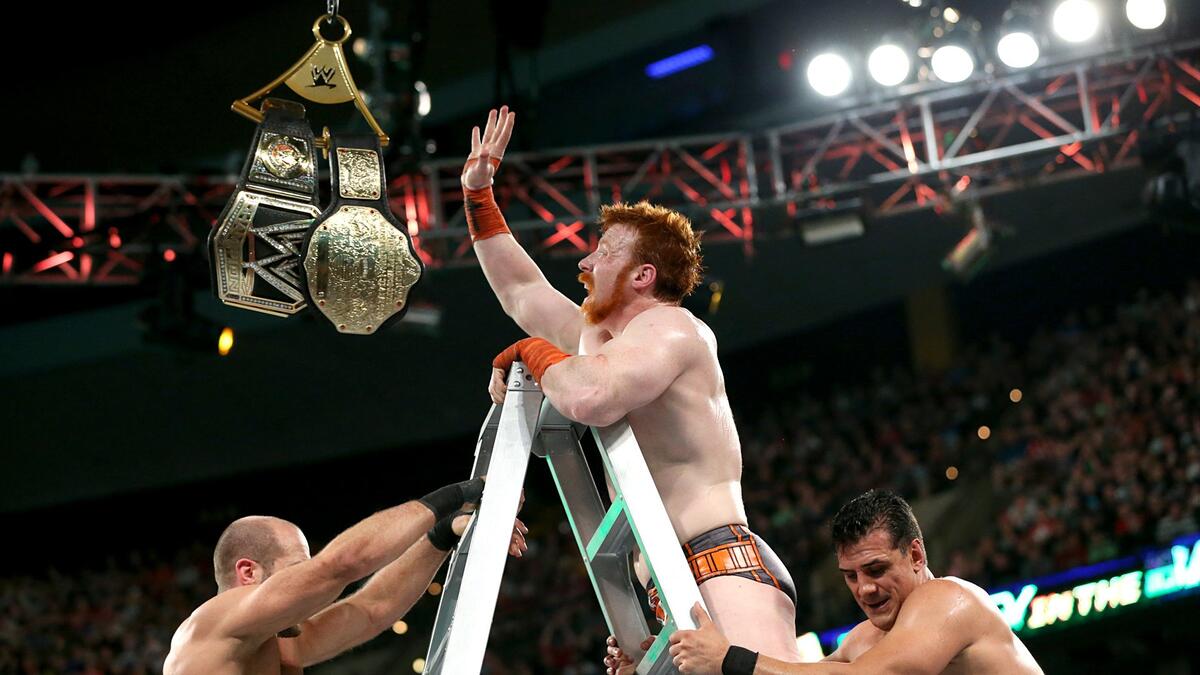
June 29, 2014 was one of those WWE nights that felt huge in the moment and even more revealing in hindsight.
John Cena had already been world champion so many times that another title win could have been treated like routine maintenance. Instead, his victory in the Money in the Bank main event became something more important than a number on a graphic. It was the company reaching for its safest possible answer at exactly the moment its bigger plans had fallen apart.
Daniel Bryan was out after neck surgery. The title had been vacated. WWE needed a new champion before SummerSlam, and it needed one while the audience was still loudly split over who the future really belonged to. Roman Reigns was gaining momentum fast. Brock Lesnar was waiting in the distance as the next monster challenge. Seth Rollins had already won the Money in the Bank contract earlier that same night, which meant the top of the card suddenly came with a built-in threat hanging over it.
Into all of that uncertainty stepped Cena, who beat Roman Reigns, Randy Orton, Bray Wyatt, Cesaro, Sheamus, Kane and Alberto Del Rio in Boston to leave with the vacant WWE World Heavyweight Championship.
That was his 15th recognized world title reign, one short of Ric Flair's famous 16. More importantly, it was a reminder of what Cena represented to WWE whenever the company felt unstable. He was not always the most exciting choice, and by 2014 he was certainly no longer the newest one, but he was the choice management trusted when the stakes got high and the room started to wobble.
The match reflected that tension from the start. This was not just a ladder match built around spectacle. It was a ladder match built around competing futures.
Reigns was the rising powerhouse, already getting reactions that suggested WWE had found the next centerpiece babyface if it wanted to commit. Cesaro had recently been paired with Paul Heyman and was still carrying the glow of his breakout spring. Bray Wyatt felt like a genuine wild card, the kind of act who could be heated up into something bigger at any moment. Orton and Kane were there as clear extensions of The Authority, with the story openly leaning into the idea that Triple H and Stephanie McMahon wanted the title brought back under their control.
Cena was the familiar constant inside that chaos.
The match itself played to that idea well. Kane kept clearing paths for Orton. Reigns had bursts where the building seemed ready to follow him all the way to the belts. Bodies crashed, ladders tilted, and the ring filled with the sort of wreckage that makes these matches feel less like contests and more like survival drills. WWE's own coverage leaned hard on the visual of Cena climbing above a ring full of damage, and that image still gets to the heart of why the finish worked.
He did not win because he felt fresh. He won because he felt reliable.
Contemporary Observer coverage made clear that the decision had been shaped by Bryan's uncertain recovery and by the company's bigger SummerSlam direction. Once Bryan could not return in time, Cena became the practical answer. Putting the championship on Reigns that early risked rushing a push that had not yet reached its natural peak. Going all the way with Wyatt would have been bolder, but it was not the route WWE trusted. So when the title picture suddenly needed a stabilizer, Cena was the man they turned back to.
That made the crowd reaction especially important. There was always a chance the result would trigger the kind of backlash that followed other heavily managed WWE coronations from that era. Instead, the story of The Authority trying to hand the match to Orton gave Cena a cleaner lane to the finish. He was still a divisive figure, but in that moment he was also the wrestler stopping a worse outcome. That balance mattered. Cena did not have to become universally beloved in Boston. He just had to feel like the right winner on that night, and he did.
The historical significance of the match comes from what happened next as much as what happened in the ring.
Cena's 15th world title reign was never really about starting a new long-term chapter for him. It was about bridging WWE from the interrupted Bryan moment into the looming Brock Lesnar collision at SummerSlam. Within weeks, the company was already framing Cena and Lesnar as the major direction, and the title win on June 29 made that possible. Without this result, the entire shape of that summer changes.
That is why the victory still matters. It sits at the intersection of several important WWE timelines at once. Bryan's first true run on top had been derailed by injury. Reigns was inching toward the role the company eventually wanted for him. Rollins had the briefcase and the kind of opportunistic positioning that would define the next stage of his rise. Lesnar was about to flatten Cena in one of the most decisive main event beatings WWE had ever presented on a major show.
Cena's win is the hinge between those stories.
It also says something useful about how WWE viewed him by that stage of his career. He was only 37, but he was already being used less like the young hero of the present and more like the institution you could plug into any crisis. That is a different kind of stardom. Not every top act gets there. The company no longer needed Cena to be the future. It needed him to make the future manageable.
That is not as romantic as an underdog breakthrough or as shocking as an upset, but it is a real kind of wrestling importance. Promotions are defined not only by the stars they create, but by the stars they trust when plans collapse.
On June 29, 2014, WWE trusted John Cena again, and he delivered exactly what it needed. He climbed the ladder, won his 15th world title, and gave the company one last familiar center before the next round of change hit all at once.
That is why this win still holds its place. It was not merely another notch on Cena's resume. It was the championship victory that steadied WWE in the gap between the Yes Movement's interruption and the brutal Lesnar era that was about to begin.