
On May 30, 2016, WWE took a meeting fans had waited years to see and twisted it into something much better than a respectful handshake.
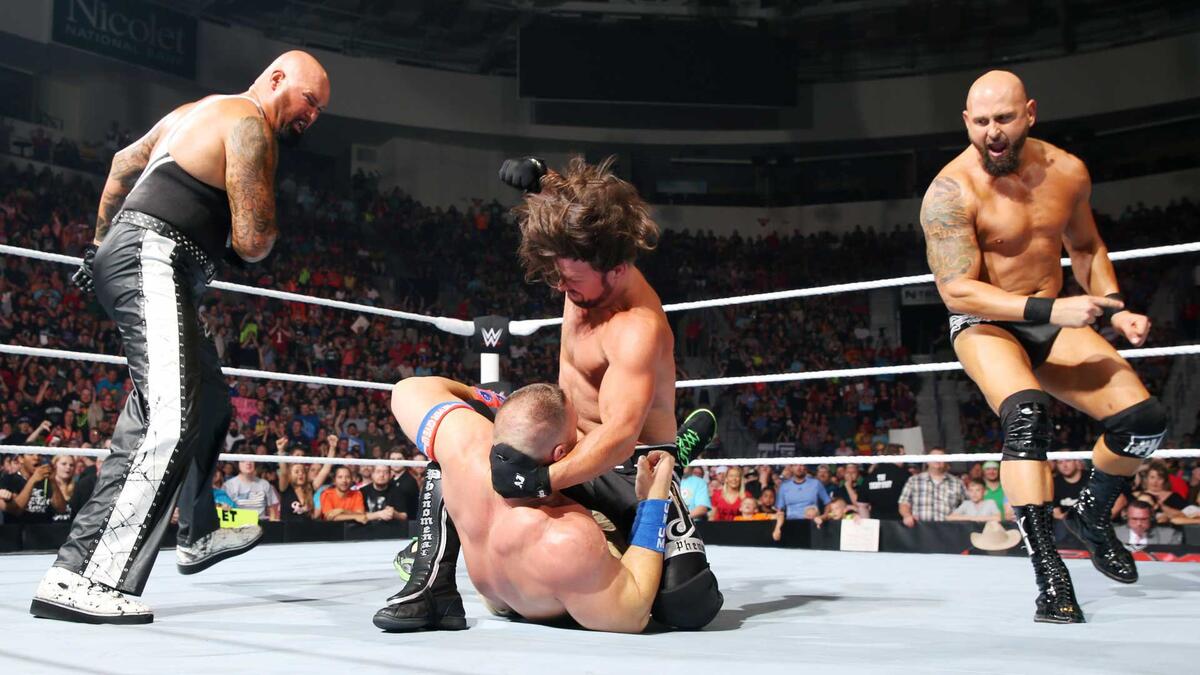
John Cena returned to Raw that night after months away with a shoulder injury. AJ Styles walked out to greet him, praised what Cena had done for the company, and for a few seconds let the building believe it was watching a symbolic passing-of-the-torch moment between two stars who had dominated different wrestling worlds. Then Luke Gallows and Karl Anderson hit the stage, the tease shifted, and Styles smashed Cena from behind.
That turn did more than launch a summer feud. It was the moment Styles stopped feeling like an exceptional guest in WWE and started feeling like a central figure in the promotion's future.
Styles had already made a huge impression before Memorial Day 2016. His Royal Rumble debut was one of the loudest crowd reactions of that year. He worked Roman Reigns for the WWE title in the spring and immediately looked comfortable in a top program. But there was still a difference between being welcomed into the main event scene and actually owning space in it. WWE had brought in a finished product, a wrestler with global credibility and a loyal following, yet it still needed to define exactly what Styles would be inside its system.
May 30 gave the company its answer.
Cena was the perfect choice of target because nobody in WWE carried more symbolic weight. By 2016 he was no longer the young franchise centerpiece being pushed toward the top. He was already the standard that new stars were measured against, the man whose approval mattered and whose name instantly told viewers how seriously they were supposed to take the story in front of them. If Styles was going to become more than a respected newcomer, he needed to collide with that standard head-on.
The segment worked because it understood the emotional trap. Cena opened with the kind of speech that framed him as a company man staring into a changing landscape. Styles entered as the fresh face of that change, but not as a loud invader. He came in polite, controlled and almost reverent, which made the crowd lean closer. WWE let the audience enjoy the novelty of seeing the two men share a ring before ripping it away. When Gallows and Anderson appeared, the scene briefly looked like it might turn into an unlikely alliance. Instead, Styles used the moment to reveal exactly where he stood.
The attack itself mattered too. It was not a quick cheap shot and a retreat. Styles kept going after Cena, hammering him again and again after the first beatdown, making sure the audience understood this was not hesitation or confusion. It was commitment. Contemporary Observer coverage of the episode emphasized how strong the angle felt in the building, and that intensity is the reason the turn still holds up. Styles did not come off like a guy borrowing heel heat for a month. He came off like someone claiming a spot.
That was important because WWE audiences had already spent years watching Cena function as a kind of test for credibility. Some stars got a match with him and came away looking good. Fewer came away feeling transformed. Styles did. Part of that was timing. Cena's return gave the angle a natural sense of importance, and the Memorial Day setting added an extra layer of drama to the show's opening scene. Part of it was trust. WWE clearly believed Styles could carry a major program on the microphone, in the ring and in the strange pressure chamber that comes with working against Cena, where every crowd reaction gets overanalyzed and every result seems to say something bigger about the company's direction.
The feud that followed justified that belief. Styles beat Cena at Money in the Bank with help from Gallows and Anderson, then beat him clean at SummerSlam in the match that really cemented the rivalry. Those matches are often remembered first because they were excellent and because the SummerSlam finish felt like a genuine changing of the guard, even if Cena was too established to be fully displaced by anyone. But the feud only got to that level because the turn on May 30 gave it a sharp emotional starting point.
It also solved a larger WWE problem. For years, the company had struggled with how to present incoming stars from outside its own developmental system. Some were softened, some were repackaged, and some lost the very edge that made them interesting in the first place. Styles did not need reinvention so much as a clear frame. Pairing him with Gallows and Anderson, then placing him opposite Cena, gave viewers a version of Styles that felt dangerous without feeling artificial. He was still the same elite wrestler fans had followed elsewhere. Now he had a WWE story big enough to match that reputation.
There is a temptation to treat this as inevitable because Styles went on to become WWE Champion later that year and one of the defining performers of the era. It did not feel inevitable at the time. A lot of acclaimed imports arrive with buzz and never fully break through the company's instincts. Styles did break through, and May 30 is where you can most clearly see it happening in real time.
Cena, in a strange way, was the ideal opponent for that transformation because he never needed protecting from the idea of someone else catching fire against him. His presence gave the moment scale, but the segment belonged to Styles by the time it was over. That was the point. WWE was telling its audience that Styles was no longer here to be admired for where he had been. He was here to shape what came next.
That is why the heel turn still lands as more than a memorable angle. It was the night a dream confrontation became a mission statement. AJ Styles had arrived months earlier. On May 30, 2016, he became essential.