
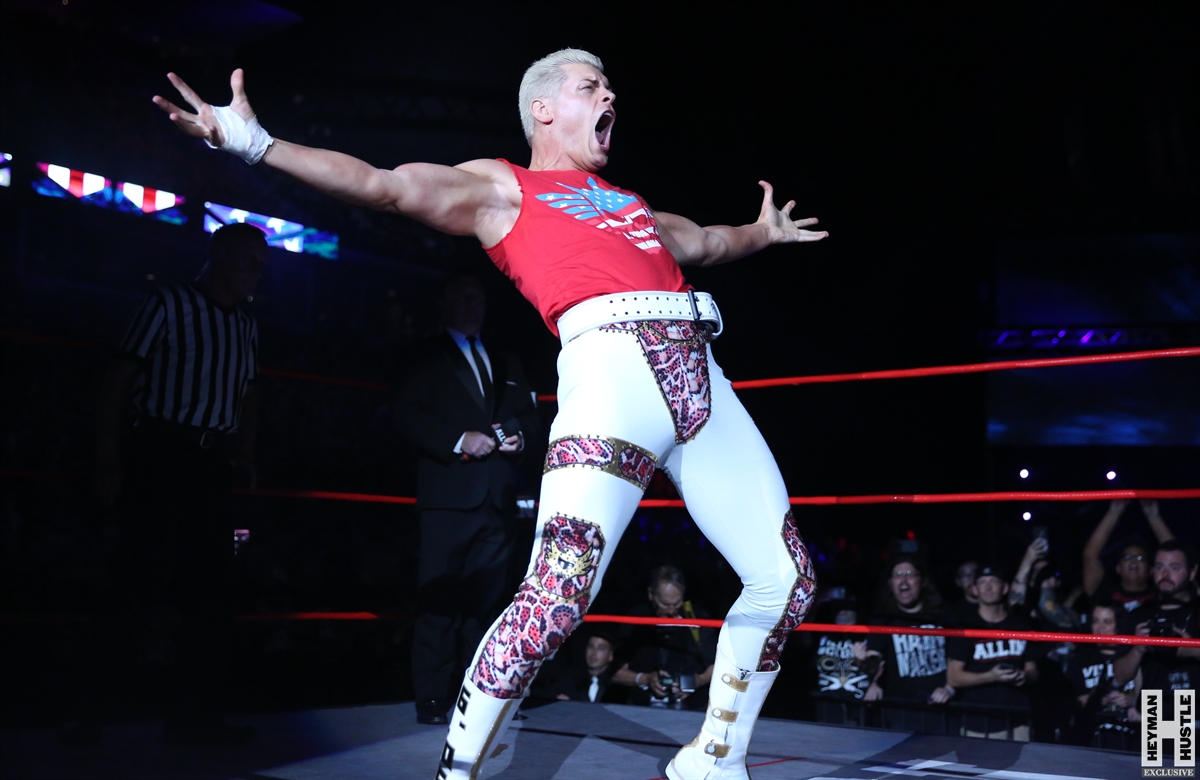
On September 1, 2018, wrestling hit one of those rare nights that felt bigger than a single finish, a single promotion, or even a single era. All In was marketed as a self-made supercard from Cody Rhodes and the Young Bucks, but by the time the night ended at the Sears Centre outside Chicago, it had become something more important than that. It had become proof.
For years, the safest line in the business was that nobody outside WWE could build a major American event at that scale anymore. National television was too powerful, the audience was too divided, and the independent scene was supposed to stay in its lane. All In blew a hole in that thinking. The show sold out its 10,000-seat setup in under half an hour, then drew 11,263 fans on the day of the event. That alone made it historic. More than that, it made the old excuses sound dated.
This was not a nostalgia reunion built around one legend. It was an independent event stitched together from talent across Ring of Honor, New Japan, AAA, NWA, Impact, and the wider scene. It ran on buzz, on Being the Elite, on smart matchmaking, and on the feeling that wrestlers were building something for themselves instead of waiting for permission.
All In felt like a dare, then a breakthrough
What made All In different was that it did not feel like a local show that happened to get hot. It felt like a challenge to the accepted limits of the modern wrestling business.
Cody and the Bucks had spent months turning skepticism into promotion. By the time Labor Day weekend arrived, the card looked like a map of the non-WWE wrestling world in 2018. Kazuchika Okada was there. Kenny Omega was there. Rey Mysterio was there. So were Penta El Zero, Bandido, Marty Scurll, Jay Lethal, Tessa Blanchard, Flip Gordon, and Stephen Amell. Starrcast gave the weekend convention energy, and the pre-show airing on WGN America gave the event a wider reach than most independent cards could dream about.
Once the bell rang, the bigger point only got stronger. The crowd treated the show like a happening. Kenny Omega and Penta delivered the kind of dream match that reminded fans how deep the talent pool outside WWE had become. Okada and Scurll gave the audience another major attraction. The main event six-man tag, with Kota Ibushi and the Young Bucks against Rey Mysterio, Rey Fenix, and Bandido, had to be shortened because the show ran long, but even that chaos added to the sense that All In was operating on major-event adrenaline rather than indie caution.
Then came the post-match surprise, Chris Jericho appearing in disguise after Omega's win and laying the groundwork for the next stage of the story. In hindsight, that moment looks even more important than it did in the building. It connected All In's independent rebellion to the larger national future that was coming a few months later.
Cody and Nick Aldis gave the night its emotional center
If All In proved the size of the audience, Cody Rhodes vs. Nick Aldis proved something else. It showed that old wrestling ideas still worked when people believed in them.
On paper, Omega vs. Penta looked like the workrate centerpiece. In execution, Cody challenging for the NWA Worlds Heavyweight Championship became the emotional heart of the show. The entrance, the entourage, the blood, the old-school pacing, the title belt itself, all of it was framed to make the NWA championship feel important again. When Cody won, the reaction was enormous.
That mattered because the match was built on a kind of storytelling wrestling had not always used well in that era. Instead of assuming the audience would care because the match had famous names, the build made the belt, the family legacy, and the moment feel meaningful before the wrestlers even touched. All In reminded promoters that fans still respond to stakes when those stakes are presented with conviction.
It also gave the night a deeper historical echo. Dusty Rhodes had defined what the NWA title meant to an earlier generation. Watching Cody win that same championship in front of a crowd that was supposed to care only about modern dream matches turned the bout into more than fan service. It became a bridge between wrestling's old vocabulary and its new audience.
Why All In mattered beyond one sellout
The easiest way to remember All In is as the show that led to AEW. That is true, but it is also incomplete.
All In mattered because it changed the level of ambition around non-WWE wrestling in North America. It showed there was real money and real appetite for a premium event built outside the usual system. Contemporary reporting on the show noted a live gate of $458,525, sold-out merchandise, and more than $1 million grossed through FITE and Starrcast buys. Those are not just nice numbers for an indie card. Those are numbers that tell wrestlers, promoters, broadcasters, and investors that this audience was waiting to be served.
That is the real legacy of September 1, 2018. The show did not magically solve every problem outside WWE. It did not make every independent company healthier. What it did was prove that the ceiling had been set too low. A lot of people in wrestling had quietly accepted that ceiling as permanent. All In knocked it down in one night.
AEW would launch a few months later with bigger backing, a clearer structure, and weekly television on the horizon. None of that came out of nowhere. All In was the field test. It showed that Cody, the Bucks, Omega, and the rest of that orbit were not just internet-famous or cult-popular. They could anchor a real event, attract national attention, and create the kind of momentum a new company could build around.
That is why the date still matters. All In was not just a successful supercard. It was the night independent wrestling stopped asking to be taken seriously and simply acted like a major league alternative. Once that happened, the business was never going to look quite the same again.