
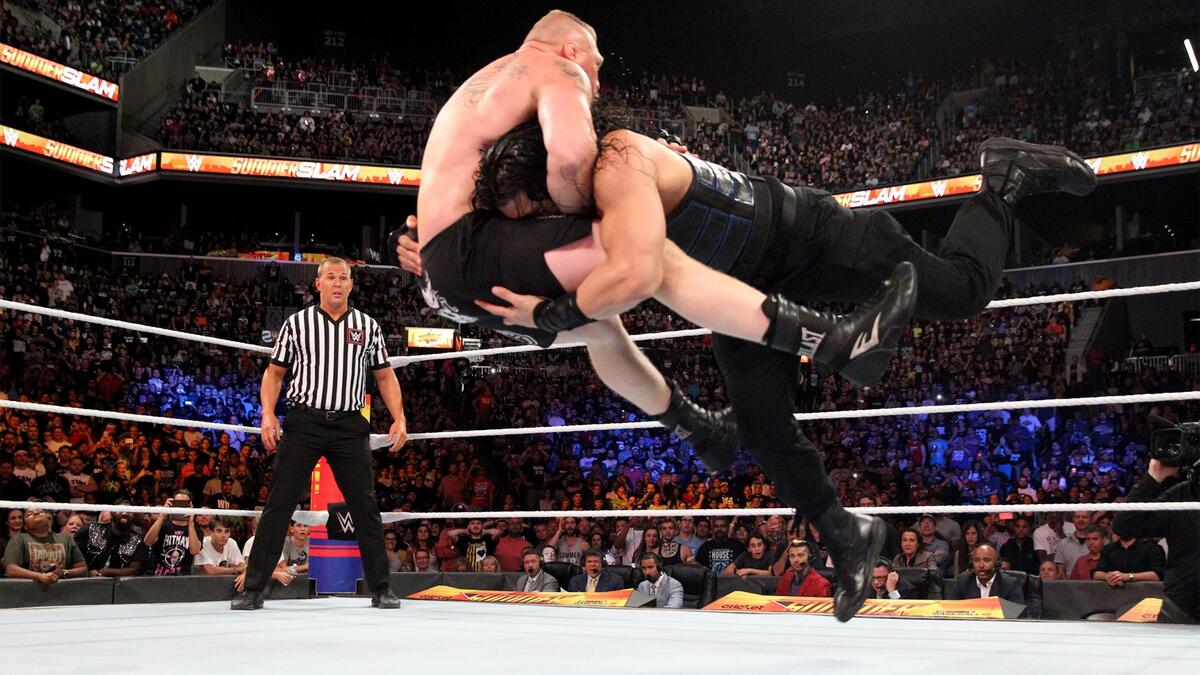
On August 19, 2018, WWE finally stopped waiting.
Roman Reigns beat Brock Lesnar in the SummerSlam main event at Barclays Center in Brooklyn, winning the Universal Championship in a finish that looked simple on paper but carried years of baggage behind it. Reigns had been pushed toward this kind of crowning moment for so long that by the time it happened, the real story was no longer whether he could beat Lesnar. It was whether WWE could get through the match without the audience rejecting the choice one more time.
That tension is what makes the night worth revisiting. SummerSlam 2018 was not just a title change. It was the end of a long, awkward chase, the close of Lesnar's part-time reign over Raw, and the moment WWE finally committed to Reigns after spending years flinching at the reaction that commitment might bring.
Roman Reigns finally got the win WWE kept delaying
The broad shape of the story had been hanging over WWE for years. Lesnar was the conquering force, the man who ended The Undertaker's WrestleMania streak and then spent long stretches presented as an attraction above the weekly roster. Reigns was the chosen successor, the next franchise centerpiece the company wanted fans to accept as its standard-bearer.
The problem was timing, or more accurately, trust. WWE had wanted a major Reigns-over-Lesnar payoff long before SummerSlam 2018, but fan resistance kept changing the path. Reigns had already beaten Undertaker at WrestleMania 33, had already been through repeated coronation attempts, and had already reached the point where every big victory was judged less on the wrestling itself and more on what it represented politically.
By the time SummerSlam arrived in Brooklyn, the company was still trying to finish a story that had lost some of its original heat simply because it had taken so long. The following week's Observer coverage framed the match as a payoff WWE had intended years earlier, only now with a completely different challenge. It was no longer about making Reigns look ready. It was about finding a way to make the audience accept the decision in real time.
That is why the title win mattered. Reigns was not some new project at that point. He was already one of the defining stars in the company, but he was still waiting for WWE to plant its flag without apology. On August 19, it finally did.
Brock Lesnar, Braun Strowman and the trick that saved the finish
The match lasted only 6:07, and that was part of the strategy.
WWE built the finish around Braun Strowman, who walked out with the Money in the Bank briefcase before the bell and announced that he would cash in after the match. That changed the atmosphere immediately. Instead of spending the whole main event turning on Reigns and Lesnar, the crowd had another variable to watch. Fans were waiting for chaos, and WWE used that expectation to redirect the energy.
The bout itself was worked as a sprint. Reigns opened hot with Superman punches and spears. Lesnar answered with guillotines and German suplexes. The crowd still started to sour, even breaking into a "You both suck" chant, which showed how fragile the whole thing still was. Then came the key sequence. Reigns crashed into Strowman on the floor, Lesnar followed him out, hit Strowman with an F-5, smashed him with the briefcase, blasted him with chair shots and threw the briefcase away. Only then did Lesnar climb back into the ring and eat the decisive spear.
It was a smart piece of match construction because it solved two problems at once. In storyline, Strowman was too beaten up to cash in. In presentation, the live crowd did not have enough time to fully turn on the outcome before the show ended. The audience thought another twist was still coming. By the time it became clear that Reigns was simply winning the title and leaving with it, the cameras were already gone.
That finish has always been more revealing than the match quality itself. WWE knew exactly what could happen if the audience sat with the moment for too long. So it built an escape hatch into the match. Reigns won clean enough for the record books, but the company still protected itself from the full force of fan backlash.
Why SummerSlam 2018 changed Raw's direction
The title change did more than end Lesnar's reign. It gave Raw a different center of gravity.
Lesnar's championship run had made the belt feel huge, but it also made the weekly show feel stalled whenever he was away. Reigns, whatever fans thought of the push, was a full-time presence. The moment he won, the title was back in the everyday flow of television. That mattered for a promotion that had spent too much time building around a champion who felt bigger than the rest of the roster but also less connected to it.
You could see the next direction almost immediately. Reigns and Strowman were the obvious next program, and the night after SummerSlam, WWE put The Shield back together to help frame that transition. Nostalgia did some of the work that booking alone had struggled to do. Putting Reigns beside Seth Rollins and Dean Ambrose gave fans something familiar to rally around, and it also softened the edges of a title win that might otherwise have been met with pure hostility.
There was another layer to the timing. Lesnar was on his way out of the immediate picture, with his UFC future hanging over everything. SummerSlam allowed WWE to close that chapter decisively instead of dragging the uncertainty deeper into the fall. In that sense, Reigns' win was not just a payoff. It was a necessary handoff.
The irony is that the match is not remembered as a classic. In fact, it was one of the weaker in-ring bouts on a news-heavy show that also gave Ronda Rousey the Raw women's title and turned Becky Lynch into an even hotter star after her post-match attack on Charlotte Flair. But history is not always about workrate. Sometimes it is about the night a company finally commits to the direction it has been circling for years.
That is what August 19, 2018 was. Roman Reigns beating Brock Lesnar did not magically erase the tension that had defined his rise. It did something more important. It ended the waiting. After years of hesitation, false starts and crowd revolt hanging over every major decision, WWE finally made the call and lived with it.