
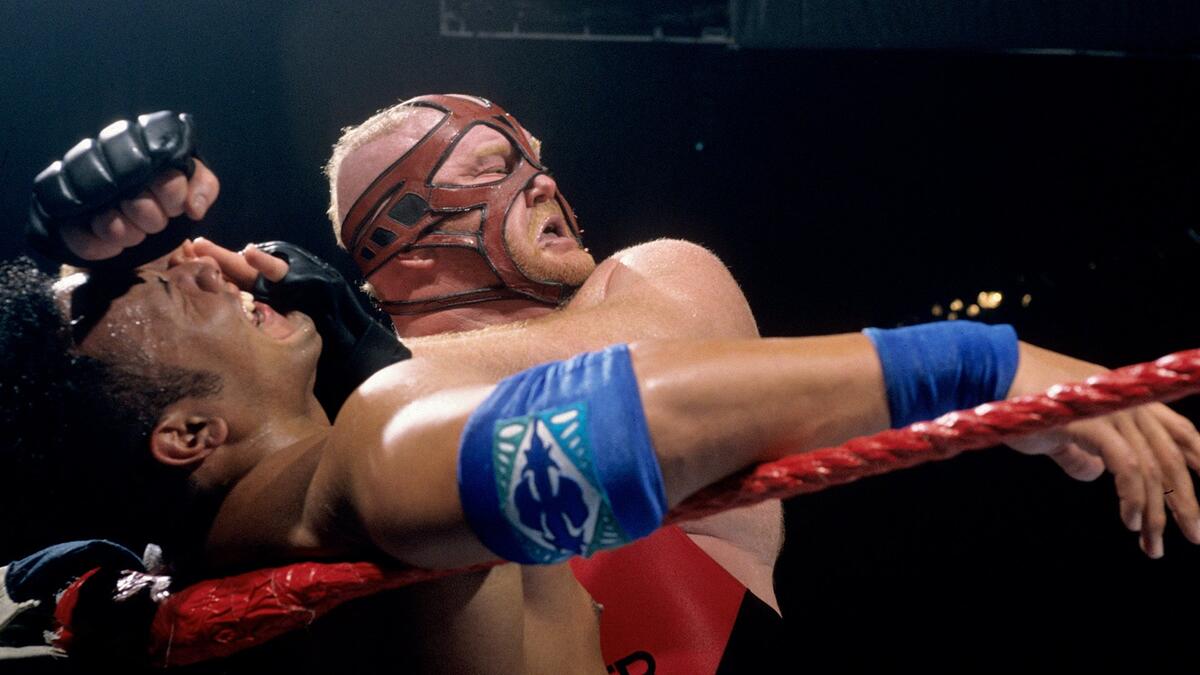
On June 18, 2018, wrestling lost one of the few monsters who never had to choose between spectacle and skill.
Leon White, known around the world as Vader and Big Van Vader, died that night at 63. His son said White had been diagnosed with a severe case of pneumonia about a month earlier, had been making progress, and then saw his heart give out. The news was sad on its own. It also landed with unusual weight because Vader was not just another famous name from a previous era. He was one of the clearest examples of a wrestler who changed what an entire body type was allowed to be.
Contemporary Observer coverage called White the best and most versatile 400-pound pro wrestler in history. That line still holds up because it gets to the real point. Vader was not memorable simply because he was huge. Plenty of wrestlers have been huge. Vader mattered because he moved like somebody 200 pounds lighter, hit like a truck, and still carried himself with the aura of a final boss. He looked impossible before the bell rang, then somehow became even more convincing once the match started.
That combination did not come from nowhere. Before wrestling, White had been a standout football player at the University of Colorado and was drafted by the Los Angeles Rams. Knee injuries ended that path before it truly began, and pro wrestling became the second act. Early stops in the AWA and Europe showed there was something special there. As Bull Power in Austria and Germany, he found one of his first real breakthroughs, building a reputation as an overwhelming powerhouse and winning the CWA world heavyweight title. But it was in Japan where the myth of Vader really took shape.
New Japan introduced him as a steam-spewing supervillain, complete with the headgear that made him look less like a normal heel and more like a machine built to wreck a main event. His famous debut at Sumo Hall in December 1987 came on a chaotic night. After Antonio Inoki beat Riki Choshu in a main event that enraged the crowd, Vader stormed in and flattened Inoki in under three minutes. Fans rioted afterward and the fallout was so severe that Sumo Hall stopped allowing pro wrestling for a time. Even by wrestling standards, that is a wild way to enter the story.
What kept Vader from becoming a one-night curiosity was that he kept growing. His program with Tatsumi Fujinami helped sharpen him from a frightening attraction into a complete top-level worker. By the early 1990s, he was doing the sort of things a man his size was not supposed to do. The moonsault was the most famous example, and it never stopped looking absurd in the best possible way. Vader was not a giant trying a neat trick for applause. He made the move feel like an extension of the same violence that defined everything else he did.
The résumé that followed was global in a way very few wrestlers can match. White took pride in having held the most meaningful world championships in multiple major markets, and the list backs him up. He won the IWGP heavyweight title three times, more than any other non-Japanese wrestler. He won the Triple Crown in All Japan when that belt still represented one of the most demanding peaks in the business. He held top championships in Europe and Mexico, sold out Tokyo's Jingu Stadium for a match with Nobuhiko Takada, and later won the WCW world title three times in the United States. A lot of wrestlers become stars in one place and legends in another. Vader felt like a major deal almost everywhere that took wrestling seriously.
That is a big reason his death hit fans from so many different corners of the wrestling world. If you grew up on early 1990s New Japan, you remember the monster who could brawl with Inoki, absorb punishment, and still work long, dramatic matches. If WCW was your language, you remember a heavyweight champion who made the company feel rougher and more dangerous. If WWF was your entry point, you remember that even in a run that never fully reached its ceiling, Vader still carried himself like somebody the audience understood was real trouble.
There is also a broader legacy here that goes beyond titles and promotions. Before Vader, the template for giant wrestlers was often narrow. Be imposing, throw people around, save your energy, and let size do most of the storytelling. Vader could obviously do all of that, but he also worked with urgency, timing, and creativity. He could make a short destruction match feel terrifying and then turn around and have the kind of big-fight performance that demanded respect from harder-to-please audiences. He did not just expand the image of a super-heavyweight. He expanded the job description.
That is why June 18, 2018 felt like more than the passing of a former champion. It felt like the end of a specific kind of wrestling miracle. Vader was one of those performers who made contradictions fit together. He was graceful and brutal. He was an old-school monster and a wrestler far ahead of his time. He could headline in the United States, Japan, Mexico, and Europe without feeling like he had been translated for each audience. He was simply Vader, and that was enough.
On this day in 2018, the business lost a giant in the plainest sense of the word. It also lost one of the men who proved that being enormous did not have to mean being limited. White built a career out of making the impossible look natural. Years later, that is still what makes Vader feel unforgettable.