
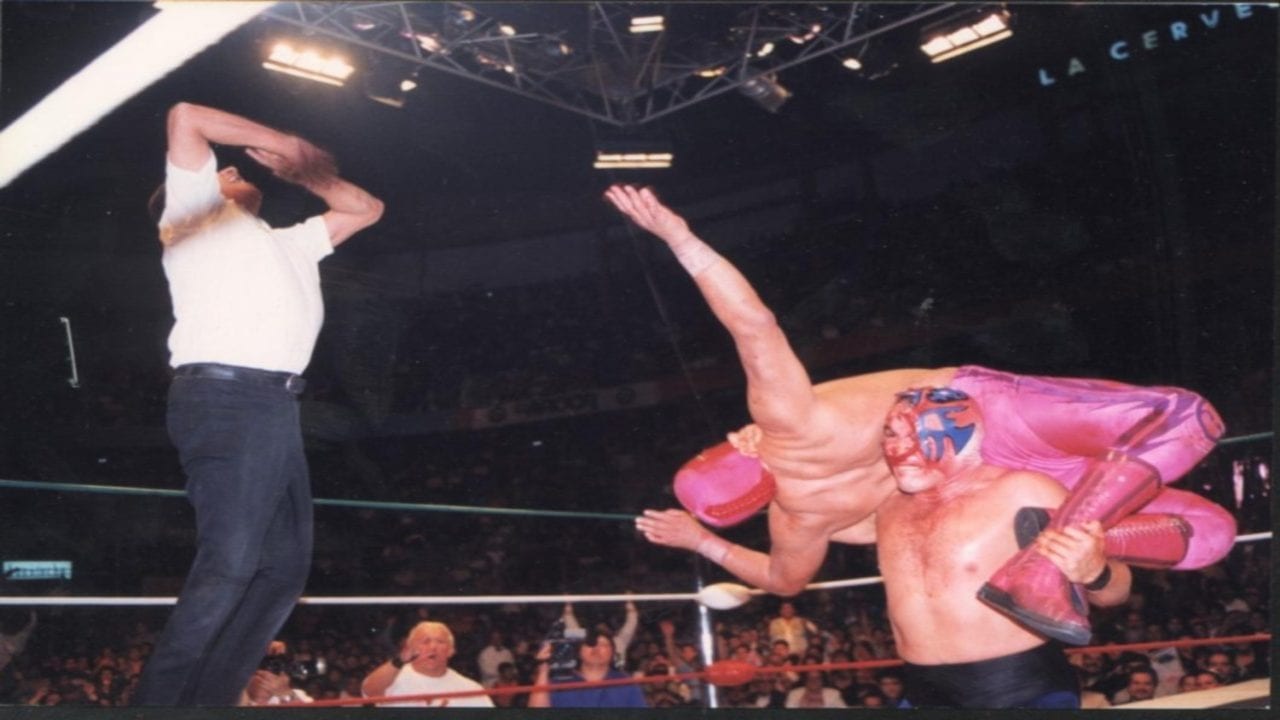
On August 21, 2018, Arturo Díaz Mendoza, known to generations of wrestling fans as Villano III, died at 66 after suffering a brain hemorrhage. In one sense it was the passing of a beloved veteran. In another, it felt like the closing of a chapter in Mexican wrestling history that stretched from the packed nights at El Toreo through the great apuestas wars of the 1990s and into the modern era.
Villano III was not just a famous name from a famous family. He was widely regarded as the most complete worker of the Villano brothers, a wrestler who could carry himself like a star, wrestle with technical precision and still make the violence of a feud feel deeply personal. For fans who grew up on lucha libre at its hottest, he represented a specific kind of greatness. He was tough, elegant, dramatic and completely believable.
The standard Villano III set
The Villano name already meant something before Arturo fully stepped into it. He was the son of Ray Mendoza, one of the towering figures in Mexican wrestling, and part of a family line that produced all five Villano brothers. But Villano III became the singles standard-bearer of the group.
His best years came in the glory days of the UWA promotion, when El Toreo in Naucalpan was one of wrestling's liveliest homes anywhere in the world. Villano III was a central figure in that boom. He held the light heavyweight championship repeatedly, worked across Mexico, Japan and Southern California, and built a reputation as a wrestler who could hang with anybody, whether the night called for mat work, drama or a fight.
What made him special was not only the résumé. It was the style. He could work with the patience of an old-school technician, then raise the temperature of a match without losing control of it. The Observer's obituary coverage at the time also pointed to something else that mattered. Younger wrestlers remembered him as a mentor, not just a star protecting his own place. That combination, skill and generosity, helps explain why his standing stayed so high long after his physical prime had passed.
The match that made his legend immortal
Great wrestlers usually have one match that turns reputation into permanence. For Villano III, it was the mask vs. mask showdown with Atlantis on March 17, 2000.
By then, Villano III was no longer the young ace of UWA. He was an aging master working on experience, timing and aura. Atlantis was one of CMLL's great institution figures. Their feud had the kind of emotional pull that promotions spend years trying to manufacture and almost never reach.
When the match finally happened at Arena México, it became something larger than a main event. The crowd was enormous and emotionally torn, because both men meant too much to too many people. That tension gave the bout its power. Fans were not simply waiting to see who would win. They were watching two pieces of lucha libre history collide, knowing one mask and one identity were about to be taken away forever.
Atlantis won, and Villano III unmasked after more than a quarter-century of wearing the character's signature look. Losing the mask did not diminish him. If anything, it completed the story. The match became one of the most revered bouts in lucha history, and for many fans it remains the clearest proof of what lucha libre can be at its absolute best: violent, emotional, ceremonial and heartbreakingly human all at once.
That is a big reason August 21 still lands so hard. Villano III did not die as a forgotten veteran whose greatness had to be rediscovered later. He died as a wrestler whose masterpiece had already secured his place, and whose body of work had long been woven into the story of the sport.
Why his death mattered beyond one obituary
Villano III's passing hit harder because it carried so much history with it. He connected several major wrestling worlds at once. He was a UWA pillar during one of the promotion's hottest eras, worked in AAA during the 1990s, returned to CMLL for one of that company's defining modern feuds, and remained an enduring name even after retirement.
His career also tells a larger truth about lucha libre. So much of the form depends on lineage, symbolism and masks, but it only works if the wrestler inside the mask can make people believe the stakes are real. Villano III could do that. He could make a title change feel serious, make a grudge look dangerous and make a crowd mourn a mask before it was even removed.
There was also a toughness to his career that reflected the era he came from. The old Mexican rings were unforgiving. The schedules were punishing. The blood, scars and wear were real. By the time Villano III retired, his body had clearly paid for the life he built in the ring. That is part of why the reaction to his death was so emotional. Fans were not only mourning the man. They were mourning an era of lucha that he embodied as well as almost anyone.
A date that still carries weight
When wrestling fans talk about giants of Mexican history, the flashiest names often come first. Villano III belongs in that conversation anyway, because his greatness was built on substance. He was a headline act in a booming territory, a champion trusted across promotions, and the centerpiece of one of the most important mask matches ever held.
August 21 is now one of those dates that instantly brings that whole legacy back into focus. It recalls the family name, the UWA years, the Atlantis feud, the image of a blood-soaked classic in Arena México, and the sense that lucha libre lost one of its most authentic masters.
Also on this date, the scan turned up another strong modern milestone: WWE launched the ThunderDome era from Orlando on August 21, 2020, a major pandemic-era production shift that changed the look of the company overnight. But Villano III's death stands taller as the day's defining historical marker, because it was the loss of a wrestler whose career still serves as a measuring stick for what lucha libre can be.
That is why this date remains worth remembering. Villano III was not just part of wrestling history. For a very long time, he helped define it.