On May 25, 2019, All Elite Wrestling stopped being a promise and became a promotion.
That distinction mattered. For months, AEW had money, executive vice presidents, a television deal in the distance, and the kind of online momentum wrestling companies usually only dream about. None of that meant much until it could put a real show in front of a real crowd and prove the hype was not just the product of message boards, Being The Elite episodes, and fans desperate for an alternative.
Double or Nothing, held at the MGM Grand Garden Arena in Las Vegas, did exactly that. It was the first official AEW event, and by the end of the night it felt less like a startup launch and more like the opening chapter of a new national power.
That is what gives the date its historical weight. All In in 2018 had already shown there was a market for something outside WWE. Double or Nothing was the night that energy got a company name, a roster identity, and a live product that could stand on its own.
Double or Nothing made AEW feel real
A lot of wrestling history turns on moments that are obvious only in hindsight. This was not one of them.
Double or Nothing felt important while it was happening. The building was hot from the start. The audience treated the show like an event they had been waiting years to see, not just another pay-per-view on the calendar. AEW had sold almost all of its roughly 11,000 tickets in a rapid pre-sale months earlier, and the atmosphere reflected that pent-up demand. These were not casual walk-up fans. They were people who wanted this promotion to work.
That emotional investment changed everything about the night. Every big entrance hit harder. Every tease of a future direction landed louder. Every win or surprise felt like part of a bigger story about whether American wrestling finally had a credible second major stage again.
The card was also smartly built for a first impression. It was varied without feeling random. The company let the wrestling breathe, gave clean finishes to every match, and avoided the kind of overbooked clutter that had pushed so many fans away from mainstream wrestling in the first place. The message was simple: if AEW was going to present itself as something fresh, it had to look fresh the second the bell rang.
Cody and Dustin gave the night its emotional center
For all the talk about business, competition, and industry change, the match that gave Double or Nothing its soul was Cody Rhodes against Dustin Rhodes.
On paper, a brother-versus-brother feud built around family history can easily become indulgent. This one did the opposite. It grounded the entire show.
The match was violent, bloody, and deeply old-school in its emotional pull. Dustin, wrestling his first match in nearly a year after double knee surgery, looked like a man trying to prove he still belonged on a major stage. Cody worked with the swagger and edge of someone who understood that this was his chance to define not just himself, but the tone of the entire company.
The crowd chants for Dusty Rhodes gave the whole thing another layer. This was not just a grudge match between siblings. It felt like a family story being carried into a new era in full view of the audience. When Cody won and then asked Dustin not to retire, but instead to stand with him as his older brother, the angle landed with the kind of sincerity wrestling almost never gets right anymore.
That mattered because AEW needed more than a successful launch. It needed a heart. Cody and Dustin gave the company one.
Jericho, Omega, and Moxley pointed AEW toward the future
If Cody and Dustin gave Double or Nothing its emotion, the final stretch gave AEW its direction.
Chris Jericho beat Kenny Omega in the main event, earning the right to face Hangman Page in the match that would crown the first AEW world champion. That result was important on its own. Jericho was the most established television star on the roster, and putting him in that position gave the new company instant gravity. AEW was telling viewers that it understood the value of a familiar headliner, even while building a new generation around him.
Earlier in the night, Bret Hart had unveiled the world title belt, another deliberate signal that AEW wanted its biggest prizes to feel like major prizes. The company was not presenting itself as a scrappy side project. It was trying to look big league from day one.
Then came the moment many fans still remember first.
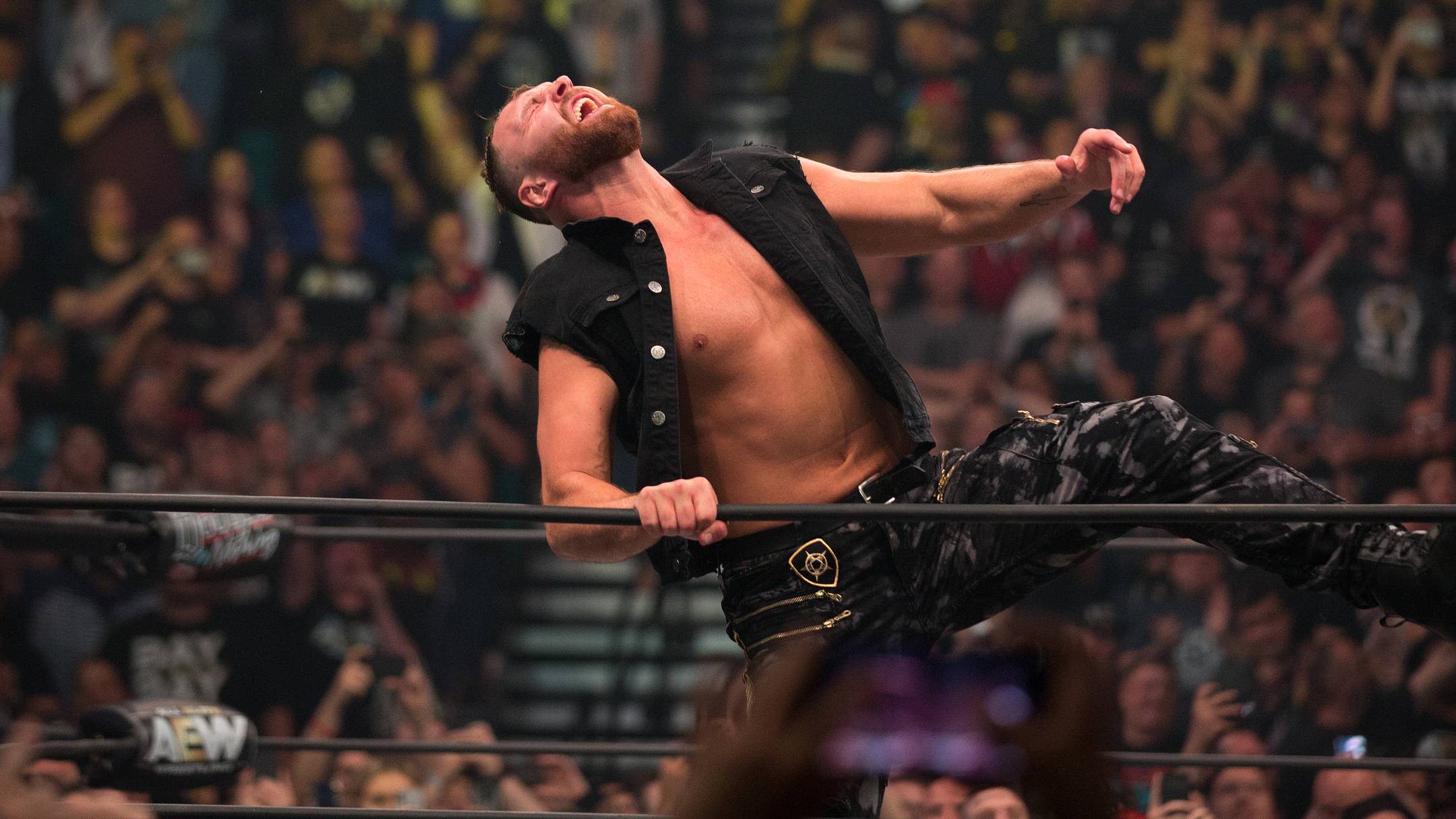
Jon Moxley, fresh out of WWE and newly stripped of the Dean Ambrose identity, stormed into the arena after the main event and attacked both Jericho and Omega. It was a perfect closing image because it did two jobs at once. It gave AEW an instant shock debut, and it made the promotion feel dangerous in the best possible way. Suddenly the roster felt deeper, the future title picture felt messier, and the company itself felt less predictable.
That was a crucial distinction. Launch shows can sometimes feel like polished presentations for a plan that has not really started yet. Moxley's arrival made Double or Nothing feel like the plan had already begun.
How Double or Nothing changed AEW's place in the market
Double or Nothing gave AEW immediate proof that fan frustration with the status quo could be turned into paying business. That changed the conversation around the company from curiosity to legitimacy.
The event was estimated at close to 98,000 pay-per-view buys, a massive number for a company with no weekly television at the time and a reminder that this was not just a niche Internet success story. The interest was broad, the buzz was real, and the reception made it clear that AEW had entered the industry with real force behind it.
Just as important, the show established the version of AEW people would come to know over the next several years. It mixed veteran star power with wrestlers who felt new to a national audience. It leaned into tag team wrestling as a selling point. It embraced variety in style. It trusted crowds to care about match quality, not only angle-heavy soap opera twists.
That identity would evolve, and at times it would get messy, as all wrestling companies do. But the essential pitch was already there on night one. AEW was offering a major-league alternative that did not look or sound like the market leader.
That is why May 25, 2019 still stands out. Not because one pay-per-view solved everything, and not because every hope attached to the company was guaranteed to come true. It stands out because this was the night the idea became tangible. Fans were no longer imagining what AEW might be. They were watching it happen.
Also on this date, Kenta Kobashi and Tsuyoshi Kikuchi beat Doug Furnas and Dan Kroffat for the All Asia Tag Team Championship in Sendai in 1992, in a match that would be remembered as one of the year's best. Four years later, on May 25, 1996, Dwayne Johnson made his Memphis television debut as Flex Kavana, an early step in the career of the man who would become The Rock.